Computers With Master’s Degrees Will Accelerate Service Sector Job Losses And Increase The Need For Non-Work Income Entitlements

Not Today's Business Computer“ARMONK, N.Y., – 18 Aug 2011: Today, IBM (NYSE: IBM) researchers unveiled a new generation of experimental computer chips designed to emulate the brain’s abilities for perception, action and cognition … cognitive computers are expected to learn through experiences, find correlations, create hypotheses, and remember – and learn from – the outcomes, mimicking the brains structural and synaptic plasticity.

IBM Unveils Cognitive Computing Chips, Press Release, IBM, August 18, 2011.

—————

“IBM sees multiple applications for these cognitive computing systems, which would fit in the size of a shoebox. Among potential uses:

  • Computers that could take in inputs such as texture, smell and feel to gauge whether food was outdated.
  • Financial applications to monitor trading and recognize patterns in a way today’s algorithms can’t.
  • Traffic monitoring.
  • And system monitoring for waterways and other natural resources.”

Larry Dignan, IBM creates cognitive semiconductors: A step toward right brain computers, ZDNet Blog Between the Lines, August 17, 2011.

—————
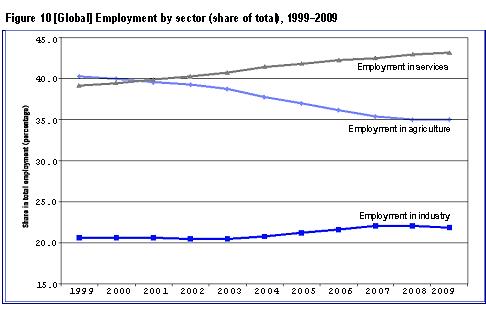
Global Employment By Sector, 1999-2009
Source: Global Employment Trends 2011, International Labor Org., p. 20

—————

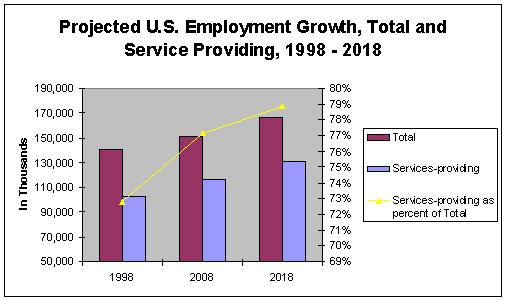
U.S. Employment Projections to 2018
Data Source: Rose A. Woods, Employment outlook: 2008–2018: Industry output and employment projections to 2018, Monthly Labor Review, November 2009.

———————–Comments———————–

The barriers to replacing intellectual and professional workers with machines are rapidly falling.  Already, computers are taking over customer service communications, digital archive research, teaching responsibilities, aspects of legal research, stock market trading, and other information gathering, information evaluation, and decision-making activities. With new computational technologies moving into the world’s workplaces almost everyday, the pace at which intellectual and professional work activities are being turned over to computers is accelerating.

The impact of this trend on global and U.S. employment can only be negative.  In every field of business, the world is crowded with competitors and the global rules governing competition are minimal and poorly enforced.  In this environment, no business leader can risk not looking at every new computational technology as a possible way to reduce labor costs faster than do competitors.

A very large proportion of the jobs that involve observation, evaluation, and decision-making activities are in service providing industries, including government, so the largest part of the negative employment impact of the accelerating use of computational technologies that emulate aspects of human thinking will be in this sector.  But the overall impact will be much greater.

Neither the agricultural sector, which is rapidly losing workers to automation, nor the industrial sector, which is already highly automated, will be able to absorb the very large numbers of workers likely to be displaced from service sector jobs.  Unemployment and underemployment will rise, and as they do non-work entitlements to income will have to play a much larger role in distributing the wealth created by the enormous and growing productive power of the world economy.

Otherwise, the future will be tragic.  The proportion of the world’s people living in poverty will increase, morbidity and preventable deaths will rise, the growth of the world’s middle class population will stagnate, and political upheavals and brutal governmental repressions will grow more numerous.

Global Technology and Education Trends Increase Global Competition for High End U.S. Jobs

“Taiwanese contract manufacturer Hon Hai Precision Industry Co. (2317.TW) said Tuesday it…plans to increase the use of robotic arms across its production lines to cope with rising demand for electronics and increasing costs…Hon Hai aims to increase robotic arms to 1 million units by 2013 from 10,000 currently…Hon Hai plans to increase automation on “dangerous and monotonous” tasks and to migrate more of its workers to “value-added” jobs such as product research and development.”

Lorraine Luk, Hon Hai Says To Increase Automation But Will Also Boost Work Force, Dow Jones Newswires, August 02, 201, published at FoxBusines,

“In 1998…Chinese universities and colleges produced 830,000 graduates a year. Last May, that number was more than six million and rising…the supply of those trained in accounting, finance and computer programming now seems limitless, and their value has plunged. Between 2003 and 2009…starting pay for college graduates stayed the same, although their wages actually decreased if inflation is taken into account.”

Andrew Jacobs, China’s Army of Graduates Struggles for Jobs, New York Times, December 11, 2010

“…among citizens between the ages of 25 and 34 in developed countries, America ranked 12th [for percentage of 25- to 34-year-olds with an Associate Degree or higher, 2007]. In this key demographic group, Canada, Korea, the Russian Federation, Japan, New Zealand, Ireland, Norway, Israel, France, Belgium and Australia are ahead of the United States. Also, Denmark and Sweden are close to parity with our nation.”

John Michael Lee, Jr. and Anita Rawls, The College Completion Agenda: 2010 Progress Report, CollegeBoard Advocacy and Policy Center,

“The world, in terms of choices available to educated, ambitious workers and entrepreneurs, is way bigger than just the United States, Japan and Europe.”

Paul Singer, founder of Elliot Management, as quoted in The Economic Manifesto of Elliott’s Paul Singer, By Evelyn M. Rusli and Azam Ahmed.

‘American jobs have been moving overseas for more than two decades. In recent years, though, those jobs have become more sophisticated — think semiconductors and software, not toys and clothes…[quoting Jeffrey Sachs, globalization expert and economist at Columbia University:] “What’s changed is that companies today are getting top talent in emerging economies, and the U.S. has to really watch out.”‘

Pallavi Gogoi, Many U.S. companies are hiring … overseas: One reason why U.S. unemployment remains as high as it is, Associated Press, 12/28/2010, published at MSNBC.

———————–Comments———————–

The U.S. is not alone in the world in the pursuit of high end jobs to grow middle class incomes and not likely to be successful enough in that endeavor to revitalize U.S middle class income growth.  The following global trends are moving strongly against high end job growth in the U.S. and the U.S. economic policy approach does not address these trends.

  • Rapid automation of production processes across the globe is increasing citizen pressure on the world’s governments to train more and more workers for high end jobs
  • Competition among the world’s numerous nations for investments that create high end jobs is intensifying as global employment growth stagnates
  • Expanding global investments in higher education are increasing competition among highly educated workers for an insufficient number of high end jobs
  • U.S.  corporations are taking advantage of the growing number of nations with educated workers to bargain with highly educated U.S. workers for wages and benefits concessions.

Pending Trade Pacts Will Continue the Downward Trends in Number and Quality of U.S. Jobs

Pending U.S. – South Korea Trade Agreement

“Most strikingly, KORUS will open Korea’s service market to U.S. exports, allowing the United States to exploit its competitive advantages in financial services, education and information and communications technologies.

The agreement also will lead to increased imports from Korea, which in turn will help the United States achieve greater economic specialization. The likely effects of more specialization—and of increased Korean investment in the United States—include greater U.S. efficiency, productivity, economic growth and job growth. Meanwhile, U.S. investors will gain new opportunities in the increasingly active Asia-Pacific region.

KORUS supports market access for U.S. investors with investment protection provisions, strong intellectual property protection, dispute settlement provisions, a requirement for transparently developed and implemented investment regulations and a similar requirement for open, fair and impartial judicial proceedings.”

Pending U.S. – Columbia Trade Agreement

“COL-US improves the investment climate in Colombia by providing investor protections, access to international arbitration and improved transparency in the country’s legislative and regulatory processes. These provisions will reduce investment risk and uncertainty.

With considerable investments, Colombia would be able to compete with East Asia for these higher quality jobs, swaying people away from black markets and other illicit activities.”

Pending U.S. – Panama Trade Agreement

“Panama’s $21 billion services market for U.S. firms offering portfolio management, insurance, telecommunications, computer, distribution, express delivery, energy, environmental, legal and other professional services.

A fair legal framework, investor protections and a dispute settlement mechanism, all features of the PFTA, are almost certain to increase U.S. investments in Panama.”

All quotes from Mauricio Cárdenas and Joshua Meltzer, Korea, Colombia, Panama: Pending Trade Accords Offer Economic and Strategic Gains for the United States, Policy Brief Series, # 183, The Brookings Institution, July 2011.

———————–Comments———————–

About improved investment climates.  These agreements add three more places in the world where U.S. corporations can invest with confidence.  U.S. banks, mutual funds, and other financial institutions will find it easier to use the money in our savings accounts and retirement funds to expand economic activities and create jobs outside the U.S.

By some estimates, U.S. corporations are sitting on about $2 trillion in cash and banks have returned to profitability, so a lot of money is sitting idle, waiting for profitable investment opportunities.  Economists have noted that there is considerable evidence that the growth of consumer demand is too anemic in the U.S. to spur much investment here, so the investment eye is on the emerging markets of the world where real incomes and consumer demand are growing.

About increased access to service sector markets.  The list of U.S. industries that will benefit include industries that are critical to increasing a nations competitive position in the world economy, and thereby nourish economic growth and enterprise profitability.  Thus, expansion of service sector sales will complement U.S. capital investment in South Korea, Columbia, and Panama, helping to insure the profitability of both U.S. and local investments and thus helping to insure that competitiveness and job growth increase in those nations.

About increased economic specialization in the U.S.  The impact of increased economic specialization on jobs in the U.S. will be a further narrowing of the base of industries and thus a further narrowing of the range of jobs available to U.S. citizens.  This means more workers will have to go through the emotionally painful, family disrupting, and financially costly process of being displaced and retrained for other work because their existing skills are no longer needed.

The record for career displacement and re-employment in a new industry is not good.  Far too many of the new jobs displaced workers end up with pay less and offer lower value in benefits.  Incomes and family welfare decline.

Likely Impact on Global Job Growth. Under existing global conditions of increasing numbers of competing businesses and stalled expansion of global consumer demand, large parts of the new investments to be facilitated by these trade pacts will very likely go into labor saving production, distribution, and management technologies.

Global productivity will increase, so jobs gained in South Korea, Columbia, and Panama will not be greater than the jobs lost in those nations from which South Korea, Columbia, and Panama win market shares.  More likely, the net effect on global employment will be negative.

Likely Impact on U.S. Jobs and Income.  Although jobs will be added in select U.S. industries, and thus in limited parts of the U.S., the net effect will be negative because profitability in sectors of the U.S. economy that have to contend with stronger competition from South Korea, Columbia, and Panama (and all the other nations where U.S. capital is nourishing productivity growth) will decline.  Investment in those sectors will further decline in response, putting more people out of work.

More people competing for work globally and more Americans competing for jobs in the U.S. can only put more downward pressure on U.S. wage and benefit levels.

Global Investments in Agriculture Technologies and Growing Demand for Paid Work

Today, a single person driving a huge $400,000 combine, burning 200 gallons of fuel daily, guided by computers and GPS satellite navigation, can cover 20 acres an hour, and harvest 8,000 to 10,000 bushels of wheat in a single day.”

 Christian Parenti, Reading the World In a Loaf of Bread: Soaring Food Prices, Wild Weather, Upheaval, and a Planetful of Trouble.

“MOLINE, Illinois (May 18, 2011)  – Deere & Company said today it will build a new manufacturing facility in northeast China to support the increased demand for large agricultural products in the region. The factory will build mid- and large-sized tractors, sprayers, planters and harvesting equipment. Deere said its initial outlay for the project is approximately $80 million.”

John Deere Press Release, May 18, 2011.

“All business is local. To understand and respond to our many customers’ needs and requirements worldwide, we must live where they live. Work where they work. That’s why John Deere reaches out across the world with factories, offices and other facilities in more than 30 countries…”

John Deere web page, Worldwide Locations http://www.deere.com/wps/dcom/en_US/corporate/our_company/about_us/worldwide_locations/worldwidelocations.page?%09%09%20%09

———————–

Displacement of families from agricultural lands by agricultural businesses with machines has long been a key driver of the demand for jobs in cities and suburbs, and continues to be in some areas of the world.  Agricultural workers, often non-paid family workers, whose work is taken over by machines migrate to cities and seek jobs in the manufacturing, service, and government sectors.  From growing food and feeding themselves, families on agricultural lands become dependent on jobs for the money to buy food produced by the remaining few workers on factory farms.  Without jobs, they become dependent on public and private handouts.

Despite the world’s need to produce more and more food for a population projected to reach 10 billion by 2100, agriculture will not offer more job opportunities.  Instead, the world’s agricultural regions will send even more millions to cities in search of paid work.

Corporations and Their Tax Breaks

So, how are corporations using their tax breaks? 

Answer A. To actually hire more of the unemployed workers whose neighbors are paying for the tax breaks?

Answer B. To replace more U.S. workers with machines and hire more workers in the emerging markets around the world that all are competing for?

This question should be making a lot of policy makers a bit nervous!

—————-

“To the extent they are hiring, companies like 3M and General Mills are adding more people abroad than domestically. [emphasis added] Connie Pautz, a spokeswoman for Hutchinson Technologies, which will cut about 600 people — or nearly half its Minnesota staff — over the next 12 months, said the company had automated much of its operations. ‘So we don’t need as many people,’ [emphasis added] she said.”

Motoko Rich, Encouraging Numbers, at First Glance,  New York Times, May 13, 2011 (May 14 print edition).

“Still, consumer spending in the United States has been surpassed by business spending.  ‘The recovery, such as it is in the United States, is really a commercially driven, as opposed to a consumer-driven thing [emphasis added],’ Timothy H. Murphy, the chief product officer for MasterCard, said at a recent investor conference.”

Christine Hauser, Recovery Seen in Rising Use of Credit Cards, New York Times, May 13, 2011 (May 14 print edition).