Time is Running Out for the “All News is Good News” Spin on U.S. Employment Prospects

ITEMS FOR YOUR CONSIDERATION

Payrolls climbed by 69,000 last month, less than the most- pessimistic forecast in a Bloomberg News survey, after a revised 77,000 gain in April that was smaller than initially estimated, Labor Department figures showed today in Washington. The median estimate called for a 150,000 May advance. The jobless rate rose to 8.2 percent from 8.1 percent, while hours worked declined.

Timothy R. Homan, Employment in U.S. Increased 69,000 in May, Bloomberg, June 1, 2012.

__________

The proportion of Americans in their prime working years who have jobs is smaller than it has been at any time in the 23 years before the recession, according to federal statistics, reflecting the profound and lasting effects that the downturn has had on the nation’s economic prospects. … The percentage of workers between the ages of 25 and 54 who have jobs now stands at 75.7 percent, just a percentage point over what it was at the downturn’s worst, according to federal statistics.

Before the recession the proportion hovered at 80 percent.

Peter Whoriskey, Job recovery is scant for Americans in prime working years, Washington Post, May 29, 2012.

__________

A gauge of manufacturing in the 17-nation euro zone fell to a three-year low of 45.1 in May, indicating a 10th month of contraction, while unemployment reached 11 percent, the highest on record. China’s Purchasing Managers’ Index dropped to 50.4 from 53.3, the weakest production growth since December.

Simon Kennedy, Global Growth Heads for Lull as Europe Output Shrinks,  Bloomberg, June 1, 2012

__________

Markit chief economist Chris Williamson attributed the [manufacturing] slowdown to “a near-stagnation of export orders, reflecting deteriorating demand in many overseas markets, notably the euro zone but also emerging markets such as China.”

Steven C. Johnson with editing by Chizu Nomiyama, Weak export demand slows May manufacturing growth: Markit, Reuters, June 1, 2012.

__________

“We are living in very unusual times,” said Mohamed A. El-Erian, the chief executive of Pimco, the world’s largest bond manager. “History may not be as reliable a guide as it’s been in the past.”

Jeff Sommer, Flights to Safety Can’t Hide the Dangers, New York Times, May 12, 2012.

COMMENTS

Since the official end of the Great Recession, economists, with very few exceptions, have reiterated optimism about U.S. job growth following economic news releases, whether the news was good or bad.  This optimism was and is untenable.

Even after decades of economic globalization, U.S. economists continue to make the mistake of treating nation to nation variations on larger global employment themes as though they are largely autonomous national employment themes.  This mistake leads economists to carry forward into the current era a trust in nation-based economic analysis tools and nation-based economic policy formulations that were developed for an economic era that is all but gone.

Until U.S. economists revise their analytical approach and policy formulations to fit the global economic era in which we all now live, Americans will continue to be fed hopes about U.S. employment trends that are largely destined to be disappointed.

In Bill Clinton’s 1992 presidential campaign the phrase, “It’s the economy, stupid”, was used as a reminder to campaign workers to stay on message.  It became fairly well known outside the campaign and is still occasionally quoted.

Long ago, U.S. economists should have revised that phrase to “It’s the world economy, stupid.”

U.S. Job Growth is Becoming Increasingly Vulnerable to Economic Troubles That Develop Almost Anywhere in the World Economy

ITEMS FOR YOUR CONSIDERATION

“’There is a separation between the United States economy and stock prices,’ said Russell Price, a senior economist with Ameriprise Financial. He said in 2008, a lot of the market momentum came from sales growth overseas in emerging markets, and a weaker dollar that helped profits.”

Christine Hauser, S.&P. 500 at Highest Close Since ’08, New York Times, February 24, 2012.

__________

“Globalization is one factor driving up profit for companies in the United States. According to a March 2011 paper by the Bureau of Economic Analysis, foreign earnings represented 40 percent to 45 percent of total profit between 2008 and 2009, against around 20 percent in the 1980s.”

Martin Hutchinson, U.S. stock bubble is in profit, not value metrics, Reuters Breakingviews, March 5, 2012.

__________

A recent Standard & Poor’s study found that 50 percent of sales by companies in the S.&P. 500-stock index are outside the United States. Interestingly, the report also found that these companies paid more in foreign taxes than to the United States government. ”

Steven M. Davidoff, Tax Policy Change Would Bring Cash Piles Abroad Back Home, New York Times, August 16, 2011.

__________

“China’s economic growth may further slow in the first quarter to 8.5 percent, from 8.9 percent in the fourth quarter of 2011, with the potential risks of a sharper global deterioration and a sudden domestic property downturn raising the government’s concerns about policy changes, a senior economist from the State Council’s think tank said on Thursday.”

Chen Jia, Economic growth could slow further, China Daily, March 23, 2012.

__________

“After a decade in which GDP rose by at least 9% a year, it slipped back to ‘only’ a bit above 8% by the end of last year, according to the OECD. For the next decade, the OECD forecasts annual growth will hover at around 7%.”

Brian Keeley, How Slow Will China Go?,OECD Insights, March 21, 2012.

__________

The difficulties in the euro area have affected the U.S. economy. … In addition, weaker demand from Europe has slowed growth in other economies, which has also lowered foreign demand for our products.

Ben S. Bernanke, The European Economic and Financial Situation, Testimony Before the Committee on Government Oversight and Reform, U.S. House of Representatives, Washington, D.C., March 21, 2012.

__________

A main indicator of business sentiment in Europe unexpectedly fell deeper toward recession territory Thursday, compounding concerns about the global recovery after signs of slowing manufacturing in China.

The survey of purchasing managers in the Chinese factory sector, released by HSBC, showed that activity declined in March for the fifth consecutive month, as the Chinese economy felt the pain of feeble global economic activity.

China has become a major market for European products as varied as heavy machinery and luxury goods, so a slowdown there worsens problems in Europe.

Jack Ewing and Bettina Wasserner: Indicators Fall in China and Europe, New York Times, March 22, 2012.

COMMENTS

U.S. job growth is becoming more vulnerable to economic troubles that develop beyond the borders of the U.S. because U.S. corporations increasingly earn their profits in multiple regions of the world economy, perhaps not even primarily in the U.S.  This trend can be expected to continue as high end manufacturing, investments in science and technology, and populations of affluent consumers continue to grow in Brazil, Russia, India, China, South Africa (referred to as BRICS) and spread to more countries.

The global distribution of U.S. corporate profit centers links economic troubles elsewhere in the world economy to U.S. job growth in two ways: through the impact of those troubles on the investment decisions of U.S. corporations and through their impact on incomes of older Americans.

Adverse Impact on Corporate Investments in the U.S.

With their economic interests spread across the world economy, economic troubles outside as well as inside the U.S. reduce the funds U.S. corporations have to invest anywhere.  Wherever economic troubles arise, U.S. corporations are largely free to distribute losses across multiple parts of their worldwide operations in whatever combinations they deem most profitable.

The U.S. is very likely to get a share of investment losses, even those losses that originate outside the U.S.  This is likely for at least two reasons:

  • In recent years rates of return on investments have generally been higher in some of the emerging economies than in the U.S., so U.S. corporations are unlikely to favor the U.S. over all other countries in which they have operations.
  • With an eye to future possibilities, U.S. corporations may even respond to shrinking profits outside the U.S. by shifting funds from the U.S. to economically troubled regions to maintain political favor, increase the productivity of operations in those regions, and/or finance takeovers of weaker competitors.

A reduction in the flow of investments in the U.S. almost necessarily slows job growth.

Adverse Impact on Spending by Older Americans

Economic troubles outside the U.S. can have an adverse impact on spending by all Americans, but the adverse impact on spending by older workers and retirees is particularly direct.  Moreover, the size of the impact is growing as large numbers of baby boomers transition out of the labor force.  (The Pew Research Center estimates that about 10,000 people now turn 65 every day. )

Older Workers.  Older workers see retirement coming, so they are likely to increase investments for retirement.  Those with families are also likely to try to build investments to leave their children.

Increases in investment activities link the spending behavior of older workers directly to economic troubles outside the U.S. because decisions about how much income to invest are influenced by stock market trends.  And those trends are tied to profits earned by U.S. corporations outside the U.S. as well as those earned in the U.S.

To reach a given financial position, higher stock market returns translate into being able to keep more income for spending.  Lower returns translate into having to reduce spending and invest more income.  (In this regard, it is important to note that the majority of older workers are at the highest income plateau they will reach in their working lives, so investment increases must be offset by spending reductions.)

By lowering the rate at which stock values increase, troubles outside the U.S. reduce spending in the U.S. Less spending translates into slower job growth.

Retirees.  The link between economic troubles outside the U.S. and the spending behavior of retirees is even stronger.

Retirement brings a partial or complete shift to sources of income that are quite dependent on trends in corporate profits and stock values – social security, pensions, and government programs that supplement incomes (e.g., Medicare, Medicaid, assistance with food, transportation, and housing costs).  Pensions are directly funded by corporate profits and stock values.  Social Security and other government programs are funded by revenues partly derived from taxes corporate profits and taxes on individual earnings on stock portfolios.

Thus, through their adverse impact on corporate profits and stock values, economic troubles outside the U.S. reduce spending by U.S. retirees and government spending on behalf of retirees.   Slower job growth necessarily follows.

The Longer View

Most economists keep looking for a much needed shift to a sustained high rate of job growth in the U.S.  It probably will not come.

As things now stand, the world economy is chronically unsteady, plagued by sporadic outcroppings of economic troubles (that are mistakenly defined in terms of national boundaries rather than in terms of the world economy).  U.S. job growth is dampened by this global and revolving economic troubles account and will be dampened further as U.S. corporations spread their operations to even more regions of the world economy.

This state of things is more likely than not to continue indefinitely, unless the world’s nations do a much better job of managing the world economy as a whole and the U.S. government does a better job of managing investments in the U.S.

Accumulating Evidence Shows That the World’s Nation-Centered Economic Policy Making Paradigm is Obsolete

ITEMS FOR YOUR CONSIDERATION

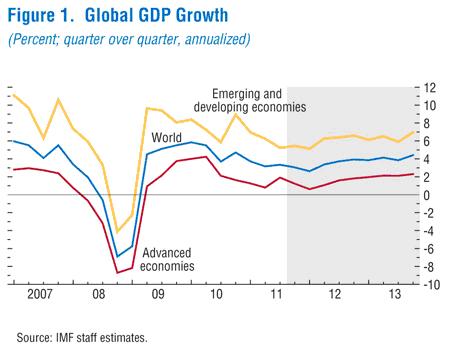
Chart-Global GDP Growth 2007-13, IMF

World Economic Outlook Update: Global Recovery Stalls, Downside Risks Intensify, International Monetary Fund, January 2012.

—————

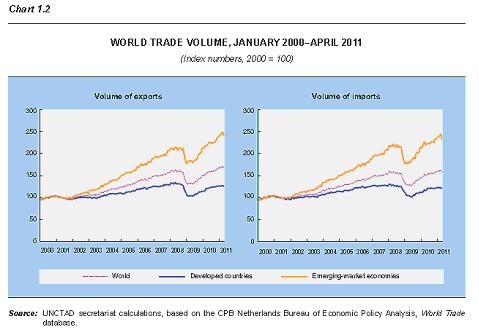
Chart-World Trade Volume 2000 - 2011

Trade and Development Report, 2011: Post-crisis Policy Challenges in the World Economy, United Nations Conference on Trade and Development (UNCTAD).

—————

“Last year alone the daily volume of currencies traded was 220 per cent higher than that in 2001, and 65 per cent of the transactions were cross-border ― up from 54 per cent in 1998. Since 1990 foreign direct investment increased more than six fold.”

Moisés Naím, The Dangerous Cocktail of Global Money and Local Politics, Financial Times, November 18, 2011, (published on Carnegie Endowment for International Peace website).

—————

“Assuming a cyclic dynamics of national economies and the interaction of different countries according to the import-export balances, we are able to investigate … the synchronization phenomenon of crises at the worldwide scale. … The results support the theory of a globalization process emerging in the decade 1970–1980, the synchronization phenomena after this period accelerates and the effect of a mesoscopic [intermediate in size] structure of communities of countries is almost dissolved in the global behavior.”

Pau Erola, Albert Diaz-Guilera, Sergio Gomez, Alex Arenas, Modeling international crisis synchronization in the World Trade Web, arXiv.org, January 10, 2012.

—————

“In today’s financial architecture, as with other supply chains, interdependent networks tend to concentrate in powerful hubs. For example, just two financial centers, London and New York, dominate international finance, and only 22 players conduct 90% of all global foreign-exchange trading.”

Andrew Sheng, Global Finance’s Supply-Chain Revolution, Project Syndicate, January 5, 2012.

—————

“So the degree of synchronisation has evolved fitfully. It is only in the most recent 1973-2006 period that we can speak meaningfully of anything resembling an international business cycle.”

Paul Ormerod, Random matrix theory and the evolution of business cycle synchronisation 1886-2006, arXiv, July 11, 2008. 

—————

“Globalization has made frontiers more porous. We see how one country’s policies, whether pertaining to work, the environment, public health, taxation, or myriad other issues, can have a direct impact on others. And we see such interdependence even more clearly in their economic performance: China’s annual GDP growth rate, for example, will slow by two percentage points this year, owing to sluggishness in the United States and the EU.”

Javier Solana, Whose Sovereignty?, Project Syndicate, March 12, 2012.

—————

“At the news conference Monday, Mr. Zhou said China was especially worried about Europe and its chronic sovereign-debt crisis … The world economy is highly globalized with a very active flow of capital worldwide,” he said. “All of these factors will have an impact on our monetary policy.’”

Ian Johnson, China Talks of More Lending but Less Currency Growth, New York Times, March 12, 2012.

—————

“Undoubtedly politicians should do a much better job of explaining to their constituents’ that what happens beyond the borders of their country-or city has implications for what happens inside their homes.”

Moisés Naím, The Dangerous Cocktail of Global Money and Local Politics, Financial Times, November 18, 2011 ( published on Carnegie Endowment for International Peace website).

COMMENTS

It is becoming increasingly clear that merging the world’s 20th century national economies into our 21st century world economy has raced ahead of merging national economic policy making institutions into a global economic policy making system.  The consequences of this lag in the development of global policy making institutions for the people of the U.S. and other nations are enormous.

National employment and income growth efforts are often ineffectual or only effective for a short time because of the ongoing policy push and shove of nations competing for advantage in the world economy.  What one nation does to improve its position in the world economy and grow jobs and incomes, other nations work quickly to undo.

For the world economy as a whole, this push and shove of nation-centered economic policy making produces a high level of economic instability and a high level of policy incoherence.

One glaring and maddening consequence of this combination of reduced national policy effectiveness and global policy incoherence is that the recovery from the financial crisis of 2008-2009 has proceeded in fits and starts and seems too frequently to be on the verge of collapsing back into crisis.  Global job and income growth is being held back and governments are being denied the tax revenues they need to protect economically vulnerable people from the ravages of poverty.

Most U.S. economists and policy makers continue to hold out hope for a much more robust economic recovery than we have had.  But, one has to wonder whether a more robust recovery is possible while the world’s economic house is so geopolitically divided.

See my related comments in:  The World Economy’s Demolition Derby of Competing and Overlapping Economic Policy Making Entities, January 22, 2012

Where Will They All Work?

“Consider Stanford’s experience: Last fall, 160,000 students in 190 countries enrolled in an Artificial Intelligence course taught by Mr. Thrun and Peter Norvig, a Google colleague. An additional 200 registered for the course on campus, but a few weeks into the semester, attendance at Stanford dwindled to about 30, as those who had the option of seeing their professors in person decided they preferred the online videos, with their simple views of a hand holding a pen, working through the problems.

Besides the Artificial Intelligence course, Stanford offered two other MOOCs last semester — Machine Learning (104,000 registered, and 13,000 completed the course), and Introduction to Databases (92,000 registered, 7,000 completed). And this spring, the university will have 13 courses open to the world, including Anatomy, Cryptography, Game Theory and Natural Language Processing.”

Tamar Lewin, Instruction for Masses Knocks Down Campus Walls, New York Times, March 4, 2012.

COMMENTS

Stanford is only the tip of a global iceberg of educational capacity growth that is beginning to dump huge numbers of well educated workers into the world economy.

A big question for state university systems:  If you are the son or daughter of a middle class family in China or India or Kenya or Peru, why settle for an online education at State U. when universities of the caliber of Stanford, MIT, and Harvard offer unlimited enrollment opportunities?

For more on this issue, see my previous post:

Too Many Well Educated Workers: a Global Problem and a U.S. Policy Dilemma, February 29, 2012

IMF: World’s Economic Recover Stalls at End of 2011; Global Policy Coordination Needed (Addendum to January 22, 2012 Post)

ITEMS FOR YOUR CONSIDERATION

Note: WEO refers to the IMF's World Economic Outlook report.

“For the United States, the growth impact of such spillovers is broadly offset by stronger underlying domestic demand dynamics in 2012. Nonetheless, activity slows from the pace reached during the second half of 2011, as higher risk aversion tightens financial conditions and fiscal policy turns more contractionary.

Importantly, not all countries should adjust in the same way, to the same extent, or at the same time, lest their efforts become self-defeating. Countries with relatively strong fiscal and external positions, for example, should not adjust to the same extent as countries lacking those strengths or facing market pressures. Through mutually consistent actions, policymakers can help anchor expectations and reestablish confidence.”

World Economic Outlook Update: Global Recovery Stalls, Downside Risks Intensify, International Monetary fund, January 2012.

COMMENTS

Most economists say (and the record of job growth during 2011 shows) that the U.S. must have GDP growth over 3 percent for a long period of time to substantially reduce the unemployment rate and bring discouraged workers back into the labor force (which will raise incomes).  Surely,  the U.S.  will not achieve the needed level of employment growth without working closely with other nations to implement a coordinated global policy approach to fixing the world economy and increasing global demand for workers.

Click this link to see related items and more comments on this topic:

The World Economy’s Demolition Derby of Competing and Overlapping Economic Policy Making Entities, January 22, 2012

The World Economy’s Demolition Derby of Competing and Overlapping Economic Policy Making Entities

CONSIDER THE FOLLOWING ITEMS

“Why can’t that work come home? Mr. Obama asked. …Mr. Jobs’s reply was unambiguous. ‘Those jobs aren’t coming back,’ he said, according to another dinner guest. … ‘We sell iPhones in over a hundred countries,’ a current Apple executive said. ‘We don’t have an obligation to solve America’s problems. Our only obligation is making the best product possible.'”

Charles Duhigg and Keith Bradsher, How U.S. Lost Out on iPhone Work, New York Times, January 21, 2012.

—————

“… we demonstrate that an individual country’s role in crisis spreading is not only dependent on its gross macroeconomic capacities, but also on its local and global connectivity profile in the context of the world economic network. … These results suggest that there can be a potential hidden cost in the ongoing globalization movement towards establishing less-constrained, trans-regional economic links between countries, by increasing the vulnerability of global economic system to extreme crises.”

Kyu-Min Lee, Jae-Suk Yang, Gunn Kim, Jaesung Lee, Kwang-Il Goh, In-mook Kim, Impact of the topology of global macroeconomic network on the spreading of economic crises, version 2, arXiv.org, April 2011.

—————

“Open feedback mechanisms ensure a supply chain’s ability to respond to a changing environment, but, in the case of financial supply chains, feedback mechanisms can amplify shocks until the whole system blows up. The Lehman Brothers collapse triggered just such an explosion … Since a complex network comprises linkages between many sub-networks, individual inefficiencies or weaknesses can have an impact on the viability of the whole.”

Andrew Sheng, Global Finance’s Supply-Chain Revolution, Project Syndicate, January 5, 2012.

—————

“Asian economies are exposed to China. Latin America is exposed to lower commodity prices (as both China and the advanced economies slow). Central and Eastern Europe are exposed to the eurozone. And turmoil in the Middle East is causing serious economic risks – both there and elsewhere …The US … faces considerable downside risks from the eurozone crisis.”

Nouriel Roubini, Fragile and Unbalanced in 2012, Project Syndicate, December 15, 2011.

—————

“Undoubtedly politicians should do a much better job of explaining to their constituents’ that what happens beyond the borders of their country-or city has implications for what happens inside their homes. … Despite all these problems, we have no choice: we must make local politics more attuned to global imperatives and make global finance more responsive to local needs.

Moisés Naím, The Dangerous Cocktail of Global Money and Local Politics, Financial Times, November 18, 2011, published on Carnegie Endowment for International Peace website.

COMMENTS

On paper it all sounds good: in a system of global free markets, nations, provinces, states, cities and corporations pit their resources and their people’s skills and smarts against each other. As unfettered competition sorts out comparative strengths and weaknesses, each competing economic unit finds its proper role in the world economy, makes its economic contribution efficiently, and earns its share of global wealth.  And the winner is … everybody!

The reality is a global demolition derby of competing and overlapping national, transnational, sub-national, and corporate economic policy making that routinely litters the planet with the wreckage of businesses, communities, families and even whole nations.

Many of us get our images of global competition from the world of sports, but those images are disastrously mistaken.  In the sports world participation is voluntary and competition is highly choreographed.  The umbrella of rules under which teams and individual athletes face each other is comprehensive and well enforced.  The wholeness of the game dominates the individual interests and actions of the competing teams and their players.  As a result, certain teams and players seldom become permanent victors and the consequences of losing are relatively benign.

Teams and players do not bring their own rules to the field of competition; teams and athletes with big differences in competitive resources are not pitted against each other (heavyweight fighters are not pitted against welterweight fighters and minor league baseball teams are not pitted against major league teams); the ratio of referees to players is very high and referees have the power to ensure that the choreographed competition designed into the game is not destroyed by rule breakers; all players get paid whether they win or lose; competitive encounters don’t leave losing teams and players permanently broken and maimed.

This is not the case for competition in the world economy.  Participation is not voluntary and competition is chaotic and brutal.  A comprehensive umbrella of rules does not exist and the rules that do exist are not well enforced.  Global social and economic goals cannot dominate the interests and actions of the thousands of governmental and private sector competitors.  Certain competitors win and maintain dominance over all others for many decades; other competitors become chronic losers.  The consequences of losing are often devastating and extremely long-term.

Competitors do bring their own rules to the global fields of competition.  The more powerful governments and corporations create rules to serve their own interests, regardless of consequences for the good of the whole or consequences for the losers, and then impose them on the less powerful governments and corporations.  Referees in the world economy are vastly outnumbered by competitors and they don’t have sufficient powers of enforcement to reign in rogue competitors.

For almost all the world’s peoples who count themselves as winners, or at least survivors, a consequence of this global demolition derby is chronic and frightening employment and income insecurity.   For losing nations and communities the consequences are often profoundly devastating: high levels of infrastructure loss, permanently broken social institutions, widespread and chronic unemployment and impoverishment, and enormous losses of life to famines, wars, preventable disasters and curable diseases.

Almost certainly, the world’s people will be much better off if we actually do make global economic competition much more like competition in sports.

What Happens In Vegas Doesn’t Stay In Vegas: National Policies Have Global Consequences

“Thus, national policies affecting capital flows can transmit multilaterally. This transmission has not been fully appreciated by national policymakers. Further, they may not have incentives to take full account of the cross-border effects of their policies. Looking ahead, the upward trend in the volume of capital flows can be expected to continue, making it ever more important to address the associated cross-border risks.”

The Multilateral Aspects of Policies Affecting Capital Flows, International Monetary Fund, October 13, 2011.

—————

“These two-way capital flows created a complex web among markets and institutions, some regulated and some not. Against this background, case studies were prepared for European banks and U.S. money market mutual funds (MMMFs) and for German banks and U.S. mortgage-backed securities (MBSs). Another important case is that of the near failure of the American International Group (AIG), which turned out to have complex and systemically cross-border linkages with other global institutions and markets.”

The Multilateral Aspects of Policies Affecting Capital Flows – Background Paper, International Monetary Fund, October 24, 2011.

—————

“Why might we expect a rise in U.S. bond yields to raise bond yields in other countries? First, openness of financial markets and arbitrage opportunities may mean that interest rate shocks are transmitted across economies. Second, a closer real integration of two economies may imply that a monetary policy shock or an inflationary shock in one economy may lead investors to expect similar developments in another, thus inducing a significant transmission of shocks in bond markets and money markets.”

Vivian Z. Yue and Leslie Shen, International Spillovers on Government Bond Yields: Are We All in the Same Boat?, August 01, 2011, Blog at website of the Federal Reserve Bank of New York.

—————

“The trend toward greater diffusion of authority and power occurring for a couple decades is likely to accelerate because of the emergence of new global players, increasingly ineffective institutions, growth in regional blocs, advanced communications technologies, and enhanced strength of nonstate actors and networks.”

Global Trends 2025: A Transformed World, National Intelligence Council, PDF version, November 2008.

———————–Comments———————–

The words in the quotes above are dispassionate, but the realities to which they refer get in our faces every day.  The mix of global economic processes and competitive and uncoordinated national policy making creates a bubbling soup of chaotic change.  (Go-it-alone economic policy making by sub-national and regional governments surely contribute to this soup of chaotic change as well.)

This environment makes decision making and planning very difficult and prone to error for the majority of the world’s investors and business owners and managers. It destabilizes the global world of work and damages the families and communities that depend on that world.  And it confounds policy experts because it is not possible to find logic in the illogical.

Moreover, this environment plays into the hands of the bad actors in the world economy, who promote and thrive on the high volumes of misunderstandings and errors that now plague economic and policy decision making at every level of organization in the world economy.

For more on this topic see my post, Fragmented and Weakened Global Governance Perpetuates the World’s Employment Crisis, September 9, 2011. Also see the topic Economics and Economic Policy (under U.S. Economic Policy heading at right).

Climate Change Is Increasing Global Employment and Income Instability

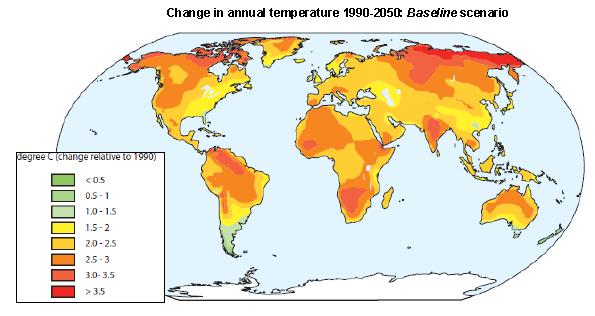
From Key Findings on Climate Change, THE OECD ENVIRONMENTAL OUTLOOK TO 2050 (forthcoming, 2012), Organization for Economic Cooperation and Development.

—————

“New figures from the U.N. weather agency Monday showed that the three biggest greenhouse gases not only reached record levels last year but were increasing at an ever-faster rate, despite efforts by many countries to reduce emissions.”

Seth Borenstein , Greenhouse gases soar; scientists see little chance of arresting global warming this century, Washington Post (Associated Press), November 21, 2011.

 —————

Primary sectors such as agriculture, forestry and fisheries will be affected more severely than others. The attraction of tourist destinations will change. … Ski resorts at low and medium altitude could be affected by reduced snow cover …The likelihood of the development of extreme weather conditions will affect the insurance industry, which will be forced to pass on the rising cost of damages to other economic sectors … Jobs will be created in companies that can take advantage of opportunities created by climate policies and jobs will be lost in companies that cannot adapt.

Climate Change and Employment, European Trade Union Confederation.

—————

About 1.3 billion people, or 40 percent of the economically active people worldwide, work in agriculture, fishing, forestry, and hunting or gathering.

Human Development Report 2011, United Nations Development Programme.


———————–Comments———————–

In recent decades, the world’s communities and working families have faced increasing employment and income instability as the pace of technological change and the pace of transnational capital transfers have increased.  More and more communities see whole industries come and go; more and more working families now cope with recurring periods of unemployment and underemployment; increasingly, working people find themselves having to negotiate major job transitions (many of which require investments in retraining and many of which result in lower wages and benefits); larger numbers of workers become trapped in long-term unemployment.

Climate change is adding to global employment and income instability through its impacts on the global distribution of investment opportunities and risks.  Primary impact is on climate sensitive industries (e.g., agriculture, fisheries, forestry, tourism, insurance, health care — in response to changing disease threats, emergency services).  Changing global weather patterns are transforming local and regional mixes of market opportunities, production and distribution costs, and risks to communities across the world.  Older business models and technologies are being modified or abandoned and replaced with different business models and new technologies, and the responsibilities assigned to governments and non-profit organizations are being transformed, as the consequences of climate change accumulate.

The contribution of climate change to global employment and income instability extends well beyond the most climate sensitive industries.  Weather is totalitarian: every aspect of our lives is affected to some degree by its patterns and changes, from housing codes to travel decisions, from clothing requirements to food choices, from health care requirements to leisure activity decisions.  Thus, as the consequences of climate change accumulate, we will make large and small changes to the way we live.

In some parts of the world, the changes made will be substantial and rapid, generating newsworthy investment and employment upheaval.  In other parts of the world they may be minor.  But even minor individual changes, when made in a short time span, can aggregate into a force that unsettles business opportunities and demands made on governments.

Recent evidence suggests that climate change is accelerating.  As it does, the consequences of climate change will accumulate more rapidly, awareness of the consequences will increase, and corporations and investors will accelerate their efforts to respond to consequences already felt and prepare for those just ahead.  Global employment and income instability will increase all the more.

The Myth of State Economies Undermines the Development of Effective Economic Policies

“In other words, if we think of state borders as physical barriers, do we also irrationally imagine that these borders protect us in some way? …

The idea was that the dark line would reinforce the biased notion that borders are impermeable—and that states are therefore meaningful categories to rely on for decision making. …

As reported in October in the online version of the journal Psychological Science, when the radioactive waste was being stored in neighboring Nevada, residents of Salt Lake City perceived much greater risk of contamination if the border was a light, dotted line. In their minds, that light, sketchy border minimized the distinction between Utah and Nevada—and thus increased their perception of risk. The thick, dark border offered psych­ological protection from radioactivity.”

 Wray Herbert, Border Bias and Our Perception of Risk, Scientific American, February 21, 2011.

———————–Comments———————–

The use of the term “state economy”, and even more to the point, terms like “Michigan economy” and “Nevada economy” by economists, economic policy experts, and policy makers is common and has the same psychological effect as drawing a dark border around a state.  The use of such terms reinforces and perpetuates the illusions that state boundaries have economic importance and that state economic policies have the power to change economic outcomes.

A state economy is nothing more than an artifact of geopolitical decisions made long ago.  Like the mix of bird species in a state, the mix of economic activities and relationships in a state is little more than an arbitrary consequence of the intersection between where a state boundary was drawn and where particular economic activities and relationships later developed.  Just as habitats expand and contract and change shape and location with time, so too do the economic boundaries defined by the distributions of economic activities and economic relationships among people.  But, state boundaries almost always stay put.

There is now only one economy, the world economy.  State economies exist only in our minds.  So too, the power of state governments to improve investment and employment outcomes exists only in our minds.

The False Promise of September Auto Sales

“Mr. Toprak said more consumers also were showing up at dealerships because their current vehicle had outlived its useful life and they had no choice but to buy a replacement.”

Nick Bunkley, U.S. Vehicle Sales Soared Nearly 10% in September, Despite Economic Gloom, New York Times, October 3, 2011

—————

“But other factors boosted truck sales. Small businesses must eventually replace aging fleets of work trucks…”

Associated Press, US auto sales rise in September as consumers buck trends and buy trucks, Washington Post, October , 2011

—————

“Personal income decreased $7.3 billion, or 0.1 percent, and disposable personal income (DPI) decreased $5.0 billion, or less than 0.1 percent, in August …Real disposable income decreased 0.3 percent in August, compared with a decrease of 0.2 percent in July.”

Personal Income and Outlays: August 2011, New Release, Bureau of Economic Analysis, U.S. Department of Commerce, September 30, 2011

—————

“But the companies will be able to contain their costs by not paying annual raises to their U.S. factory workers and by hiring thousands of new workers at lower wage rates.”

Dee-Ann Durbin and Tom Krisher (Associated Press), Ford to pay workers $6,000 bonus, Lansing State Journal, Oct. 4, 2011

—————

“Retailers are coming to terms with a new reality: the consumer who traded down during the recession and never came back.”

Ann Zimmerman, Frontier of Frugality, Wall Street Journal, October 4, 2011

———————–Comments———————–

September’s jump in vehicle sales did not signal a change in the behaviors of global investors, corporations, and governments that currently translate consumer decisions into employment and income outcomes.  Global investment decisions still favor machines over workers and still favor nations with low wages, weak regulations, corruptible government officials and/or growing populations of people with disposable income.  Global economic growth is still slowing; employment opportunities are still disappearing; opportunities for investors and corporations to pit desperate nations and workers against each other in bidding wars for investments and jobs are increasing.

In this context, September’s jump in vehicle sales can’t be read as good news for U.S. working families and small business owners.  The economic benefits will be minimal and short lived.

Consumers and small businesses locked themselves into loan payments that reduce other spending: Auto sales were driven by frustrations with aging vehicles and other factors, not by income growth that had increased savings for down payments and created extra spending capacity to cover new loan payments.  It is thus very likely that tens of thousands of families and small businesses are now locked into years of new auto loan payments they can’t afford.  And global circumstances virtually insure that family incomes in the U.S. will stay flat or even decline over the next year.   Consumers and small businesses must either reduce spending on other items or take on more debt.

More debt, of course, means a larger share of income goes to loan payments.  Sooner or later, unless incomes rise enough to offset loan payments, consumer demand and business-to-business demand will fall.

With the holiday season coming, retailers may be the first to see sales losses as consumers cut back on optional spending so they can make auto loan payments.

Employment and income benefits for U.S. families are minimized by global supply chains and global wage and benefit inequalities: These days, “made in the U.S.” really means assembled in the U.S.  Many of the parts that become a finished vehicle here are produced outside the U.S.  Thus, a jump in U.S. auto sales generates job and income growth in other nations as well as in the U.S.  Moreover, the U.S. share of total job and income growth from auto sales declines over time.

Because of huge wage and benefit inequalities across nations the families in other nations that get income increases as a result of U.S. auto purchases will spent most of their extra income on goods and services produced in the U.S. — in the emerging economies (e.g., Brazil, Russia, India, China) where many high tech consumer and business goods are produced more cheaply than in the U.S. and in low wage nations that produce all the other consumer basics (blankets, dinner ware, clothing, etc.) that are mostly not produced in the U.S. (except when produced by U.S. crafts people and a select few U.S. companies that market to wealthy and status conscious consumers).

Interest on loans goes into bloated investment funds, and from there to other nations and into financial bubbles: In the early days of a loan, the part of a loan payment that goes to interest is typically at its highest.   Thus, for the immediate future, September vehicle sales will be pumping cash into the hands of bankers and other investors.  Under current global circumstances, this does not benefit U.S. families

It has become well known that U.S. corporations and investors are aggressively pursuing investment opportunities in parts of the world with growing populations of middle class consumers.  It is thus very likely that a large part of the loan payments on the new vehicles will generate jobs outside the U.S. and strengthen global competitors to smaller U.S. businesses.

Concern about the formation of new financial bubbles has been mounting because the investment world is flush with cash and a stagnant world economy has reduced the number of sound investment opportunities.  Pumping more cash into the investment world under these circumstances can only increase the risk that cash rich but profit-hungry investors will herd themselves into unsound investment trends.