Scientists Map Key Component of World Economy

“We present the first investigation of the architecture of the international ownership network, along with the computation of the control held by each global player. We find that transnational corporations form a giant bow-tie structure and that a large portion of control flows to a small tightly-knit core of financial institutions. This core can be seen as an economic “super-entity” that raises new important issues both for researchers and policy makers. [from the abstract]

Remarkably, the existence of such a core in the global market was never documented before and thus, so far, no scientific study demonstrates or excludes that this international “super-entity” has ever acted as a bloc. However, some examples suggest that this is not an unlikely scenario. For instance, previous studies have shown how even small cross-shareholding structures, at a national level, can affect market competition in sectors such as airline, automobile and steel, as well as the financial one.”

Stefania Vitali, James B. Glattfelder, Stefano Battiston, The network of global corporate control, arXiv.org, July 2011

—————

“‘This is empirical evidence of what’s been understood anecdotally for years,’ says information theorist Brandy Aven of the Tepper School of Business at Carnegie Mellon in Pittsburgh.”

Rachel Ehrenberg,  Financial world dominated by a few deep pockets, ScienceNews, September 24th, 2011; Vol.180 #7 (p. 13)

———————–Comments———————–

This study does not show that the allocation of investments that create employment opportunities for the world’s people is managed almost exclusively for the benefit of the members of this super-entity and their managerial minions and political allies.

It does not show that this super-entity uses its power to pressure governments around the world, including U.S. federal and state governments, to implement policies that are not in the best interests of the people who must live under and with the policies of those governments.

It does show that there is an entity with the power to do such things.

Note: the study examined relationships among 43,000 transnational corporations and 600,508 economic actors connected by more than a million ownership ties.
Multiple Trends Bring Increased Global Economic Instability

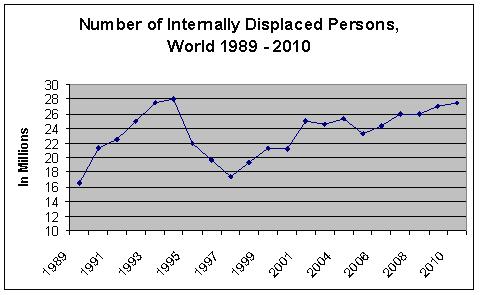
Internally Displaced Persons Trend

Data for chart provided by Internal Displacement Monitoring Center (IDMC). See Internal Displacement: Global Overview of Trends and Developments in 2010, March 2011.

—————

In the broader sense, the biggest question is whether we will be able to feed the world’s population going forward and how much it is going to cost us. Falling yields over the last few decades are raising concerns that current agricultural techniques are nearing their natural limit for productivity.

Global Economic Outlook Q2 2011: Navigating a world of turmoil, Deloitte Research, 2011.

—————

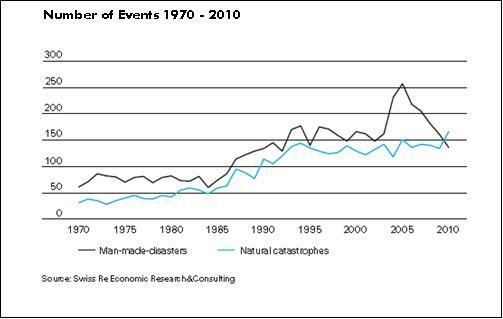
Disasters and Catastrophes 1970-2010

Chart source: Natural catastrophes and man made disasters in 2010, Swiss Reinsurance Company Ltd

—————

“The already stressed resource sector will be further complicated and, in most cases, exacerbated by climate change … Technological advances and policy decisions around the world … are likely to determine whether the globe’s temperature ultimately rises more than 2 degree centigrade—the threshold at which effects are thought to be no longer manageable.

For various reasons the US appears better able than most to absorb those shocks, but US fortunes also ride on the strength and resiliency of the entire international system, which we judge to be more fragile and less prepared for the implications of obvious trends like energy security, climate change, and increased conflict, let alone surprises.”

Global Trends 2025: A Transformed World, National Intelligence Council, PDF version, November 2008

—————

“Since the publication of the April 2011 Global Financial Stability Report (GFSR), financial risks have risen for three reasons … Third, notwithstanding some recent pullback in risk appetite, the prolonged period of low interest rates may push investors into riskier assets in a “search for yield.” This trend has the potential to build financial imbalances for the future, particularly in some emerging markets.

Global Financial Stability Report Market Update, International Monetary Fund,  Updated: June 20, 2011

———————–Comments———————–

Perhaps it is only a coincidence that the number of man-made disasters peaked just before the U.S. financial system went on life support and its troubles kicked off the Great Recession of 2008-09.  Perhaps it’s not.

In a world in which global markets and global investment flows tie each of us to everyone else, anything that happens is likely to bump into and jar everything else. Disruptive weather events, disruptive economic events, transformative investment shifts, and disruptive political events are not unconnected.

Thomas Friedman tells us the world is hot, flat, and crowded.  It is also becoming increasingly susceptible to spasms of destructive instability as global trends more frequently generate destabilizing conjunctures of economically costly events.

The world does not have adequate systems of governance for managing these destabilizing conjunctures, so as the world gets hotter, flatter, and more crowded, the more devastating these spasms of instability will be.

Global Investments in Agriculture Technologies and Growing Demand for Paid Work

Today, a single person driving a huge $400,000 combine, burning 200 gallons of fuel daily, guided by computers and GPS satellite navigation, can cover 20 acres an hour, and harvest 8,000 to 10,000 bushels of wheat in a single day.”

 Christian Parenti, Reading the World In a Loaf of Bread: Soaring Food Prices, Wild Weather, Upheaval, and a Planetful of Trouble.

“MOLINE, Illinois (May 18, 2011)  – Deere & Company said today it will build a new manufacturing facility in northeast China to support the increased demand for large agricultural products in the region. The factory will build mid- and large-sized tractors, sprayers, planters and harvesting equipment. Deere said its initial outlay for the project is approximately $80 million.”

John Deere Press Release, May 18, 2011.

“All business is local. To understand and respond to our many customers’ needs and requirements worldwide, we must live where they live. Work where they work. That’s why John Deere reaches out across the world with factories, offices and other facilities in more than 30 countries…”

John Deere web page, Worldwide Locations http://www.deere.com/wps/dcom/en_US/corporate/our_company/about_us/worldwide_locations/worldwidelocations.page?%09%09%20%09

———————–

Displacement of families from agricultural lands by agricultural businesses with machines has long been a key driver of the demand for jobs in cities and suburbs, and continues to be in some areas of the world.  Agricultural workers, often non-paid family workers, whose work is taken over by machines migrate to cities and seek jobs in the manufacturing, service, and government sectors.  From growing food and feeding themselves, families on agricultural lands become dependent on jobs for the money to buy food produced by the remaining few workers on factory farms.  Without jobs, they become dependent on public and private handouts.

Despite the world’s need to produce more and more food for a population projected to reach 10 billion by 2100, agriculture will not offer more job opportunities.  Instead, the world’s agricultural regions will send even more millions to cities in search of paid work.

Investors Say It’s 1950 Somewhere Else

Last Sunday’s New York Times (July 10, 2011) had a half page ad on page 15 of the Mutual Funds Report section with the following words in the banner:

1950 Somewhere

A quote from one of the pages at globalizeyourthinking.com:

“…Over the past generation, the global economic, political and social landscapes have changed dramatically and, we think, irreversibly…  We believe investors who embrace the idea that investment opportunities are no longer defined by borders [emphasis added] are positioned to benefit most from the insights and opportunities presented by the new landscape.”

This perspective is widespread among investment houses – just read the ads and visit the web sites.  Goldman Sachs, for example: