Too Many Well Educated Workers: a Global Problem and a U.S. Policy Dilemma

SEVEN ITEMS FOR YOUR CONSIDERATION
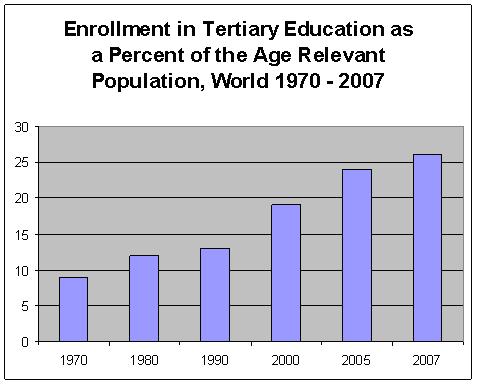
Chart-Tertiary Education enrollment ratiosData source: Global Education Digest 2009: Comparing Education Statistics Across the World, UNESCO Institute for Statistics, 2009.

—————

Chart-Tertiary Education enrollment by regionData source: Global Education Digest 2009: Comparing Education Statistics Across the World, UNESCO Institute for Statistics, 2009.

—————

“Companies no longer need to divide their skills strategies between high-cost ‘head’ nations employing-high skilled, high-waged workers, and ‘body’ nations that are restricted to low skilled, low waged employment. This change has come about via a combination of factors including the rapid expansion in the global supply of high skilled workers, in low-cost as well as high-cost economies, advances in information technologies, and rapid improvements in quality standards in emerging economies, including the capability to undertake research and development.”

Phillip Brown, Hugh Lauder, and David Ashton, Education, globalisation and the knowledge economy, Teaching and Learning Research Programme and Economic and Social Research Council, September 2008.

—————

“Unemployment is running at 14 percent and record numbers of people are emigrating in search of work. … Ireland’s pitch to China was its usual combination of low corporate tax rates, a well-educated work force of English speakers and ready access to the European Union’s market of 500 million people. The country’s technological skill, particularly in agribusiness and education, was also emphasized.”

Douglas Dalby, Ireland Makes Pitch to Official From China, New York Times, February 20, 201.

—————

“More people are losing the same gamble as a 33 percent jump in U.S. graduate school enrollment in the past decade … runs headlong into a weaker job market.”

Janet Lorin, Trapped by $50,000 Degree in Low-Paying Job Is Increasing Lament, Bloomberg, Dec 7, 2011.

—————

[IBM] stopped providing a geographic breakdown of its employees in 2009. At the end of 2008, U.S. staff accounted for 115,000 of its 398,455 employees, according to its annual report that year.

Beth Jinks,  IBM Cuts More Than 1,000 Workers, Group Says, Bloomberg, February 28, 2012.

—————

“Tech drives the economy, but it doesn’t drive employment. ‘We are a 100-person company and we serve 50 million people. That kind of leverage has never existed before,’ said Drew Houston, co-founder of the start-up Dropbox, a service that stores and shares digital files.

Nick Bilton, Disruptions: In Davos, Technology Moves Center Stage, New York Times, January 29, 2012.

COMMENTS

The assertion that a major impediment to economic growth and reducing unemployment and underemployment is a mismatch between the knowledge and skills most workers have and the knowledge and skills corporations are seeking is repeated often in the media and is widely accepted as true.  Thus, calls for investing in the higher education programs that will create a workforce with the newer and higher end knowledge and skills the corporations want are also common.

The policy experts who make the skills mismatch assertion base it on reports by business leaders that they have a hard time filling certain positions.  Unfortunately, those policy experts make the mistake of generalizing from a sample of workforce recruiting situations that is not at all representative of the larger population of U.S. recruitment situations.

Three reasons shortages of high end workers are not representative:

  • They are almost always geographically localized, concentrated in particular industries, and relatively short term
  • They evolve and move from place to place, but they never disappear; they develop when and where innovation is successful and reflect the nature of the innovation
  • On an ongoing basis, they account for only a small part of the overall demand for high end workers.

Those policy experts also make the mistake of drawing artificial national and sub national boundaries around workforce recruitment activities, ignoring the fact that a growing proportion of the world’s corporations, including smaller domestic corporations now recruit globally.  (And new evidence shows that corporations, not small businesses, account for the bulk of job creation and job destruction — see Floyd Norris, Small Companies Create More Jobs? Maybe Not, New York Times, February 24, 2012. )

The Global Problem

For the world economy as a whole, the salient shortage is the other way around: high end workers face a shortage of opportunities to put their educations and skills to work in good jobs (living wages and adequate benefits, safe working conditions, socially beneficial products and services).  And this mismatch between the supply of high end workers and the demand for their knowledge and skills is getting worse.

The key factors:

  • Global demand for highly educated workers is growing very slowly because the world economy as a whole is growing very slowly;
  • The global supply of highly educated workers is increasing rapidly as nations, states, provinces, and cities invest in education as a way of competing for the business investments that generate good jobs
  • Businesses of every size and in every economic sector pursue competitive advantage by investing in newer technologies than can now do the kinds of communications, evaluation, and decision-making work that most college educations prepare people to do.

Education is a good in and of itself, but global investing in higher education will not solve the long term problems of high unemployment and declining wages and benefits in the world economy.  Public investments in education address the supply side of the global labor market equation, but unemployment and underemployment in a world with an expanding population of workers, including well educated workers is fundamentally a demand side problem.

U.S. Public Policy Dilemma

Again, education is a good in and of itself, but more U.S. investments in higher education will not pay off in better jobs and growing incomes for U.S. workers.  The reasons are tied to extensive U.S. engagement in the world economy:

  • Investments in higher education produce high end workers who become part of the global supply of high end workers; the skills and knowledge of those workers are available not only to U.S. corporations but to the competitors of U.S. corporations
  • Those investments also put more downward pressure on high end wages and benefits in the U.S. because they add to an already excessive global supply of high end workers available to U.S. corporations
  • Investments in programs that increase the demand for high end workers (big government investments in transitioning to green energy sources is often proposed) don’t increase demand only for U.S. high end workers; not only do U.S. corporations outsource work and recruit lower cost workers from other countries, so too do government agencies.

U.S. workers will get more employment opportunities and wage growth from investments in higher education only if the global demand for high end workers is brought into balance with the global supply.  U.S. policy makers, acting alone, cannot cause this to happen.  A much higher level of global management of investments in higher education, investments in job creation programs, and investments in income supports for working people whose labor is not needed is required.

A good model for this is offered by federal government management of the supply and demand for workers in the in the U.S. 1950’s and 1960’s.

In those decades, federal investments in higher education increased substantially, but it also made large investments in job creating programs – notably, investments in the development of military technology, in an ambitious space program, in research across the spectrum of intellectual fields, in new regulatory programs, and in community jobs programs.  It also expanded income supports for workers not easily absorbed into the labor force because of disabilities, age, and skill limitations.

Thus, while higher education investments increased the demand for high end jobs, other government investments increased the supply of high end jobs, low end jobs in both the public and private sectors, and moderated the overall demand for jobs.

U.S. policy makers could and should lead in implementing this model for managing labor force development in the world economy as a whole.  That would serve the interests of U.S. working families.  But they cannot even fully participate in such an effort because American voters believe strongly in American exceptionalism and have an associated strong dislike for multinational government institutions (and for government involvement in economic matters in general).  And that is a real dilemma.
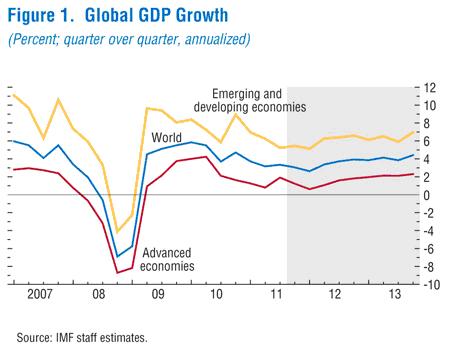
IMF: World’s Economic Recover Stalls at End of 2011; Global Policy Coordination Needed (Addendum to January 22, 2012 Post)

ITEMS FOR YOUR CONSIDERATION

Note: WEO refers to the IMF's World Economic Outlook report.

“For the United States, the growth impact of such spillovers is broadly offset by stronger underlying domestic demand dynamics in 2012. Nonetheless, activity slows from the pace reached during the second half of 2011, as higher risk aversion tightens financial conditions and fiscal policy turns more contractionary.

Importantly, not all countries should adjust in the same way, to the same extent, or at the same time, lest their efforts become self-defeating. Countries with relatively strong fiscal and external positions, for example, should not adjust to the same extent as countries lacking those strengths or facing market pressures. Through mutually consistent actions, policymakers can help anchor expectations and reestablish confidence.”

World Economic Outlook Update: Global Recovery Stalls, Downside Risks Intensify, International Monetary fund, January 2012.

COMMENTS

Most economists say (and the record of job growth during 2011 shows) that the U.S. must have GDP growth over 3 percent for a long period of time to substantially reduce the unemployment rate and bring discouraged workers back into the labor force (which will raise incomes).  Surely,  the U.S.  will not achieve the needed level of employment growth without working closely with other nations to implement a coordinated global policy approach to fixing the world economy and increasing global demand for workers.

Click this link to see related items and more comments on this topic:

The World Economy’s Demolition Derby of Competing and Overlapping Economic Policy Making Entities, January 22, 2012

The Myth of State Economies Undermines the Development of Effective Economic Policies

“In other words, if we think of state borders as physical barriers, do we also irrationally imagine that these borders protect us in some way? …

The idea was that the dark line would reinforce the biased notion that borders are impermeable—and that states are therefore meaningful categories to rely on for decision making. …

As reported in October in the online version of the journal Psychological Science, when the radioactive waste was being stored in neighboring Nevada, residents of Salt Lake City perceived much greater risk of contamination if the border was a light, dotted line. In their minds, that light, sketchy border minimized the distinction between Utah and Nevada—and thus increased their perception of risk. The thick, dark border offered psych­ological protection from radioactivity.”

 Wray Herbert, Border Bias and Our Perception of Risk, Scientific American, February 21, 2011.

———————–Comments———————–

The use of the term “state economy”, and even more to the point, terms like “Michigan economy” and “Nevada economy” by economists, economic policy experts, and policy makers is common and has the same psychological effect as drawing a dark border around a state.  The use of such terms reinforces and perpetuates the illusions that state boundaries have economic importance and that state economic policies have the power to change economic outcomes.

A state economy is nothing more than an artifact of geopolitical decisions made long ago.  Like the mix of bird species in a state, the mix of economic activities and relationships in a state is little more than an arbitrary consequence of the intersection between where a state boundary was drawn and where particular economic activities and relationships later developed.  Just as habitats expand and contract and change shape and location with time, so too do the economic boundaries defined by the distributions of economic activities and economic relationships among people.  But, state boundaries almost always stay put.

There is now only one economy, the world economy.  State economies exist only in our minds.  So too, the power of state governments to improve investment and employment outcomes exists only in our minds.

Depreciate This: Good for the Stock Market, Bad for the Job Market

“Capital goods orders rose a robust 4.2 percent in August from July.

Core capital goods orders — nondefense bookings for items such as industrial machinery, power transmission equipment and computers, but excluding the auto and aircraft sectors — rose 1.1 percent.

‘We think large companies are so cash-rich that they can keep spending despite lower confidence. In competitive industries, the company which does not spend loses market share,’ he [Ian Shepherdson at High Frequency Economics] said.”

US capital goods orders shine in August, Breitbart.com, Sep 28, 2011

 —————

“The business spending … may be further supported by a December agreement between President Barack Obama and congressional Republicans. Companies will be able to depreciate 100 percent of capital equipment put in service by the end of this year.”

Bob Willis, Demand for U.S. Capital Goods Rises by Most in Three Months, Washington Post, Sep 28, 2011

 ———————–Comments———————–

From the standpoint of business leaders, the impact of investments in capital goods on employment opportunities is only a side effect.  If the investments contribute to job growth, they are happy to get the positive public relations bump.  If they undercut job growth, well, that’s just unavoidable collateral damage.

Yes, a burst of investments in capital goods can generate employment, but only in the short term.  Downstream, as those new computers, manufacturing robots, and assorted other high end technologies go live in workplaces, jobs will bleed out, more than offsetting short term job gains.

We now live in a world in which an accelerating global shift in the mix of humans and machines engaged in the production of goods and services is squeezing the life out of employment and income growth.  The pace at which machine energy is replacing human energy in the workplace is accelerating.  Machine energy has already replaced enormous amounts of human energy in agriculture, mining and manufacturing.  Today machine energy is increasingly replacing human energy used in thinking (evaluation and decision-making activities) in more and more fields of work, including professional fields.

Public policy cannot and should not stop innovation and the growing use of machines to supplement and replace humans in the workplace.  (Indeed, workers in many types of work are still exposed to dangers that can best be reduced by using more machines.)  But, use of tax write offs to encourage even faster displacement of workers by machines when done in the absence of a comprehensive policy approach to creating wealth and equitably distributing that wealth is extraordinarily wrongheaded.  Such unlinked use of tax write offs can only exacerbate the damage already being done to jobs and income in the U.S.

This kind of unlinked use of tax write offs is not just a U.S. practice.  Many of the world’s nations take the same approach to increasing market shares in very competitive global investment markets.  These nation by nation tax write off practices aggregate into a global economic force that increases wealth production and increases corporate profits, but also relentlessly destroys jobs and the incomes of families that depend on those jobs.

As of now the world does not have a comprehensive policy approach to managing the growth of the world economy.  More to the point, the world does not have global institutions with the power to coordinate economic policy-making across the world’s nations on behalf of the world’s people.  Thus, the ongoing global transition to more and more use of machines in place of people is both unmanaged and unmanageable.  The largely destructive aspects of this transition cannot yet be addressed and rectified.

In this context, the Obama administration’s 100 percent depreciation of new equipment can only become a 100 percent disaster for working families in the U.S. and in the rest of the world.

Policies of U.S. States Have Negligible Impact on Employment Growth

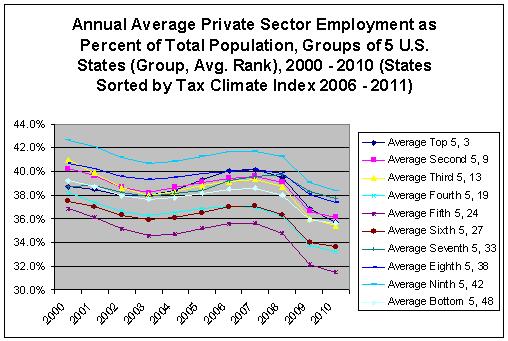
State Groups by Tax Rank
Data Sources: U.S. Bureau of Labor Statistics, U.S. Census, Tax Foundation.
States Top % By Tax Rank
Data Sources: U.S. Bureau of Labor Statistics, U.S. Census, Tax Foundation.
States Bottom 5 By Tax Rank
Data Sources: U.S. Bureau of Labor Statistics, U.S. Census, Tax Foundation.

Annual Change in Distribution of Percents of State Populations That Are Employed

2000 2001 2002 2003 2004 2005
Range 15.6% 14.5% 13.9% 14.0% 14.1% 14.5%
Minimum 30.9% 31.3% 30.9% 30.5% 30.6% 30.7%
Maximum 46.4% 45.8% 44.9% 44.5% 44.7% 45.2%
         
2006 2007 2008 2009 2010
Range 14.4% 14.3% 14.8% 16.0% 15.6%
Minimum 31.1% 31.1% 30.6% 28.7% 28.3%
Maximum 45.5% 45.4% 45.4% 44.6% 44.0%

———————–Comments———————–

What is striking in the first chart above (employment change for groups of states defined by Tax Climate Ranking) is that the patterns of change are so similar across the groups.  One might easily imagine the changes are choreographed.

This much unity of change is not consistent with the oft stated assertion that state policies have a large impact on state level employment change.  It is much more consistent with the proposition that state level employment change is driven primarily by economic forces that transcend state boundaries.

This interpretation is supported by variations within Tax Climate Ranking groups (second and third charts).  If state economic policies produced large employment effects, one would expect states with very different Tax Climate Rankings to proceed along visibly different employment change paths, while states with similar Tax Climate Rankings would proceed along similar employment change paths.  This isn’t the case.

The differences among the patterns of change for the closely ranked top ten states and among the patterns of change for the closely ranked bottom ten states appear to be greater than the differences among the patterns of change for groups of states.

Other employment change charts using the same formats  (not included here) display very similar patterns.  Again, patterns of change across groups are very similar  and differences within groups are as large as differences across groups.

For those charts the same employment change data were sorted differently.  One set of charts displays patterns of change for ten groups created by sorting the employment change data on percent of total population employed in 2000 (on the assumption that different initial employment levels might correspond to different policy histories and thus produce divergent change patterns).  The second set displays patterns for groups created by sorting the data on change in the percent of total population employed from 2000 to 2010 (on the assumption that differences among states in how well they performed over the decade might reflect policy differences other than Tax Climate that would produce noticeable differences in patterns of change).

The last item above, the table showing the distribution of percents of state populations employed,  offers more evidence that state employment levels change in unison.  Over the course of the decade the highest percent of population employed and the lowest percent change together, producing an almost constant range between highest to lowest.  Again, this is much more in keeping with conclusion that economic forces that transcend states in scope, not state policies, drive employment change at the state level.

A Plausible Explanation

It would be very surprising to find policy differences across states large enough to produce large differences in patterns of employment growth.

First, the states are part of a national governmental system in which constitutional provisions limit the policy options available to states, state governments are very similarly organized, and policy makers generally agree on the beneficence of the free enterprise system.  These factors inhibit the development of large policy differences among states.

Second, when a state enacts a policy or set of policies that seem to provide it with investment and employment growth advantages over other states, those other states adopt those or similar policies very quickly.  Thus, large policy differences will not persist.

Third, U.S. states are exposed to economic forces that are global in scope.  Global financial and production corporations move large volumes of money and commodities  across state and national boundaries.  So do many local businesses.  Ownership often transcends state and national boundaries.   States are subject to the policy rules of numerous  bilateral and multilateral trade and investment agreements entered into by the U.S.

These global economic forces are certainly powerful enough to overwhelm the effects of policies limited in scope to state boundaries and to wash away the employment change differences among states that policy differences might otherwise produce.

Pending Trade Pacts Will Continue the Downward Trends in Number and Quality of U.S. Jobs

Pending U.S. – South Korea Trade Agreement

“Most strikingly, KORUS will open Korea’s service market to U.S. exports, allowing the United States to exploit its competitive advantages in financial services, education and information and communications technologies.

The agreement also will lead to increased imports from Korea, which in turn will help the United States achieve greater economic specialization. The likely effects of more specialization—and of increased Korean investment in the United States—include greater U.S. efficiency, productivity, economic growth and job growth. Meanwhile, U.S. investors will gain new opportunities in the increasingly active Asia-Pacific region.

KORUS supports market access for U.S. investors with investment protection provisions, strong intellectual property protection, dispute settlement provisions, a requirement for transparently developed and implemented investment regulations and a similar requirement for open, fair and impartial judicial proceedings.”

Pending U.S. – Columbia Trade Agreement

“COL-US improves the investment climate in Colombia by providing investor protections, access to international arbitration and improved transparency in the country’s legislative and regulatory processes. These provisions will reduce investment risk and uncertainty.

With considerable investments, Colombia would be able to compete with East Asia for these higher quality jobs, swaying people away from black markets and other illicit activities.”

Pending U.S. – Panama Trade Agreement

“Panama’s $21 billion services market for U.S. firms offering portfolio management, insurance, telecommunications, computer, distribution, express delivery, energy, environmental, legal and other professional services.

A fair legal framework, investor protections and a dispute settlement mechanism, all features of the PFTA, are almost certain to increase U.S. investments in Panama.”

All quotes from Mauricio Cárdenas and Joshua Meltzer, Korea, Colombia, Panama: Pending Trade Accords Offer Economic and Strategic Gains for the United States, Policy Brief Series, # 183, The Brookings Institution, July 2011.

———————–Comments———————–

About improved investment climates.  These agreements add three more places in the world where U.S. corporations can invest with confidence.  U.S. banks, mutual funds, and other financial institutions will find it easier to use the money in our savings accounts and retirement funds to expand economic activities and create jobs outside the U.S.

By some estimates, U.S. corporations are sitting on about $2 trillion in cash and banks have returned to profitability, so a lot of money is sitting idle, waiting for profitable investment opportunities.  Economists have noted that there is considerable evidence that the growth of consumer demand is too anemic in the U.S. to spur much investment here, so the investment eye is on the emerging markets of the world where real incomes and consumer demand are growing.

About increased access to service sector markets.  The list of U.S. industries that will benefit include industries that are critical to increasing a nations competitive position in the world economy, and thereby nourish economic growth and enterprise profitability.  Thus, expansion of service sector sales will complement U.S. capital investment in South Korea, Columbia, and Panama, helping to insure the profitability of both U.S. and local investments and thus helping to insure that competitiveness and job growth increase in those nations.

About increased economic specialization in the U.S.  The impact of increased economic specialization on jobs in the U.S. will be a further narrowing of the base of industries and thus a further narrowing of the range of jobs available to U.S. citizens.  This means more workers will have to go through the emotionally painful, family disrupting, and financially costly process of being displaced and retrained for other work because their existing skills are no longer needed.

The record for career displacement and re-employment in a new industry is not good.  Far too many of the new jobs displaced workers end up with pay less and offer lower value in benefits.  Incomes and family welfare decline.

Likely Impact on Global Job Growth. Under existing global conditions of increasing numbers of competing businesses and stalled expansion of global consumer demand, large parts of the new investments to be facilitated by these trade pacts will very likely go into labor saving production, distribution, and management technologies.

Global productivity will increase, so jobs gained in South Korea, Columbia, and Panama will not be greater than the jobs lost in those nations from which South Korea, Columbia, and Panama win market shares.  More likely, the net effect on global employment will be negative.

Likely Impact on U.S. Jobs and Income.  Although jobs will be added in select U.S. industries, and thus in limited parts of the U.S., the net effect will be negative because profitability in sectors of the U.S. economy that have to contend with stronger competition from South Korea, Columbia, and Panama (and all the other nations where U.S. capital is nourishing productivity growth) will decline.  Investment in those sectors will further decline in response, putting more people out of work.

More people competing for work globally and more Americans competing for jobs in the U.S. can only put more downward pressure on U.S. wage and benefit levels.

Tax Cuts, Stimulus Spending, Low Interest Rates Do Little to Create Jobs

“In carrying out its QE2 purchases, the Fed had to follow standard operating procedure for “open market operations”: it took secret bids from the 20 “primary dealers”authorized to sell securities to the Fed and accepted the best offers. The problem was that 12 of these dealers — or over half — are U.S.-based branches of foreign banks (including BNP Paribas, Barclays, Credit Suisse, Deutsche Bank, HSBC, UBS and others), and they evidently won the bids.

…According to Scott Fullwiler, Associate Professor of Economics at Wartburg College, the money multiplier model is not just broken but obsolete.”

Ellen Brown, Why QE2 Failed: The Money All Went Overseas,  Huffington Post, July 11, 2011,

In the past 60 years, job growth has actually been greater in years when the top income tax rate was much higher than it is now. … in years when the top marginal rate was more than 90 percent, the average annual growth in total payroll employment was 2 percent. In years when the top marginal rate was 35 percent or less—which it is now—employment grew by an average of just 0.4 percent. … if you ranked each year since 1950 by overall job growth, the top five years would all boast marginal tax rates at 70 percent or higher. The top 10 years would share marginal tax rates at 50 percent or higher.

Michael Linden, Rich People’s Taxes Have Little to Do with Job Creation, Center for American Progress, June 27, 2011,

“Of particular note, we find that fiscal policy is less effective in lifting recovery growth in more open economies. In open economies, fiscal stimulus may spill over to higher growth in partner countries by increasing demand for imported foreign goods and services. This finding suggests the need for more coordination in fiscal stimulus across countries, so that the spillover to other countries is offset by equivalent increases in foreign demand for domestic goods and services.”

Cerra, Valerie, Ugo Panizza, and Sweta C. Saxena, International Evidence on Recovery from Recessions, Working Paper, International Monetary Fund, 2009.

———————–Comments———————–

In the current U.S. open economy environment (put into place over decades of pro-globalization policy shifts) neither larger tax cuts for consumers nor larger tax cuts for corporations nor lower taxes for the wealthiest Americans nor Federal Reserve actions to lower borrowing costs for banking institutions have had the positive U.S. job growth effects we desire.  Millions of working people are unemployed and most U.S. families are experiencing either stagnant income levels or falling incomes.

  • Consumers do buy more with their tax cuts, but a large part of the job creation effect goes to other parts of the world because so much of what we consume is imported
  • Banks do increase their lending, but a large part of the lending is used to finance projects outside the U.S.
  • The corporations do use their tax breaks to increase investments in new plants and facilities, but an increasingly large part of those investments go into emerging market areas of the world
  • Wealthier Americans do use tax savings to increase stock holdings, and thus contribute to the pool of investment funds, but more and more the wealthy purchase stocks in corporations that are expanding operations in emerging markets because that is where the highest returns are being obtained.

U.S. job creation and income distribution policies are out of date.  They were designed for the affluent manufacturing nations operating in the much less economically integrated world of the mid twentieth century.  Major changes in the U.S. policy approach to creating jobs and distributing income will be required to put things right for U.S. families.

Corporations and Their Tax Breaks

So, how are corporations using their tax breaks? 

Answer A. To actually hire more of the unemployed workers whose neighbors are paying for the tax breaks?

Answer B. To replace more U.S. workers with machines and hire more workers in the emerging markets around the world that all are competing for?

This question should be making a lot of policy makers a bit nervous!

—————-

“To the extent they are hiring, companies like 3M and General Mills are adding more people abroad than domestically. [emphasis added] Connie Pautz, a spokeswoman for Hutchinson Technologies, which will cut about 600 people — or nearly half its Minnesota staff — over the next 12 months, said the company had automated much of its operations. ‘So we don’t need as many people,’ [emphasis added] she said.”

Motoko Rich, Encouraging Numbers, at First Glance,  New York Times, May 13, 2011 (May 14 print edition).

“Still, consumer spending in the United States has been surpassed by business spending.  ‘The recovery, such as it is in the United States, is really a commercially driven, as opposed to a consumer-driven thing [emphasis added],’ Timothy H. Murphy, the chief product officer for MasterCard, said at a recent investor conference.”

Christine Hauser, Recovery Seen in Rising Use of Credit Cards, New York Times, May 13, 2011 (May 14 print edition).