Climate Change Is Increasing Global Employment and Income Instability

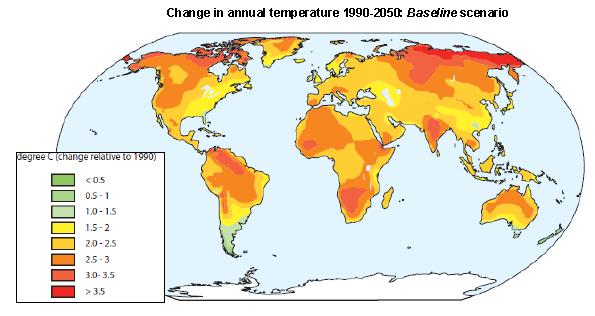
From Key Findings on Climate Change, THE OECD ENVIRONMENTAL OUTLOOK TO 2050 (forthcoming, 2012), Organization for Economic Cooperation and Development.

—————

“New figures from the U.N. weather agency Monday showed that the three biggest greenhouse gases not only reached record levels last year but were increasing at an ever-faster rate, despite efforts by many countries to reduce emissions.”

Seth Borenstein , Greenhouse gases soar; scientists see little chance of arresting global warming this century, Washington Post (Associated Press), November 21, 2011.

 —————

Primary sectors such as agriculture, forestry and fisheries will be affected more severely than others. The attraction of tourist destinations will change. … Ski resorts at low and medium altitude could be affected by reduced snow cover …The likelihood of the development of extreme weather conditions will affect the insurance industry, which will be forced to pass on the rising cost of damages to other economic sectors … Jobs will be created in companies that can take advantage of opportunities created by climate policies and jobs will be lost in companies that cannot adapt.

Climate Change and Employment, European Trade Union Confederation.

—————

About 1.3 billion people, or 40 percent of the economically active people worldwide, work in agriculture, fishing, forestry, and hunting or gathering.

Human Development Report 2011, United Nations Development Programme.


———————–Comments———————–

In recent decades, the world’s communities and working families have faced increasing employment and income instability as the pace of technological change and the pace of transnational capital transfers have increased.  More and more communities see whole industries come and go; more and more working families now cope with recurring periods of unemployment and underemployment; increasingly, working people find themselves having to negotiate major job transitions (many of which require investments in retraining and many of which result in lower wages and benefits); larger numbers of workers become trapped in long-term unemployment.

Climate change is adding to global employment and income instability through its impacts on the global distribution of investment opportunities and risks.  Primary impact is on climate sensitive industries (e.g., agriculture, fisheries, forestry, tourism, insurance, health care — in response to changing disease threats, emergency services).  Changing global weather patterns are transforming local and regional mixes of market opportunities, production and distribution costs, and risks to communities across the world.  Older business models and technologies are being modified or abandoned and replaced with different business models and new technologies, and the responsibilities assigned to governments and non-profit organizations are being transformed, as the consequences of climate change accumulate.

The contribution of climate change to global employment and income instability extends well beyond the most climate sensitive industries.  Weather is totalitarian: every aspect of our lives is affected to some degree by its patterns and changes, from housing codes to travel decisions, from clothing requirements to food choices, from health care requirements to leisure activity decisions.  Thus, as the consequences of climate change accumulate, we will make large and small changes to the way we live.

In some parts of the world, the changes made will be substantial and rapid, generating newsworthy investment and employment upheaval.  In other parts of the world they may be minor.  But even minor individual changes, when made in a short time span, can aggregate into a force that unsettles business opportunities and demands made on governments.

Recent evidence suggests that climate change is accelerating.  As it does, the consequences of climate change will accumulate more rapidly, awareness of the consequences will increase, and corporations and investors will accelerate their efforts to respond to consequences already felt and prepare for those just ahead.  Global employment and income instability will increase all the more.
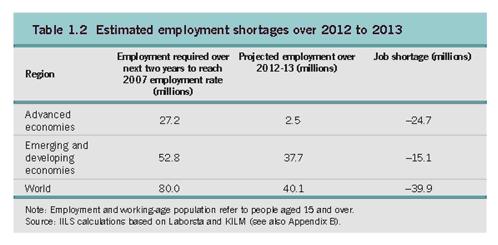
Overheated Global Competition Drives Job Growth Down

Estimated Job Shortage 2012-13

Table presented in World of Work Report 2011, International Labor Organization, October 31, 2011, Pg. 9.

—————

“Non-financial firms have increasingly invested in financial assets at the expense of physical assets. … This is particularly the case with firms in advanced economies, but in recent years, developing and emerging economies have started to exhibit similar trends. …   Empirical evidence shows that rising profitability in the financial sector has played an important role in drawing in investment from the non-financial sector towards the financial sector.”

World of Work Report 2011, ILO, October 31, 2011, pg. 41.

 —————

“The great thing about the new I.T. revolution, says Jeff Weiner, the C.E.O. of LinkedIn, is that ‘it makes it easier and cheaper than ever for anyone anywhere to be an entrepreneur’ and to have access to all the best infrastructure of innovation.”

Thomas Friedman, One Country, Two Revolutions, New York Times, October 22, 2011.

 —————

“… technology investments are playing an increasingly larger role in mid-market companies’ bottom line. Business process automation and technology improvements are the two top contributing factors to the jump in mid-market productivity; new hiring ranked fifth overall. …

“’Technology is on the mind of most mid-market executives,’ said McGee [Tom McGee, national managing partner, Deloitte Growth Enterprise Services, Deloitte LLP].  ‘ … 74 percent of respondents believe globalization is forcing U.S. companies to become more productive to stay competitive … and set themselves apart from the pack ‘”

Deloitte: Mid-Market Executives Increase Long-Term Investments Despite Economic Uncertainty, Deloitte Press Release, Oct. 10, 2011.

—————

“Despite representing only … 19 percent of employment [in 2007], multinational companies contributed 41 percent to overall productivity growth from 1990 to 2007.”

James Manyika et al, Growth and renewal in the United States: Retooling America’s economic engine, McKinsey Global Institute, February 2011.

—————

“His solution is to offer a new and altogether different kind of TV set, although in typical CEO fashion, he refuses to elaborate on what that might involve. He simply offers the assurance that a great deal of R&D investment is going into designing a new TV that could reverse Sony’s fortunes.”

Vlad Savov, Sony CEO Howard Stringer: Every TV set we make loses money, Washington Post (originally published in The Verge), Friday, November 11.

—————

“First, in a global economy, we need to be thinking more about the sources of apparent productivity growth. It matters greatly for wages and employment whether rising value-added per worker is being driven by domestic production improvements, supply chain efficiencies, or by productivity gains abroad. …

Second, government policies designed to increase incentives for business investment, such as accelerated expensing, may have the effect of increasing supply chain efficiency rather than domestic productivity. …

Third, we are effectively flying blind in terms of the effect of the global economy on US workers.”

Michael Mandel and Susan Houseman, Not all productivity gains are the same. Here’s why, What Matters, McKinsey & Company,  June 1, 2011.

———————–Comments———————–

The transformations in communications, transportation, transnational trade and investment flows, geopolitics, and access to advanced technologies that we summarize with the term globalization have greatly multiplied the number of businesses in every sector of the world economy competing for customers.

Moreover, companies are competing for a stagnant number of consumers and consumer dollars.   Although the buying power of working families is growing in the countries experiencing rapid economic growth (called the emerging economies), it is declining or barely growing in many of the advanced economies and in many other parts of the world.  This is greatly intensifying the competition among the worlds much larger number of competing business enterprises.

This environment of overheated competition puts enormous downward pressure on global job growth.  It drives the owners and managers of almost every business enterprise to pursue strategies that are good for the business but destructive to the world’s labor force much more aggressively than would be the case in an environment of moderated competitive pressures.  These strategies include:

  • Investments in financial assets as a way to park money that can’t be profitably invested in production of goods and services
  • Large investments in technologies that reduce work hours without reducing the capacity to meet existing customer demand
  • Large investments in product innovations designed to displace similar products rather than to create new products that meet new needs
  • Large investments in ad campaigns designed to lure current consumers to change consumption activities (e.g., switch from watching TV to playing video games)

The impact of these strategies on employment is fairly straight forward:

  • Profitable investment opportunities are in short supply, so money parked in financial assets is more likely to help generate financial bubbles than to generate new jobs
  • Productivity gains eliminate jobs when demand for products and services is not growing
  • Investments that only lure consumers to replace one product for another, to replace one consumer activity with another, and/or to buy the same product from a different company only move consumers around in the market place; the net effect on the labor force is job churning not job growth.

Overheated global competition will continue to do harm to global job growth until a global policy response creates a mechanism for market sharing and puts boundaries on the use of competitive strategies.  Without that response,  global rates of unemployment, underemployment, poverty, and political upheaval will continue to increase.  And the U.S. will not avoid sharing in these miseries.

The False Promise of September Auto Sales

“Mr. Toprak said more consumers also were showing up at dealerships because their current vehicle had outlived its useful life and they had no choice but to buy a replacement.”

Nick Bunkley, U.S. Vehicle Sales Soared Nearly 10% in September, Despite Economic Gloom, New York Times, October 3, 2011

—————

“But other factors boosted truck sales. Small businesses must eventually replace aging fleets of work trucks…”

Associated Press, US auto sales rise in September as consumers buck trends and buy trucks, Washington Post, October , 2011

—————

“Personal income decreased $7.3 billion, or 0.1 percent, and disposable personal income (DPI) decreased $5.0 billion, or less than 0.1 percent, in August …Real disposable income decreased 0.3 percent in August, compared with a decrease of 0.2 percent in July.”

Personal Income and Outlays: August 2011, New Release, Bureau of Economic Analysis, U.S. Department of Commerce, September 30, 2011

—————

“But the companies will be able to contain their costs by not paying annual raises to their U.S. factory workers and by hiring thousands of new workers at lower wage rates.”

Dee-Ann Durbin and Tom Krisher (Associated Press), Ford to pay workers $6,000 bonus, Lansing State Journal, Oct. 4, 2011

—————

“Retailers are coming to terms with a new reality: the consumer who traded down during the recession and never came back.”

Ann Zimmerman, Frontier of Frugality, Wall Street Journal, October 4, 2011

———————–Comments———————–

September’s jump in vehicle sales did not signal a change in the behaviors of global investors, corporations, and governments that currently translate consumer decisions into employment and income outcomes.  Global investment decisions still favor machines over workers and still favor nations with low wages, weak regulations, corruptible government officials and/or growing populations of people with disposable income.  Global economic growth is still slowing; employment opportunities are still disappearing; opportunities for investors and corporations to pit desperate nations and workers against each other in bidding wars for investments and jobs are increasing.

In this context, September’s jump in vehicle sales can’t be read as good news for U.S. working families and small business owners.  The economic benefits will be minimal and short lived.

Consumers and small businesses locked themselves into loan payments that reduce other spending: Auto sales were driven by frustrations with aging vehicles and other factors, not by income growth that had increased savings for down payments and created extra spending capacity to cover new loan payments.  It is thus very likely that tens of thousands of families and small businesses are now locked into years of new auto loan payments they can’t afford.  And global circumstances virtually insure that family incomes in the U.S. will stay flat or even decline over the next year.   Consumers and small businesses must either reduce spending on other items or take on more debt.

More debt, of course, means a larger share of income goes to loan payments.  Sooner or later, unless incomes rise enough to offset loan payments, consumer demand and business-to-business demand will fall.

With the holiday season coming, retailers may be the first to see sales losses as consumers cut back on optional spending so they can make auto loan payments.

Employment and income benefits for U.S. families are minimized by global supply chains and global wage and benefit inequalities: These days, “made in the U.S.” really means assembled in the U.S.  Many of the parts that become a finished vehicle here are produced outside the U.S.  Thus, a jump in U.S. auto sales generates job and income growth in other nations as well as in the U.S.  Moreover, the U.S. share of total job and income growth from auto sales declines over time.

Because of huge wage and benefit inequalities across nations the families in other nations that get income increases as a result of U.S. auto purchases will spent most of their extra income on goods and services produced in the U.S. — in the emerging economies (e.g., Brazil, Russia, India, China) where many high tech consumer and business goods are produced more cheaply than in the U.S. and in low wage nations that produce all the other consumer basics (blankets, dinner ware, clothing, etc.) that are mostly not produced in the U.S. (except when produced by U.S. crafts people and a select few U.S. companies that market to wealthy and status conscious consumers).

Interest on loans goes into bloated investment funds, and from there to other nations and into financial bubbles: In the early days of a loan, the part of a loan payment that goes to interest is typically at its highest.   Thus, for the immediate future, September vehicle sales will be pumping cash into the hands of bankers and other investors.  Under current global circumstances, this does not benefit U.S. families

It has become well known that U.S. corporations and investors are aggressively pursuing investment opportunities in parts of the world with growing populations of middle class consumers.  It is thus very likely that a large part of the loan payments on the new vehicles will generate jobs outside the U.S. and strengthen global competitors to smaller U.S. businesses.

Concern about the formation of new financial bubbles has been mounting because the investment world is flush with cash and a stagnant world economy has reduced the number of sound investment opportunities.  Pumping more cash into the investment world under these circumstances can only increase the risk that cash rich but profit-hungry investors will herd themselves into unsound investment trends.

More on Computers With Master’s Degrees and Accelerating Job Losses

“Six decades into the computer revolution, four decades since the invention of the microprocessor, and two decades into the rise of the modern Internet, all of the technology required to transform industries through software finally works and can be widely delivered at global scale.

Agriculture is increasingly powered by software as well, including satellite analysis of soils linked to per-acre seed selection software algorithms

Health care and education, in my view, are next up for fundamental software-based transformation

many people in the U.S. and around the world lack the education and skills … This problem is even worse than it looks because many workers in existing industries will be stranded on the wrong side of software-based disruption and may never be able to work in their fields again. ”

Marc Andreessen (Hewlett-Packard board member), Why Software Is Eating The World, Wall Street Journal, August 20, 2011

—————

“Robots have the potential to replace humans in a variety of applications with far-reaching implications. … The development and implementation of robots for elder-care applications, and the development of human-augmentation technologies, mean that robots could be working alongside humans in looking after and rehabilitating people. A change in domestic and social responsibilities and a change in domestic employment

SRI Consulting Business Intelligence requirements could adversely affect lower income service-oriented workers.

By 2025 Internet nodes may reside in everyday things—food packages, furniture, paper documents, and more. … Streamlining—or revolutionizing—supply chains and logistics could slash costs, increase efficiencies, and reduce dependence on human labor.”

Disruptive Civil Technologies: Six Technologies with Potential Impacts on US Interests out to 2025,  Conference Report, National Intelligence Council, April 2008

———————–Comments———————–

See comments in the Reconnaissance Report for August 19, 2011 (immediately below).

Computers With Master’s Degrees Will Accelerate Service Sector Job Losses And Increase The Need For Non-Work Income Entitlements

Not Today's Business Computer“ARMONK, N.Y., – 18 Aug 2011: Today, IBM (NYSE: IBM) researchers unveiled a new generation of experimental computer chips designed to emulate the brain’s abilities for perception, action and cognition … cognitive computers are expected to learn through experiences, find correlations, create hypotheses, and remember – and learn from – the outcomes, mimicking the brains structural and synaptic plasticity.

IBM Unveils Cognitive Computing Chips, Press Release, IBM, August 18, 2011.

—————

“IBM sees multiple applications for these cognitive computing systems, which would fit in the size of a shoebox. Among potential uses:

  • Computers that could take in inputs such as texture, smell and feel to gauge whether food was outdated.
  • Financial applications to monitor trading and recognize patterns in a way today’s algorithms can’t.
  • Traffic monitoring.
  • And system monitoring for waterways and other natural resources.”

Larry Dignan, IBM creates cognitive semiconductors: A step toward right brain computers, ZDNet Blog Between the Lines, August 17, 2011.

—————

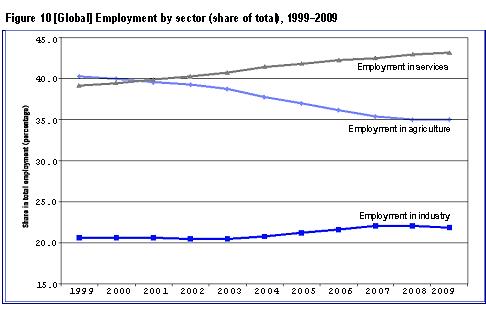
Global Employment By Sector, 1999-2009
Source: Global Employment Trends 2011, International Labor Org., p. 20

—————

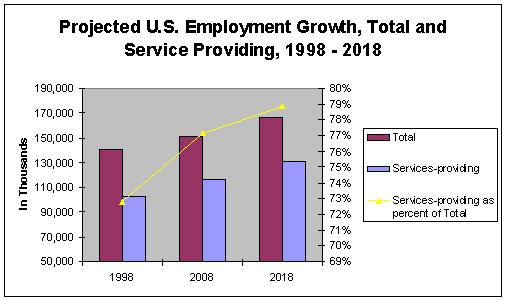
U.S. Employment Projections to 2018
Data Source: Rose A. Woods, Employment outlook: 2008–2018: Industry output and employment projections to 2018, Monthly Labor Review, November 2009.

———————–Comments———————–

The barriers to replacing intellectual and professional workers with machines are rapidly falling.  Already, computers are taking over customer service communications, digital archive research, teaching responsibilities, aspects of legal research, stock market trading, and other information gathering, information evaluation, and decision-making activities. With new computational technologies moving into the world’s workplaces almost everyday, the pace at which intellectual and professional work activities are being turned over to computers is accelerating.

The impact of this trend on global and U.S. employment can only be negative.  In every field of business, the world is crowded with competitors and the global rules governing competition are minimal and poorly enforced.  In this environment, no business leader can risk not looking at every new computational technology as a possible way to reduce labor costs faster than do competitors.

A very large proportion of the jobs that involve observation, evaluation, and decision-making activities are in service providing industries, including government, so the largest part of the negative employment impact of the accelerating use of computational technologies that emulate aspects of human thinking will be in this sector.  But the overall impact will be much greater.

Neither the agricultural sector, which is rapidly losing workers to automation, nor the industrial sector, which is already highly automated, will be able to absorb the very large numbers of workers likely to be displaced from service sector jobs.  Unemployment and underemployment will rise, and as they do non-work entitlements to income will have to play a much larger role in distributing the wealth created by the enormous and growing productive power of the world economy.

Otherwise, the future will be tragic.  The proportion of the world’s people living in poverty will increase, morbidity and preventable deaths will rise, the growth of the world’s middle class population will stagnate, and political upheavals and brutal governmental repressions will grow more numerous.

Policies of U.S. States Have Negligible Impact on Employment Growth

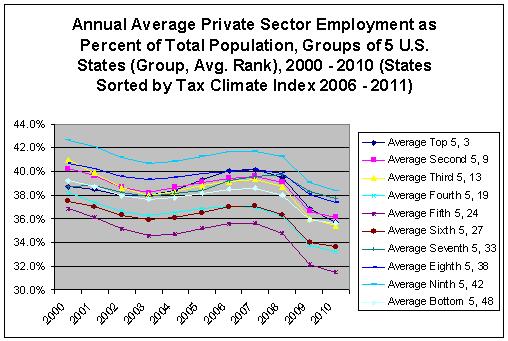
State Groups by Tax Rank
Data Sources: U.S. Bureau of Labor Statistics, U.S. Census, Tax Foundation.
States Top % By Tax Rank
Data Sources: U.S. Bureau of Labor Statistics, U.S. Census, Tax Foundation.
States Bottom 5 By Tax Rank
Data Sources: U.S. Bureau of Labor Statistics, U.S. Census, Tax Foundation.

Annual Change in Distribution of Percents of State Populations That Are Employed

2000 2001 2002 2003 2004 2005
Range 15.6% 14.5% 13.9% 14.0% 14.1% 14.5%
Minimum 30.9% 31.3% 30.9% 30.5% 30.6% 30.7%
Maximum 46.4% 45.8% 44.9% 44.5% 44.7% 45.2%
         
2006 2007 2008 2009 2010
Range 14.4% 14.3% 14.8% 16.0% 15.6%
Minimum 31.1% 31.1% 30.6% 28.7% 28.3%
Maximum 45.5% 45.4% 45.4% 44.6% 44.0%

———————–Comments———————–

What is striking in the first chart above (employment change for groups of states defined by Tax Climate Ranking) is that the patterns of change are so similar across the groups.  One might easily imagine the changes are choreographed.

This much unity of change is not consistent with the oft stated assertion that state policies have a large impact on state level employment change.  It is much more consistent with the proposition that state level employment change is driven primarily by economic forces that transcend state boundaries.

This interpretation is supported by variations within Tax Climate Ranking groups (second and third charts).  If state economic policies produced large employment effects, one would expect states with very different Tax Climate Rankings to proceed along visibly different employment change paths, while states with similar Tax Climate Rankings would proceed along similar employment change paths.  This isn’t the case.

The differences among the patterns of change for the closely ranked top ten states and among the patterns of change for the closely ranked bottom ten states appear to be greater than the differences among the patterns of change for groups of states.

Other employment change charts using the same formats  (not included here) display very similar patterns.  Again, patterns of change across groups are very similar  and differences within groups are as large as differences across groups.

For those charts the same employment change data were sorted differently.  One set of charts displays patterns of change for ten groups created by sorting the employment change data on percent of total population employed in 2000 (on the assumption that different initial employment levels might correspond to different policy histories and thus produce divergent change patterns).  The second set displays patterns for groups created by sorting the data on change in the percent of total population employed from 2000 to 2010 (on the assumption that differences among states in how well they performed over the decade might reflect policy differences other than Tax Climate that would produce noticeable differences in patterns of change).

The last item above, the table showing the distribution of percents of state populations employed,  offers more evidence that state employment levels change in unison.  Over the course of the decade the highest percent of population employed and the lowest percent change together, producing an almost constant range between highest to lowest.  Again, this is much more in keeping with conclusion that economic forces that transcend states in scope, not state policies, drive employment change at the state level.

A Plausible Explanation

It would be very surprising to find policy differences across states large enough to produce large differences in patterns of employment growth.

First, the states are part of a national governmental system in which constitutional provisions limit the policy options available to states, state governments are very similarly organized, and policy makers generally agree on the beneficence of the free enterprise system.  These factors inhibit the development of large policy differences among states.

Second, when a state enacts a policy or set of policies that seem to provide it with investment and employment growth advantages over other states, those other states adopt those or similar policies very quickly.  Thus, large policy differences will not persist.

Third, U.S. states are exposed to economic forces that are global in scope.  Global financial and production corporations move large volumes of money and commodities  across state and national boundaries.  So do many local businesses.  Ownership often transcends state and national boundaries.   States are subject to the policy rules of numerous  bilateral and multilateral trade and investment agreements entered into by the U.S.

These global economic forces are certainly powerful enough to overwhelm the effects of policies limited in scope to state boundaries and to wash away the employment change differences among states that policy differences might otherwise produce.

Global Technology and Education Trends Increase Global Competition for High End U.S. Jobs

“Taiwanese contract manufacturer Hon Hai Precision Industry Co. (2317.TW) said Tuesday it…plans to increase the use of robotic arms across its production lines to cope with rising demand for electronics and increasing costs…Hon Hai aims to increase robotic arms to 1 million units by 2013 from 10,000 currently…Hon Hai plans to increase automation on “dangerous and monotonous” tasks and to migrate more of its workers to “value-added” jobs such as product research and development.”

Lorraine Luk, Hon Hai Says To Increase Automation But Will Also Boost Work Force, Dow Jones Newswires, August 02, 201, published at FoxBusines,

“In 1998…Chinese universities and colleges produced 830,000 graduates a year. Last May, that number was more than six million and rising…the supply of those trained in accounting, finance and computer programming now seems limitless, and their value has plunged. Between 2003 and 2009…starting pay for college graduates stayed the same, although their wages actually decreased if inflation is taken into account.”

Andrew Jacobs, China’s Army of Graduates Struggles for Jobs, New York Times, December 11, 2010

“…among citizens between the ages of 25 and 34 in developed countries, America ranked 12th [for percentage of 25- to 34-year-olds with an Associate Degree or higher, 2007]. In this key demographic group, Canada, Korea, the Russian Federation, Japan, New Zealand, Ireland, Norway, Israel, France, Belgium and Australia are ahead of the United States. Also, Denmark and Sweden are close to parity with our nation.”

John Michael Lee, Jr. and Anita Rawls, The College Completion Agenda: 2010 Progress Report, CollegeBoard Advocacy and Policy Center,

“The world, in terms of choices available to educated, ambitious workers and entrepreneurs, is way bigger than just the United States, Japan and Europe.”

Paul Singer, founder of Elliot Management, as quoted in The Economic Manifesto of Elliott’s Paul Singer, By Evelyn M. Rusli and Azam Ahmed.

‘American jobs have been moving overseas for more than two decades. In recent years, though, those jobs have become more sophisticated — think semiconductors and software, not toys and clothes…[quoting Jeffrey Sachs, globalization expert and economist at Columbia University:] “What’s changed is that companies today are getting top talent in emerging economies, and the U.S. has to really watch out.”‘

Pallavi Gogoi, Many U.S. companies are hiring … overseas: One reason why U.S. unemployment remains as high as it is, Associated Press, 12/28/2010, published at MSNBC.

———————–Comments———————–

The U.S. is not alone in the world in the pursuit of high end jobs to grow middle class incomes and not likely to be successful enough in that endeavor to revitalize U.S middle class income growth.  The following global trends are moving strongly against high end job growth in the U.S. and the U.S. economic policy approach does not address these trends.

  • Rapid automation of production processes across the globe is increasing citizen pressure on the world’s governments to train more and more workers for high end jobs
  • Competition among the world’s numerous nations for investments that create high end jobs is intensifying as global employment growth stagnates
  • Expanding global investments in higher education are increasing competition among highly educated workers for an insufficient number of high end jobs
  • U.S.  corporations are taking advantage of the growing number of nations with educated workers to bargain with highly educated U.S. workers for wages and benefits concessions.

U.S. Private Sector Investment Strategies Do Not Favor U.S. Employment Growth

“At GE, our success is predicated on accurately assessing the dynamic forces that are reshaping our world and having a strategy in place to make the most of the opportunities they present.”

Our Viewpoints, GE Website

“International revenues from Industrial (ex NBCU) were $13.4 billion, up 23% representing 59% of total Industrial revenues. GE revenue for the Industrial segments accelerated in growth regions, including double-digit increases in India, China, Southeast Asia, Africa, Russia, Australia, Canada, and Latin America.”

GE Corporation Press Release, July 22, 2011, GE Website

According to a Fox Business story, GE had a worldwide workforce of 287,000 at the end of 2010, of which the U.S. share was 133,000.

Bob Sechler, GE’s Worldwide Workforce Down 5.6% In 2010 At 287,000, February 25, 2011, Dow Jones Newswires.

———————–Comments———————–

Burdening the U.S. private sector with creating enough job growth to achieve something close to the frictional rate of unemployment (unemployment due mainly to brief periods of unemployment between jobs) is misguided in the current world economic context.

First, U.S. corporations are legally required to pursue the investment strategies that best serve their stockholders.  Many more opportunities for profitable investments in facilities and workforces are emerging in other parts of the world than in the U.S.

Second, neither U.S. corporations nor other U.S. businesses are legally required to create jobs for U.S. workers, except to the extent they have entered into contractual agreements to do so.

Private sector job growth must be supplemented by government programs to produce public sector jobs and/or to reduce demand for jobs by engaging potential workers in paid alternatives to private sector employment.  Such activities might include paid educational leaves, paid parental leaves for up to a year, career change leaves, longer annual vacations, etc.

Only by creating such a combination of socially recognized entitlements to income can we restore the U.S. middle class to good financial health and again produce success in reducing the number of Americans living in poverty.

Global Investments in Agriculture Technologies and Growing Demand for Paid Work

Today, a single person driving a huge $400,000 combine, burning 200 gallons of fuel daily, guided by computers and GPS satellite navigation, can cover 20 acres an hour, and harvest 8,000 to 10,000 bushels of wheat in a single day.”

 Christian Parenti, Reading the World In a Loaf of Bread: Soaring Food Prices, Wild Weather, Upheaval, and a Planetful of Trouble.

“MOLINE, Illinois (May 18, 2011)  – Deere & Company said today it will build a new manufacturing facility in northeast China to support the increased demand for large agricultural products in the region. The factory will build mid- and large-sized tractors, sprayers, planters and harvesting equipment. Deere said its initial outlay for the project is approximately $80 million.”

John Deere Press Release, May 18, 2011.

“All business is local. To understand and respond to our many customers’ needs and requirements worldwide, we must live where they live. Work where they work. That’s why John Deere reaches out across the world with factories, offices and other facilities in more than 30 countries…”

John Deere web page, Worldwide Locations http://www.deere.com/wps/dcom/en_US/corporate/our_company/about_us/worldwide_locations/worldwidelocations.page?%09%09%20%09

———————–

Displacement of families from agricultural lands by agricultural businesses with machines has long been a key driver of the demand for jobs in cities and suburbs, and continues to be in some areas of the world.  Agricultural workers, often non-paid family workers, whose work is taken over by machines migrate to cities and seek jobs in the manufacturing, service, and government sectors.  From growing food and feeding themselves, families on agricultural lands become dependent on jobs for the money to buy food produced by the remaining few workers on factory farms.  Without jobs, they become dependent on public and private handouts.

Despite the world’s need to produce more and more food for a population projected to reach 10 billion by 2100, agriculture will not offer more job opportunities.  Instead, the world’s agricultural regions will send even more millions to cities in search of paid work.

Economists Discover Consumer Demand Problem. It’s About Time!

“The main reason U.S. companies are reluctant to step up hiring is scant demand, rather than uncertainty over government policies, according to a majority of economists in a new Wall Street Journal survey.”

Phil Izzo, Dearth of Demand Seen Behind Weak Hiring, Wall Street Journal, July 18, 2011

(See my post on July 14 for an estimate prepared by Moody’s Analytics of the dollars that will be drained from U.S. consumer demand by the end of this year because of changes in government programs.)

The political fight over the deficit is off target.  The political fight over the size of government is off target.  The traditional public-private system for equitably distributing the wealth we produce (a substantial level of high wage private sector employment supplemented by government employment and targeted income entitlements) is badly broken because the private sector can’t create enough jobs, much less enough quality jobs for the old system to work.

Given investment trends now at work in the world economy, and given the weakness of the labor movement, the U.S. private sector will necessarily play a much smaller role in equitably and rationally distributing the vast amount of wealth produced in the U.S. every year than it did in the past.   It will not produce enough jobs and high enough earnings to do the wealth distribution job that must be done.

Government will have to play a bigger role or we will have to give up a lot more economic security and wellbeing than we already have.