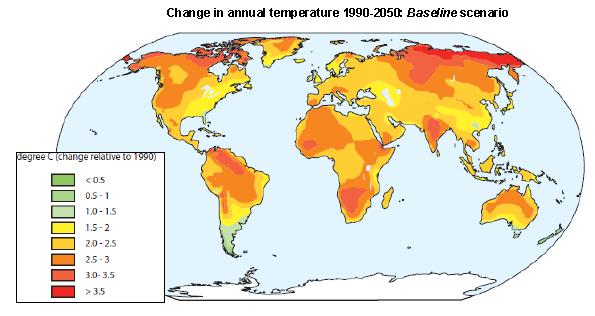
Climate Change Is Increasing Global Employment and Income Instability

From Key Findings on Climate Change, THE OECD ENVIRONMENTAL OUTLOOK TO 2050 (forthcoming, 2012), Organization for Economic Cooperation and Development.

—————

“New figures from the U.N. weather agency Monday showed that the three biggest greenhouse gases not only reached record levels last year but were increasing at an ever-faster rate, despite efforts by many countries to reduce emissions.”

Seth Borenstein , Greenhouse gases soar; scientists see little chance of arresting global warming this century, Washington Post (Associated Press), November 21, 2011.

 —————

Primary sectors such as agriculture, forestry and fisheries will be affected more severely than others. The attraction of tourist destinations will change. … Ski resorts at low and medium altitude could be affected by reduced snow cover …The likelihood of the development of extreme weather conditions will affect the insurance industry, which will be forced to pass on the rising cost of damages to other economic sectors … Jobs will be created in companies that can take advantage of opportunities created by climate policies and jobs will be lost in companies that cannot adapt.

Climate Change and Employment, European Trade Union Confederation.

—————

About 1.3 billion people, or 40 percent of the economically active people worldwide, work in agriculture, fishing, forestry, and hunting or gathering.

Human Development Report 2011, United Nations Development Programme.


———————–Comments———————–

In recent decades, the world’s communities and working families have faced increasing employment and income instability as the pace of technological change and the pace of transnational capital transfers have increased.  More and more communities see whole industries come and go; more and more working families now cope with recurring periods of unemployment and underemployment; increasingly, working people find themselves having to negotiate major job transitions (many of which require investments in retraining and many of which result in lower wages and benefits); larger numbers of workers become trapped in long-term unemployment.

Climate change is adding to global employment and income instability through its impacts on the global distribution of investment opportunities and risks.  Primary impact is on climate sensitive industries (e.g., agriculture, fisheries, forestry, tourism, insurance, health care — in response to changing disease threats, emergency services).  Changing global weather patterns are transforming local and regional mixes of market opportunities, production and distribution costs, and risks to communities across the world.  Older business models and technologies are being modified or abandoned and replaced with different business models and new technologies, and the responsibilities assigned to governments and non-profit organizations are being transformed, as the consequences of climate change accumulate.

The contribution of climate change to global employment and income instability extends well beyond the most climate sensitive industries.  Weather is totalitarian: every aspect of our lives is affected to some degree by its patterns and changes, from housing codes to travel decisions, from clothing requirements to food choices, from health care requirements to leisure activity decisions.  Thus, as the consequences of climate change accumulate, we will make large and small changes to the way we live.

In some parts of the world, the changes made will be substantial and rapid, generating newsworthy investment and employment upheaval.  In other parts of the world they may be minor.  But even minor individual changes, when made in a short time span, can aggregate into a force that unsettles business opportunities and demands made on governments.

Recent evidence suggests that climate change is accelerating.  As it does, the consequences of climate change will accumulate more rapidly, awareness of the consequences will increase, and corporations and investors will accelerate their efforts to respond to consequences already felt and prepare for those just ahead.  Global employment and income instability will increase all the more.

The False Promise of September Auto Sales

“Mr. Toprak said more consumers also were showing up at dealerships because their current vehicle had outlived its useful life and they had no choice but to buy a replacement.”

Nick Bunkley, U.S. Vehicle Sales Soared Nearly 10% in September, Despite Economic Gloom, New York Times, October 3, 2011

—————

“But other factors boosted truck sales. Small businesses must eventually replace aging fleets of work trucks…”

Associated Press, US auto sales rise in September as consumers buck trends and buy trucks, Washington Post, October , 2011

—————

“Personal income decreased $7.3 billion, or 0.1 percent, and disposable personal income (DPI) decreased $5.0 billion, or less than 0.1 percent, in August …Real disposable income decreased 0.3 percent in August, compared with a decrease of 0.2 percent in July.”

Personal Income and Outlays: August 2011, New Release, Bureau of Economic Analysis, U.S. Department of Commerce, September 30, 2011

—————

“But the companies will be able to contain their costs by not paying annual raises to their U.S. factory workers and by hiring thousands of new workers at lower wage rates.”

Dee-Ann Durbin and Tom Krisher (Associated Press), Ford to pay workers $6,000 bonus, Lansing State Journal, Oct. 4, 2011

—————

“Retailers are coming to terms with a new reality: the consumer who traded down during the recession and never came back.”

Ann Zimmerman, Frontier of Frugality, Wall Street Journal, October 4, 2011

———————–Comments———————–

September’s jump in vehicle sales did not signal a change in the behaviors of global investors, corporations, and governments that currently translate consumer decisions into employment and income outcomes.  Global investment decisions still favor machines over workers and still favor nations with low wages, weak regulations, corruptible government officials and/or growing populations of people with disposable income.  Global economic growth is still slowing; employment opportunities are still disappearing; opportunities for investors and corporations to pit desperate nations and workers against each other in bidding wars for investments and jobs are increasing.

In this context, September’s jump in vehicle sales can’t be read as good news for U.S. working families and small business owners.  The economic benefits will be minimal and short lived.

Consumers and small businesses locked themselves into loan payments that reduce other spending: Auto sales were driven by frustrations with aging vehicles and other factors, not by income growth that had increased savings for down payments and created extra spending capacity to cover new loan payments.  It is thus very likely that tens of thousands of families and small businesses are now locked into years of new auto loan payments they can’t afford.  And global circumstances virtually insure that family incomes in the U.S. will stay flat or even decline over the next year.   Consumers and small businesses must either reduce spending on other items or take on more debt.

More debt, of course, means a larger share of income goes to loan payments.  Sooner or later, unless incomes rise enough to offset loan payments, consumer demand and business-to-business demand will fall.

With the holiday season coming, retailers may be the first to see sales losses as consumers cut back on optional spending so they can make auto loan payments.

Employment and income benefits for U.S. families are minimized by global supply chains and global wage and benefit inequalities: These days, “made in the U.S.” really means assembled in the U.S.  Many of the parts that become a finished vehicle here are produced outside the U.S.  Thus, a jump in U.S. auto sales generates job and income growth in other nations as well as in the U.S.  Moreover, the U.S. share of total job and income growth from auto sales declines over time.

Because of huge wage and benefit inequalities across nations the families in other nations that get income increases as a result of U.S. auto purchases will spent most of their extra income on goods and services produced in the U.S. — in the emerging economies (e.g., Brazil, Russia, India, China) where many high tech consumer and business goods are produced more cheaply than in the U.S. and in low wage nations that produce all the other consumer basics (blankets, dinner ware, clothing, etc.) that are mostly not produced in the U.S. (except when produced by U.S. crafts people and a select few U.S. companies that market to wealthy and status conscious consumers).

Interest on loans goes into bloated investment funds, and from there to other nations and into financial bubbles: In the early days of a loan, the part of a loan payment that goes to interest is typically at its highest.   Thus, for the immediate future, September vehicle sales will be pumping cash into the hands of bankers and other investors.  Under current global circumstances, this does not benefit U.S. families

It has become well known that U.S. corporations and investors are aggressively pursuing investment opportunities in parts of the world with growing populations of middle class consumers.  It is thus very likely that a large part of the loan payments on the new vehicles will generate jobs outside the U.S. and strengthen global competitors to smaller U.S. businesses.

Concern about the formation of new financial bubbles has been mounting because the investment world is flush with cash and a stagnant world economy has reduced the number of sound investment opportunities.  Pumping more cash into the investment world under these circumstances can only increase the risk that cash rich but profit-hungry investors will herd themselves into unsound investment trends.

Scientists Map Key Component of World Economy

“We present the first investigation of the architecture of the international ownership network, along with the computation of the control held by each global player. We find that transnational corporations form a giant bow-tie structure and that a large portion of control flows to a small tightly-knit core of financial institutions. This core can be seen as an economic “super-entity” that raises new important issues both for researchers and policy makers. [from the abstract]

Remarkably, the existence of such a core in the global market was never documented before and thus, so far, no scientific study demonstrates or excludes that this international “super-entity” has ever acted as a bloc. However, some examples suggest that this is not an unlikely scenario. For instance, previous studies have shown how even small cross-shareholding structures, at a national level, can affect market competition in sectors such as airline, automobile and steel, as well as the financial one.”

Stefania Vitali, James B. Glattfelder, Stefano Battiston, The network of global corporate control, arXiv.org, July 2011

—————

“‘This is empirical evidence of what’s been understood anecdotally for years,’ says information theorist Brandy Aven of the Tepper School of Business at Carnegie Mellon in Pittsburgh.”

Rachel Ehrenberg,  Financial world dominated by a few deep pockets, ScienceNews, September 24th, 2011; Vol.180 #7 (p. 13)

———————–Comments———————–

This study does not show that the allocation of investments that create employment opportunities for the world’s people is managed almost exclusively for the benefit of the members of this super-entity and their managerial minions and political allies.

It does not show that this super-entity uses its power to pressure governments around the world, including U.S. federal and state governments, to implement policies that are not in the best interests of the people who must live under and with the policies of those governments.

It does show that there is an entity with the power to do such things.

Note: the study examined relationships among 43,000 transnational corporations and 600,508 economic actors connected by more than a million ownership ties.

Global Technology and Education Trends Increase Global Competition for High End U.S. Jobs

“Taiwanese contract manufacturer Hon Hai Precision Industry Co. (2317.TW) said Tuesday it…plans to increase the use of robotic arms across its production lines to cope with rising demand for electronics and increasing costs…Hon Hai aims to increase robotic arms to 1 million units by 2013 from 10,000 currently…Hon Hai plans to increase automation on “dangerous and monotonous” tasks and to migrate more of its workers to “value-added” jobs such as product research and development.”

Lorraine Luk, Hon Hai Says To Increase Automation But Will Also Boost Work Force, Dow Jones Newswires, August 02, 201, published at FoxBusines,

“In 1998…Chinese universities and colleges produced 830,000 graduates a year. Last May, that number was more than six million and rising…the supply of those trained in accounting, finance and computer programming now seems limitless, and their value has plunged. Between 2003 and 2009…starting pay for college graduates stayed the same, although their wages actually decreased if inflation is taken into account.”

Andrew Jacobs, China’s Army of Graduates Struggles for Jobs, New York Times, December 11, 2010

“…among citizens between the ages of 25 and 34 in developed countries, America ranked 12th [for percentage of 25- to 34-year-olds with an Associate Degree or higher, 2007]. In this key demographic group, Canada, Korea, the Russian Federation, Japan, New Zealand, Ireland, Norway, Israel, France, Belgium and Australia are ahead of the United States. Also, Denmark and Sweden are close to parity with our nation.”

John Michael Lee, Jr. and Anita Rawls, The College Completion Agenda: 2010 Progress Report, CollegeBoard Advocacy and Policy Center,

“The world, in terms of choices available to educated, ambitious workers and entrepreneurs, is way bigger than just the United States, Japan and Europe.”

Paul Singer, founder of Elliot Management, as quoted in The Economic Manifesto of Elliott’s Paul Singer, By Evelyn M. Rusli and Azam Ahmed.

‘American jobs have been moving overseas for more than two decades. In recent years, though, those jobs have become more sophisticated — think semiconductors and software, not toys and clothes…[quoting Jeffrey Sachs, globalization expert and economist at Columbia University:] “What’s changed is that companies today are getting top talent in emerging economies, and the U.S. has to really watch out.”‘

Pallavi Gogoi, Many U.S. companies are hiring … overseas: One reason why U.S. unemployment remains as high as it is, Associated Press, 12/28/2010, published at MSNBC.

———————–Comments———————–

The U.S. is not alone in the world in the pursuit of high end jobs to grow middle class incomes and not likely to be successful enough in that endeavor to revitalize U.S middle class income growth.  The following global trends are moving strongly against high end job growth in the U.S. and the U.S. economic policy approach does not address these trends.

  • Rapid automation of production processes across the globe is increasing citizen pressure on the world’s governments to train more and more workers for high end jobs
  • Competition among the world’s numerous nations for investments that create high end jobs is intensifying as global employment growth stagnates
  • Expanding global investments in higher education are increasing competition among highly educated workers for an insufficient number of high end jobs
  • U.S.  corporations are taking advantage of the growing number of nations with educated workers to bargain with highly educated U.S. workers for wages and benefits concessions.

Pending Trade Pacts Will Continue the Downward Trends in Number and Quality of U.S. Jobs

Pending U.S. – South Korea Trade Agreement

“Most strikingly, KORUS will open Korea’s service market to U.S. exports, allowing the United States to exploit its competitive advantages in financial services, education and information and communications technologies.

The agreement also will lead to increased imports from Korea, which in turn will help the United States achieve greater economic specialization. The likely effects of more specialization—and of increased Korean investment in the United States—include greater U.S. efficiency, productivity, economic growth and job growth. Meanwhile, U.S. investors will gain new opportunities in the increasingly active Asia-Pacific region.

KORUS supports market access for U.S. investors with investment protection provisions, strong intellectual property protection, dispute settlement provisions, a requirement for transparently developed and implemented investment regulations and a similar requirement for open, fair and impartial judicial proceedings.”

Pending U.S. – Columbia Trade Agreement

“COL-US improves the investment climate in Colombia by providing investor protections, access to international arbitration and improved transparency in the country’s legislative and regulatory processes. These provisions will reduce investment risk and uncertainty.

With considerable investments, Colombia would be able to compete with East Asia for these higher quality jobs, swaying people away from black markets and other illicit activities.”

Pending U.S. – Panama Trade Agreement

“Panama’s $21 billion services market for U.S. firms offering portfolio management, insurance, telecommunications, computer, distribution, express delivery, energy, environmental, legal and other professional services.

A fair legal framework, investor protections and a dispute settlement mechanism, all features of the PFTA, are almost certain to increase U.S. investments in Panama.”

All quotes from Mauricio Cárdenas and Joshua Meltzer, Korea, Colombia, Panama: Pending Trade Accords Offer Economic and Strategic Gains for the United States, Policy Brief Series, # 183, The Brookings Institution, July 2011.

———————–Comments———————–

About improved investment climates.  These agreements add three more places in the world where U.S. corporations can invest with confidence.  U.S. banks, mutual funds, and other financial institutions will find it easier to use the money in our savings accounts and retirement funds to expand economic activities and create jobs outside the U.S.

By some estimates, U.S. corporations are sitting on about $2 trillion in cash and banks have returned to profitability, so a lot of money is sitting idle, waiting for profitable investment opportunities.  Economists have noted that there is considerable evidence that the growth of consumer demand is too anemic in the U.S. to spur much investment here, so the investment eye is on the emerging markets of the world where real incomes and consumer demand are growing.

About increased access to service sector markets.  The list of U.S. industries that will benefit include industries that are critical to increasing a nations competitive position in the world economy, and thereby nourish economic growth and enterprise profitability.  Thus, expansion of service sector sales will complement U.S. capital investment in South Korea, Columbia, and Panama, helping to insure the profitability of both U.S. and local investments and thus helping to insure that competitiveness and job growth increase in those nations.

About increased economic specialization in the U.S.  The impact of increased economic specialization on jobs in the U.S. will be a further narrowing of the base of industries and thus a further narrowing of the range of jobs available to U.S. citizens.  This means more workers will have to go through the emotionally painful, family disrupting, and financially costly process of being displaced and retrained for other work because their existing skills are no longer needed.

The record for career displacement and re-employment in a new industry is not good.  Far too many of the new jobs displaced workers end up with pay less and offer lower value in benefits.  Incomes and family welfare decline.

Likely Impact on Global Job Growth. Under existing global conditions of increasing numbers of competing businesses and stalled expansion of global consumer demand, large parts of the new investments to be facilitated by these trade pacts will very likely go into labor saving production, distribution, and management technologies.

Global productivity will increase, so jobs gained in South Korea, Columbia, and Panama will not be greater than the jobs lost in those nations from which South Korea, Columbia, and Panama win market shares.  More likely, the net effect on global employment will be negative.

Likely Impact on U.S. Jobs and Income.  Although jobs will be added in select U.S. industries, and thus in limited parts of the U.S., the net effect will be negative because profitability in sectors of the U.S. economy that have to contend with stronger competition from South Korea, Columbia, and Panama (and all the other nations where U.S. capital is nourishing productivity growth) will decline.  Investment in those sectors will further decline in response, putting more people out of work.

More people competing for work globally and more Americans competing for jobs in the U.S. can only put more downward pressure on U.S. wage and benefit levels.

Tax Cuts, Stimulus Spending, Low Interest Rates Do Little to Create Jobs

“In carrying out its QE2 purchases, the Fed had to follow standard operating procedure for “open market operations”: it took secret bids from the 20 “primary dealers”authorized to sell securities to the Fed and accepted the best offers. The problem was that 12 of these dealers — or over half — are U.S.-based branches of foreign banks (including BNP Paribas, Barclays, Credit Suisse, Deutsche Bank, HSBC, UBS and others), and they evidently won the bids.

…According to Scott Fullwiler, Associate Professor of Economics at Wartburg College, the money multiplier model is not just broken but obsolete.”

Ellen Brown, Why QE2 Failed: The Money All Went Overseas,  Huffington Post, July 11, 2011,

In the past 60 years, job growth has actually been greater in years when the top income tax rate was much higher than it is now. … in years when the top marginal rate was more than 90 percent, the average annual growth in total payroll employment was 2 percent. In years when the top marginal rate was 35 percent or less—which it is now—employment grew by an average of just 0.4 percent. … if you ranked each year since 1950 by overall job growth, the top five years would all boast marginal tax rates at 70 percent or higher. The top 10 years would share marginal tax rates at 50 percent or higher.

Michael Linden, Rich People’s Taxes Have Little to Do with Job Creation, Center for American Progress, June 27, 2011,

“Of particular note, we find that fiscal policy is less effective in lifting recovery growth in more open economies. In open economies, fiscal stimulus may spill over to higher growth in partner countries by increasing demand for imported foreign goods and services. This finding suggests the need for more coordination in fiscal stimulus across countries, so that the spillover to other countries is offset by equivalent increases in foreign demand for domestic goods and services.”

Cerra, Valerie, Ugo Panizza, and Sweta C. Saxena, International Evidence on Recovery from Recessions, Working Paper, International Monetary Fund, 2009.

———————–Comments———————–

In the current U.S. open economy environment (put into place over decades of pro-globalization policy shifts) neither larger tax cuts for consumers nor larger tax cuts for corporations nor lower taxes for the wealthiest Americans nor Federal Reserve actions to lower borrowing costs for banking institutions have had the positive U.S. job growth effects we desire.  Millions of working people are unemployed and most U.S. families are experiencing either stagnant income levels or falling incomes.

  • Consumers do buy more with their tax cuts, but a large part of the job creation effect goes to other parts of the world because so much of what we consume is imported
  • Banks do increase their lending, but a large part of the lending is used to finance projects outside the U.S.
  • The corporations do use their tax breaks to increase investments in new plants and facilities, but an increasingly large part of those investments go into emerging market areas of the world
  • Wealthier Americans do use tax savings to increase stock holdings, and thus contribute to the pool of investment funds, but more and more the wealthy purchase stocks in corporations that are expanding operations in emerging markets because that is where the highest returns are being obtained.

U.S. job creation and income distribution policies are out of date.  They were designed for the affluent manufacturing nations operating in the much less economically integrated world of the mid twentieth century.  Major changes in the U.S. policy approach to creating jobs and distributing income will be required to put things right for U.S. families.

U.S. Private Sector Investment Strategies Do Not Favor U.S. Employment Growth

“At GE, our success is predicated on accurately assessing the dynamic forces that are reshaping our world and having a strategy in place to make the most of the opportunities they present.”

Our Viewpoints, GE Website

“International revenues from Industrial (ex NBCU) were $13.4 billion, up 23% representing 59% of total Industrial revenues. GE revenue for the Industrial segments accelerated in growth regions, including double-digit increases in India, China, Southeast Asia, Africa, Russia, Australia, Canada, and Latin America.”

GE Corporation Press Release, July 22, 2011, GE Website

According to a Fox Business story, GE had a worldwide workforce of 287,000 at the end of 2010, of which the U.S. share was 133,000.

Bob Sechler, GE’s Worldwide Workforce Down 5.6% In 2010 At 287,000, February 25, 2011, Dow Jones Newswires.

———————–Comments———————–

Burdening the U.S. private sector with creating enough job growth to achieve something close to the frictional rate of unemployment (unemployment due mainly to brief periods of unemployment between jobs) is misguided in the current world economic context.

First, U.S. corporations are legally required to pursue the investment strategies that best serve their stockholders.  Many more opportunities for profitable investments in facilities and workforces are emerging in other parts of the world than in the U.S.

Second, neither U.S. corporations nor other U.S. businesses are legally required to create jobs for U.S. workers, except to the extent they have entered into contractual agreements to do so.

Private sector job growth must be supplemented by government programs to produce public sector jobs and/or to reduce demand for jobs by engaging potential workers in paid alternatives to private sector employment.  Such activities might include paid educational leaves, paid parental leaves for up to a year, career change leaves, longer annual vacations, etc.

Only by creating such a combination of socially recognized entitlements to income can we restore the U.S. middle class to good financial health and again produce success in reducing the number of Americans living in poverty.

Economists Discover Consumer Demand Problem. It’s About Time!

“The main reason U.S. companies are reluctant to step up hiring is scant demand, rather than uncertainty over government policies, according to a majority of economists in a new Wall Street Journal survey.”

Phil Izzo, Dearth of Demand Seen Behind Weak Hiring, Wall Street Journal, July 18, 2011

(See my post on July 14 for an estimate prepared by Moody’s Analytics of the dollars that will be drained from U.S. consumer demand by the end of this year because of changes in government programs.)

The political fight over the deficit is off target.  The political fight over the size of government is off target.  The traditional public-private system for equitably distributing the wealth we produce (a substantial level of high wage private sector employment supplemented by government employment and targeted income entitlements) is badly broken because the private sector can’t create enough jobs, much less enough quality jobs for the old system to work.

Given investment trends now at work in the world economy, and given the weakness of the labor movement, the U.S. private sector will necessarily play a much smaller role in equitably and rationally distributing the vast amount of wealth produced in the U.S. every year than it did in the past.   It will not produce enough jobs and high enough earnings to do the wealth distribution job that must be done.

Government will have to play a bigger role or we will have to give up a lot more economic security and wellbeing than we already have.

Corporations and Their Tax Breaks

So, how are corporations using their tax breaks? 

Answer A. To actually hire more of the unemployed workers whose neighbors are paying for the tax breaks?

Answer B. To replace more U.S. workers with machines and hire more workers in the emerging markets around the world that all are competing for?

This question should be making a lot of policy makers a bit nervous!

—————-

“To the extent they are hiring, companies like 3M and General Mills are adding more people abroad than domestically. [emphasis added] Connie Pautz, a spokeswoman for Hutchinson Technologies, which will cut about 600 people — or nearly half its Minnesota staff — over the next 12 months, said the company had automated much of its operations. ‘So we don’t need as many people,’ [emphasis added] she said.”

Motoko Rich, Encouraging Numbers, at First Glance,  New York Times, May 13, 2011 (May 14 print edition).

“Still, consumer spending in the United States has been surpassed by business spending.  ‘The recovery, such as it is in the United States, is really a commercially driven, as opposed to a consumer-driven thing [emphasis added],’ Timothy H. Murphy, the chief product officer for MasterCard, said at a recent investor conference.”

Christine Hauser, Recovery Seen in Rising Use of Credit Cards, New York Times, May 13, 2011 (May 14 print edition).

Investors Say It’s 1950 Somewhere Else

Last Sunday’s New York Times (July 10, 2011) had a half page ad on page 15 of the Mutual Funds Report section with the following words in the banner:

1950 Somewhere

A quote from one of the pages at globalizeyourthinking.com:

“…Over the past generation, the global economic, political and social landscapes have changed dramatically and, we think, irreversibly…  We believe investors who embrace the idea that investment opportunities are no longer defined by borders [emphasis added] are positioned to benefit most from the insights and opportunities presented by the new landscape.”

This perspective is widespread among investment houses – just read the ads and visit the web sites.  Goldman Sachs, for example: