U.S. Jobs Report for October Looks Good, But Economic Forces Are Still Aligned to Degrade Employment And Wages

SOURCE ITEMS

Making matters worse, the return on investment in education is falling, because the economy is growing slowly and changing rapidly, making it difficult for some graduates to secure employment that takes advantage of their knowledge and skills. Universities are often slow to adapt their curricula to the economy’s needs, while new technologies and business models are exacerbating the winner-take-all phenomenon.

Mohamed A. El-Erian, America’s Education Bubble, Project Syndicate, November 9 2015.  Accessed November 9, 2015.

—————

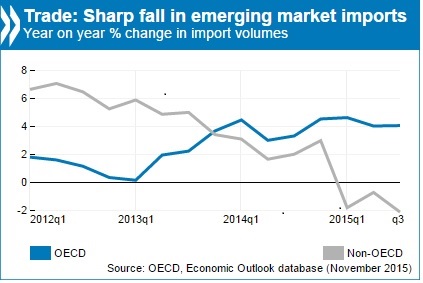
Chart-Imports from Emerging Markets, 2015

9/11/2015-A further sharp downturn in emerging market economies and world trade has weakened global growth to around 2.9% this year – well below the long-run average – and is a source of uncertainty for near-term prospects, says the OECD.

 Emerging market slowdown and drop in trade clouding global outlook, Organization for Economic Cooperation and Development.  Accessed November 9, 2015.

—————

The demonstration is significant for two reasons. First, the tasks the robot is being asked to perform aren’t rigidly defined. Instead the robot needs to identify and adapt to a complex situation involving several variables. … But that technology migration is underway, and it will change the way products are manufactured and delivered. … On the robotics front, that means we’re going to see more flexible systems that can switch between tasks on the fly.

Greg Nichols, Why a fruit sorting robot will disrupt industrial automation Adaptable, smart, and cheap. Welcome to the future of automation, ZDNet, November 7, 2015. Accessed November 9, 2015.

—————

Without human advisers — people are the biggest expense at any securities firm — the new ventures can charge annual fees of 0.5 percent of assets under management or less. That undercuts full-service brokers, which typically charge annual fees of at least 1 percent.

Hugh Son, A Money-Managing Robot Is About to Join BofA’s Thundering Herd, Bloomberg Business, November 6, 2015. Accessed November 9, 2015.

COMMENTS

The old economic narrative that each nation has it’s economic destiny in its own hands is dead. The old economic narrative that a rising tide lifts all boats is dead. The old economic narrative that new jobs in new industries are created faster than automation displaces workers in existing industries is also dead. What this means is that the institutional and policy logics of job creation that served Americans and other western peoples well though the middle of the 20th century are dead.

We must replace those outdated logics with new ones that fit the realities of an Inclusive World Economy in which all destinies are tied together and rights to income can no longer be tied almost exclusively to having a wealth producing job.

Economists are Still Dragging Their Analytic Feet

But right now I’m stuck. I have no idea how the United States economy is doing. And the closer I look at the data, the more contradictory it looks. … Yeah, but what happened in 2008 was a once-a-century kind of storm. If you always think that the big one is imminent, most of the time you’ll turn out to be wrong.

Neil Irwin, Is the Economy Really in Trouble? A Debate, New York Times, October 30, 2015.

 COMMENTS

Yes, but why would anyone, especially an economist, think that the once-a-century kind of storm rule still holds for economic matters. This century is unlike any other century before it, in so many ways. For the first time in human history, virtually every inhabitant on the planet is connected to every other inhabitant through commodity markets, communications systems, transportation systems, and a global financial system.

If economic theories and models can still be applied in any valid way, they can only be applied to the single world economy. National governments exist, nation boundaries exist, but national economies do not exist, except as ghosts of their former selves.  If an economy is a system that produces and distributes wealth, then it is glaringly apparent that the economic activities found within a national boundary do not constitute an economy.

To get un-stumped, economists must abandon the ghosts of economies past.  What’s keeping them stuck with an analytic approach that is a century behind the times?

Sustainability and the Inevitable Return of Physical Activity and Physical Exertion to Jobs in the Affluent Regions of the World

SOURCE ITEMS

Professional, managerial, clerical, sales, and service workers (except private household service workers) grew from one-quarter to three-quarters of total employment between 1910 and 2000; laborers (except mine laborers), private household service workers, and farmers lost the most jobs over the period

Ian D. Wyatt and Daniel E. Hecker, Occupational changes during the 20th century, Monthly Labor Review, Bureau of Labor Statistics, March 2006. Accessed October 17, 2015.

—————

The amount of time that most of us spend sitting has increased substantially in recent decades, especially as computers and deskbound activities have come to dominate the workplace. According to one telling recent study, the average American sits for at least eight hours a day.

Gretchen Reynolds, The Marathon Runner as Couch Potato, New York Times, October 30, 2013. Accessed October 17, 2015.

COMMENTS

One of the well known trends in the evolution of jobs in the affluent parts of the world during the last few centuries has been a decrease in physical activity and physical exertion. Sedentary office jobs abound and many jobs in industries traditionally associated with hard physical work are not physically demanding (e.g., ditches and trenches are no longer dug by sweating men with shovels and wheelbarrows but by men sitting on padded seats, and sometimes in air conditioned cabs, operating earth moving machines).

This trend has been powered by the massive and still growing use of fossil fuels and small amounts of nuclear fuels to augment and displace the use of human caloric energy in the production and distribution of goods and services. Sustainable growth optimists believe this trend is sustainable, even as fossil fuels are phased out of the world economy. They believe humans can continue to increase energy use to spread affluent lifestyles (and less physically demanding work) to more and more of the world’s people as long as we abandon fossil fuels. However, this sustainability logic is flawed.

Sustainability optimists get their optimism about holding onto the affluent lifestyle by continuing to divide the earth into the human world economy and the rest of nature, as economists have traditionally done. This keeps open the option of attributing the most threatening environmental problems to the types of energy we use, not to the massive amount of energy we use. This option disappears when we see the human world economy and the rest of the earth as a single Inclusive World Economy. Not only can the types of energy humans use endanger our wellbeing, the amounts of energy, regardless of type, can also endanger us.

The Inclusive World Economy concept counts all the material items on earth and the totality of energy flows from stored solar energy sources (fossil fuels), from geothermal sources, from nuclear sources, from gravitational sources (ocean tides) and from current solar energy flows (wind, photovoltaic, flowing water) as a single system that produces and distributes a vast array of goods and services we humans use and consume. This is a sum total of wealth, a wealth constant, if you will.[1]

Humans can neither add to nor subtract from this totality; we can only speed up or slow down the rate at which the materials of the earth are processed from one form into another form (e.g., clay into pottery). We can change the transformation rate by mobilizing and demobilizing flows of energy (e.g., by using more or less fossil and nuclear fuels) and by diverting existing energy flows from natural processes to faster or slower paced human controlled processes.

In this Inclusive World Economy view, humans cannot solve environmental degradation problems by only changing our energy sources. The use of each energy source has its own inevitable, unintended, and destructive consequences, but so too does the volume of energy being used by humans. The wealth constant in the Inclusive World Economy requires that increasing the use of solar energy to fuel the human world will divert equivalent amounts of solar energy away from natural material transformation processes.  This must have unintended consequences, some of which will be detrimental to humans and other species of life.

Inevitably, covering vast expanses of desert with solar panels, populating thousands of square miles of farm land with wind turbines, and dotting miles of coastal waters with massive machinery to harness tidal energy will have multiple unintended consequences, not just the intended consequence of powering the human world. Those unintended consequences will propagate throughout the entire Inclusive World Economy, just as the unintended consequences of burning fossil fuels at a rapid pace have. The existential threat from fossil fuels may go away, but another form of existential threat will emerge to take its place.

A solar future is necessary and inevitable, but the Inclusive World Economy view precludes a solar future in which the caloric energy of billions of humans is not a very large part of the total amount of energy derived from solar sources to power the human world. Continuing to create jobs in which human energy plays less and less of a role in processes that transform materials from form to form will only continue to move us further into a world of existential threat and catastrophes. If we don’t stop ourselves, the rules of the universe that control the Inclusive World Economy will.

Some of the broader implications of this conclusion for the future of work are clear. Rebuilding the role of human energy in the production of goods and services will entail refitting our many workplaces with machines that are manually powered. For example, we will almost certainly decide to replace electric pencil sharpeners and staplers with manual types and stop using “always on” electrical equipment. But, such small changes will not go far enough.

To increase the share of human energy in the total energy flow into human purposes enough to sustain the viability of the planet for human habitation, we will have to invent new ways for human energy to power the human world. In the past we have put small generators on bicycles to convert human energy into electricity to power the lights on the bicycle. To create the human energy centered workplace of the future, thousands of innovations and thousands of changes in human work activity will be required.

Restoring the role of human energy in the human world economy will also require a slowdown in the overall rate of material transformations involved in the production of goods and services for human use and consumption. To accomplish this, quantity of output will have to give way to quality of output so product life cycles become much longer. Again, accomplishing this will entail vast changes in workplace environments and workplace practices.

The role of human energy in the human world economy is already increasing, although this change is largely invisible. The world’s governments are only able to monitor a portion of the world’s workplaces. This is the formal part of the human world economy. The informal part of the human world economy has been growing in recent years as formal jobs have disappeared. Jobs in the informal sector are generally more physically demanding, so this shift can be interpreted as an increase in human energy inputs into the production and distribution of goods in the human world economy.

Even in this formal part, work is becoming more physically demanding. In the U.S., this shows up as less equipment per worker – reducing costs by increasing the number of shared printers means more workers have to get up and walk to the printer to retrieve a print job. This is certainly a minor increase in physical activity, but it suggests a trend that will develop as U.S. employers work to reduce energy use both to cut costs and to meet environmental regulations.

Most of the world’s peoples and their leaders have accepted that the world must transition to using less fossil fuel to using more solar energy. We just haven’t realized that in the not so distant future even those who are middle class will have to put more physical effort into their jobs because a very big part of the flow of solar energy that powers the sustainable human world world economy will have to be human energy.

Notes

[1] For additional reading on the argument for conceptualizing the human world economy and the non-human natural world as a single economic entity, see my article, Replacing the Concept of Externalities to Analyze Constraints on Global Economic Growth and Move Toward a New Economic Paradigm, Cadmus, October 19, 2014, and the work of Jason W. Moore and his colleagues at their website, World-Ecology Network).

Robotics, Artificial Intelligence (AI), and the New Era of Labor Exploitation and Coercion

SOURCE ITEMS

But salaries higher than those offered last year might not be part of the deal. … Gardner said about a third of employers surveyed plan to raise salaries this year, compared with 60 percent to 70 percent before the 2008 recession.

Curt Smith, Job market better for recent grads, MSU survey finds, Lansing State Journal, October 9, 2015. Accessed October 10, 2015.

—————

By one dismal measure, America is joining the likes of Third World countries. … The number of U.S. residents who are struggling to survive on just $2 a day has more than doubled since 1996, placing 1.5 million households and 3 million children in this desperate economic situation. That’s according to “$2.00 a Day: Living on Almost Nothing in America,” a book from publisher Houghton Mifflin Harcourt that will be released on Sept. 1.

Aimee Picchi, The surging ranks of America’s ultrapoor, CBS News, September 1, 2015. Accessed October 10, 2015.

​—————

There could be between 10,000 and 13,000 victims of slavery in the UK, higher than previous figures, analysis for the Home Office suggests. … Modern slavery victims are said to include women forced into prostitution, “imprisoned” domestic staff and workers in fields, factories and fishing boats.

Slavery levels in UK ‘higher than thought’, BBC News, November 29, 2014. Accessed October 10, 2015.

—————

Erik Brynjolfsson has a dream of the future. Or perhaps more accurately, a nightmare. … A vision of a world where computers entrench the power of a wealthy elite and push the majority into poverty. … Brynjolfsson is an economist at the Massachusetts Institute of Technology (MIT) and co-author of The Second Machine Age, a book that asks what jobs will be left once software has perfected the art of driving cars, translating speech and other tasks once considered the domain of humans.

Nick Heath, Why AI could destroy more jobs than it creates, and how to save them, TechRepublic, No Date. Accessed October 10, 2015.

COMMENTS

In the distant past, when the worth of a human worker was primarily her/his calorie power (for moving, pushing, pulling, lifting, twisting, and turning materials and equipment used in the production and distribution of wealth), only a very few workers were engaged in highly skilled work and decision-making.   In most of the world of work, one worker could easily replace another (according to one story, a mule was more valuable to a mine owner than a man). Slavery was cost effective, immigrant and seasonal workers and starvation wages were the norm.

In the nearer past, workers in affluent nations had gained substantial economic power as business owners increasingly needed human workers not only as a source of energy but also as a repository of learned production skills (e.g., skill at soldering a resister to a circuit board without leaving an electrical arc point), and as managers, problem solvers (the intelligence to figure out why the assembly line shut down or whether a particular article contained information relevant to a lawsuit) and planners. The nearer past was also a time when much of the world was still not incorporated into nation-states and markets, so capturing more and more of the world’s people as consumers required more and more production and distribution facilities and equipment, which required more and more highly skilled workers and managers.

All of that is going fast. Fossil fuels and solar power (in all its forms) replace human muscle power. Robotic skills replace human skills. AI software and massive computing power combine to make better, faster and more consistent (unbiased by considerations of kin, ethnicity, race, gender, looks, etc.) decisions than human decision-makers.

What is left to give the mere mortal economic importance? Not much.

AI and robotics, in conduction with fossil fuels and solar energy, have dramatically reduced and will continue to reduce the value of working people for the world’s business owners and managers. In the context of global competition, American and European workers are much too costly given the savings achievable through combining AI, robots, and low wage, unskilled workers in the world’s factories and offices. Even the most honorable of business owners and managers must succumb to the competitive pressures – shedding higher wage, skilled workers and escaping regulations and taxes now devoted to protecting employment rights. Wages, benefits, and employment protections must continue to fall in the wealthiest nations and the best of businesses.

Enslavement, indentured servitude, unpaid family labor, and self-exploitation are labor acquisition strategies as old as humanity and there is no reason to believe the less honorable among the world’s owners and managers will not directly and indirectly take advantage of these strategies. Studies are already finding that these things are on the rise. There is no reason to believe the business owners and managers who are fair to their own workers will stop closing their eyes to the exploitation and coercion of working people practiced by the other owners and managers with whom they do business. Relying on the cheapest sources of components and raw materials must be part of the competitive strategy of every business owner and manager, including the most honorable.

The Broken Capitalist World Economy and the Future of Good Jobs

SOURCE ITEMS

But things are changing. Longer-term shifts—such as declining middle-class jobs, a continued fallout from the global financial crisis, but also a shrinking global workforce—are shaping labor markets worldwide. Whereas the problem today seems to be a glut of workers, in coming years the global labor force will shrink. These shifts could constrain growth, but they should also help correct some of the current labor market imbalances that have prevented workers from sharing in productivity gains. The beneficiaries, however, will mainly be high-skilled workers. The prospects for lower-skilled workers are less hopeful, which is bad news not only for them, but for efforts to reduce inequality.

Ekkehard Ernst, The Shrinking Middle, Finance & Development, International Monetary Fund, March 2015, Vol. 52, No. 1. Accessed September 19, 2015.

—————

“It has become clear that we are really dealing with a different kind of economic recovery than anyone has experienced since World War II,” says Mr. Hammond, chief executive officer of Hammond Power Solutions Inc., a Guelph, Ont. company that makes electrical transformers for industrial clients around the world. … “This is far different from any recession I have seen.” … Seven years after Europe and the United States slipped into what would become the one of the deepest global recessions in history, and five and a half years since the North American economy returned to growth, the recovery remains a perplexing, inconsistent and frustratingly elusive work in progress.

David Parkinson, Richard Blackwell and Iain Marlow, The 7-year slump: Why the global economy can’t seem to get started. The Globe and Mail, January 23, 2015. Accessed September 19, 2015.

—————

Many have characterized the U.S. economy’s inability to grow robustly as an expected after- effect of a severe cyclical downturn. Such interpretation is well past its sell-by date. It’s time to recognize that globalization has brought with it issues that defy cyclical economic prescriptions.

Daniel Alpert, Why the US economy can’t seem to shake off the Great Recession, BusinessInsiDer.com, May 21, 2015.

—————

Climate change threatens to provoke a new ecological panic. So far, poor people in Africa and the Middle East have borne the brunt of the suffering. … Climate change has also brought uncertainties about food supply back to the center of great power politics. China today, like Germany before the war, is an industrial power incapable of feeding its population from its own territory, and is thus dependent on unpredictable international markets.

Timothy Snyder, The Next Genocide, New York Times, Sept. 12, 2015. Accessed September 19, 2015.

—————

Together with his team of designers and engineers, Dutch artist and innovator Daan Roosegaarde is working on a prototype of a Smog Free Tower, that would create a clean air zone outside. … This smog solver is meant to move to other major cities too. So everyone can get acquainted with it. This way, Roosegaarde wants to bring NGO’s, concerned citizens and designers together in smog-free bubbles, to work on healthy cities around the globe.

Daan Roosegaarde’s clean air zones, Rotterdam City Blog, July 28, 2015. Accessed September 19, 2015.

—————

The paper contends that we have already crossed four “planetary boundaries.” They are the extinction rate; deforestation; the level of carbon dioxide in the atmosphere; and the flow of nitrogen and phosphorous (used on land as fertilizer) into the ocean.

Joel Achenbach, Scientists: Human activity has pushed Earth beyond four of nine ‘planetary boundaries’, Washington Post, January 15, 2015. Accessed on August 27, 2015.

COMMENTS

An abundance of good jobs is one of the core features of societal prosperity and it is an article of faith for most of the peoples in affluent societies that capitalism is the engine of growing prosperity.

However, it is quite clear to almost everyone that global capitalism is malfunctioning. Economists who write for the media and journalists who cover economic matters routinely refer to the fact that the world economy has still not recovered from the financial traumas of 2008 and that global employment trends are not good one.

There is much more to the problems afflicting the world economy than a cyclical downturn and poor national policy choices. The world economy has entered an era of declining wealth accumulation that is irreversible. Without increasing prosperity, the world economy will not be able to generate the growing stock of good jobs for the world’s working people.

The few good jobs the world economy has to offer are found almost exclusively in the affluent cities and nations in the world economy. And even in those affluent areas very large proportions of workers are consigned to jobs that pay low wages and benefits, expose them to health risks, and offer no employment security.

The reason is straight forward: good jobs are expensive to create and maintain. Not only do good jobs garner premium wages and benefits, they also require high cost work environments (expensive machines, high volumes of consumable supplies, expenditures on training and workplace safety), and expensive public and private oversight and enforcement activities. Thus, for the world economy to continue to produce and maintain good jobs, the wealth of the world’s people must continue to grow. But, it can’t.  The world economy has hit a wealth production wall.

We typically use the word ‘wealth” to refer to human made goods and services, yet we know, at least intuitively, that such things as the oxygen rich air we breath and zones of moderate temperature that support agriculture are forms of wealth that nature produces. What we have yet to fully acknowledge is that these two worlds of wealth creation are inextricably interconnected.

The capitalist world economy is the human part of an inclusive world economy that includes nature’s wealth production processes. The human world economy is a massive economic machine that takes forms of wealth produced by nature and converts them into different forms of wealth – the goods and services that define affluent society. In so doing, the capitalist world economy extracts and uses flows of energy and stocks of living and non-living resources that nature would otherwise use in its own production processes.

As a totality, this inclusive world economy of humans and nature is a single economic system. The only real input is the energy from the sun (discounting the miniscule meteorite contributions to the mass of the earth). We can process one form of wealth (say soil and water) into another form of wealth (crops), but we cannot make net additions to the earth’s total store of wealth.

The point here is that the human part of the inclusive world economy grows at the expense of the natural part. Conversely, the natural part expands at the expense of the human part (in the forms of rust, rot, and natural disasters). Human economies have always used nature, just as all living things do, but the capitalist world economy is the first human economy to press against the fixed stock and regenerative limits of the entire earth. This is a crucial and overlooked reason the human world economy is trapped in dysfunction.

The capitalist world economy grew and thrived on an earth where yet another pristine forest, yet another stock of game fish, yet another unspoiled river, yet another abundance of fertile land, yet another source of cheap labor, was just an explorer and a military conquest away. It was an era in which yet another technological innovation would solve a problem and increase human wealth. That was the era in which some parts of the world became extraordinarily affluent and good jobs were created.

Fossil fueled industrialization was the driving force in that period. It provided the means for accelerating the diversion nature’s supply of energy and resources into human economic activities and it provided the means by which certain parts of Europe and North America incorporated the rest of the world into the world economy, primarily as suppliers of labor and resources and more often than not through economic and military coercion. Affluent European, North American, and allied nations became more affluent and good jobs became abundant and set the standard for the world’s people.

That limitless earth disappeared over the course of the 20th century. The era of global geopolitical economic incorporation of “foreign” lands and peoples has come to an end. It is no longer possible for human wealth to increase as it did in the past. Thus, it is no longer possible to add to the stock of good jobs in the world economy and maintain them all.

The scale of the human world economy is now so enormous that the costs for maintaining human wealth are demanding an increasing proportion of the productive capacity of the world economy.

First, the scale of damage done to nature’s wealth production by the human world economy has become enormous and keeps growing, so more and more of our human economic activities must be devoted to repairing the damages and compensating for the damages we can’t yet repair (industrial cleaning of air and water because nature’s regenerative capacity has been overwhelmed). Second, the massive stock of human wealth (including people – human capital) that we have accumulated over the last several centuries gets older every day and, as we well know, with age comes deterioration and death. A large and growing proportion of human economic activity must now be devoted to maintaining this large stock of wealth and to replacing those items of wealth that are lost to rust, rot, and irreparable damage.

As the world’s population continues to grow and the world’s rulers continue to invest in massive urban infrastructures, the energy and resource conflicts between the human and natural parts of the inclusive world economy will increase. Our technologies will not save us because they were and continue to be designed to divert evermore energy and resources from nature’s wealth production processes. Nature will prevail and force an irreversible decline in human wealth and a loss of good jobs as that happens.

The world’s leaders continue to talk about restoring global economic growth and moving more and more of the world’s people into good jobs, but the actual trends in both parts of the inclusive world economy expose this as empty rhetoric. The leaders of affluent nations have already begun to dismantle the stock of good jobs available to their peoples and most people in the poor areas of the world know they have almost no chance of ever working at a good job.

The kind of affluence and the configurations of good jobs the peoples of the west became comfortable with in the 20th century can no longer be offered to the rest of the world; nor can they be retained for the majority of people in the now affluent nations. We must invent a new definition of affluence and a new kind of good job for a new kind of world. We won’t do that until the world’s economists and policy leaders acknowledge that the world has hit the ceiling on net wealth growth and incorporate this knowledge into economic and policy theory.
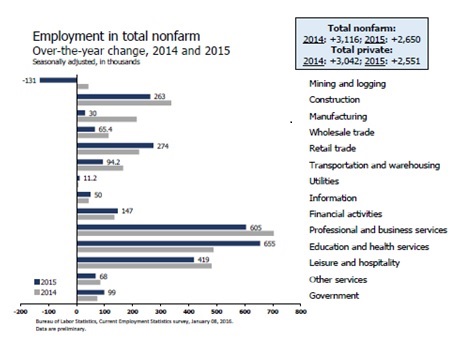
Supply Chains, Productivity, and Economic Growth: The Global Context for Understanding U.S. Employment Growth

SOURCE ITEMS

Canada’s gross domestic product contracted for a second quarter in the three months through June, a Sept. 1 report will show, according to almost all economists in a Bloomberg survey. The economy probably shrank by 1 percent, even worse than the 0.6 percent first-quarter drop.

“When Canada hurts, U.S. exporters do, too,” Bricklin Dwyer, an economist at BNP Paribas in New York, wrote in an Aug. 27 note to clients titled “Canada (not China) matters more.”

Jeanna Smialek, Uh-oh, Canada. China Pales as a Risk to U.S. Growth, BloombergBusiness, August 28, 2015. Accessed August 29, 2015.

—————

Moody’s Investors Service has revised downward its forecast for GDP growth in the G20 economies to 2.8% next year, from 3.1%. Moody’s says that the revision mainly reflects the impact of a more marked slowdown now forecast in China and more prolonged negative effects of low commodity prices on G20 producers than earlier expected.

Moody’s has slightly revised downwards its GDP growth forecast for China in 2016 to 6.3%, from 6.5% previously. Recently published economic indicators show that China’s slowdown in exports and investment has continued into Q3 2015. In addition, signs that employment growth is weakening point to a more marked and broadly-based deceleration in the Chinese economy than previously expected.

Moody’s revises forecast for G20 economies’ growth downwards to 2.8% in 2016, Press Release, Moody’s Investors Service, August 28, 2015. Accessed August 29, 2015.

—————

International production fragmentation, in which manufacturing or services activities done at home are combined with those performed abroad, has now taken centre stage. This represents a major point of departure from the so-called “Fordist” production system – exemplified by the American automobile industry – where all economic activity was organised within a single firm located on one site or in close proximity (Feenstra 1998).

Increasingly, firms across advanced and developing countries add value along these global supply chains by completing a specific task associated with the production of a finished product and then exporting it. This may be an important part or component required in the production of a good. It may even be a service that is a vital intermediate input in further production.

Albert Park, Gaurav Nayyar and Patrick Low, Supply Chain Perspectives and Issues: A Literature Review, Part I, World Trade Organization, 2013. Accessed August 29, 2015.

—————

I prefer to date the slowdown in productivity growth from the end of 2010 because productivity growth (in the nonfarm business sector) averaged a bountiful 2.6% per annum from mid-1995 through the end of 2010, but only a paltry 0.4% since. Other scholars prefer earlier break points. For example, productivity growth averaged 2.9% from mid-1995 through the end of 2005, but only 1.3% since.

Either way, the drop is large, and the scary thing is that we don’t understand why.

Alan S. Blinder, The Mystery of Declining Productivity Growth, The Wall Street Journal, May 14, 2015. Accessed August 29, 2015.

—————

In advanced economies, where plenty of sectors have both the money and the will to invest in automation, growth in productivity (measured by value added per employee or hours worked) has been low for at least 15 years. And, in the years since the 2008 global financial crisis, these countries’ overall economic growth has been meager, too – just 4% or less on average.

Hence the question on the minds of politicians and economists alike: Is the productivity slowdown a permanent condition and constraint on growth, or is it a transitional phenomenon?

Michael Spence, Automation, Productivity, and Growth, Project Syndicate, August 26, 2015. Accessed August 29, 2015.

—————

This paper offers an integrated analysis of outsourcing, offshoring, and foreign direct investment within a systems view of international business. This view takes the supply chain rather than the firm as the basic unit of analysis. It argues that competition in the global economy selects supply chains that maximise the joint profit of all the firms in the chain. The systems view is compared with the firm-centred view commonly used in strategy literature. The paper shows that a firm’s strategy must be embedded within an efficient supply-chain strategy, and that this strategy must be negotiated with, rather than imposed upon, other firms.

From the Abstract, Mark Casson & Nigel Wadeson, The Economic Theory of International Supply Chains: A Systems View, International Journal of the Economics of Business, Volume 20, Issue 2, 2013. Accessed August 27, 2015.

COMMENTS

Most economists explain a slowdown in a nation’s economic growth in terms of stagnant productivity growth. Yet it is seriously questionable whether such a thing as the productivity of a nation is a meaningful statistic at this late date in the development of the world economy.

Global supply chains now distribute production processes across multiple nations. Even the local bakery is, even if unwittingly, often part of supply chains that transcends national borders. The development of the global supply chain system has reached such a level of maturity that some researchers argue that the supply chain, not the individual firm, is the key competitive unit in the world economy.

The implications for measuring productivity seem obvious. If the competitive unit is a supply chain, then it is the productivity of a supply chain as a whole that is relevant to economic growth. If supply chains cross national boundaries, then measuring the productivity of only the part that is within a national boundary will obscure the positive or negative impact on total supply chain productivity of the “foreign” firms in the supply chain. The competitive position of the supply chain will not be correctly understood.

In the aggregate, measuring the productivity of a nation’s firms rather than the productivity of the supply chains in which the nation’s firms operate will lead economists and policy makers to misunderstand their nation’s prospects for economic growth. That, in turn, will lead to misguided expectations about employment and wage growth.

Wishful Thinking about Jobs, Wages and Consumer Spending: Ability to Spend More is Not Rising in the U.S.

SOURCE ITEMS

The dour tone of the report was reinforced by declines among discretionary items such as automobiles, furniture and electronics. Demand at grocery stores, service stations and general merchandise retailers also declined.

The labor market continues to provide the wherewithal for Americans to spend. Payrolls bounced back in April with a 223,000 increase following a 85,000 gain the prior month, and the jobless rate fell to 5.4 percent, the lowest since May 2008, according to Labor Department data.

 U.S. Retail Sales Disappoint Again, BloombergBusiness, May 13, 2015. Accessed May 13, 2015.

—————

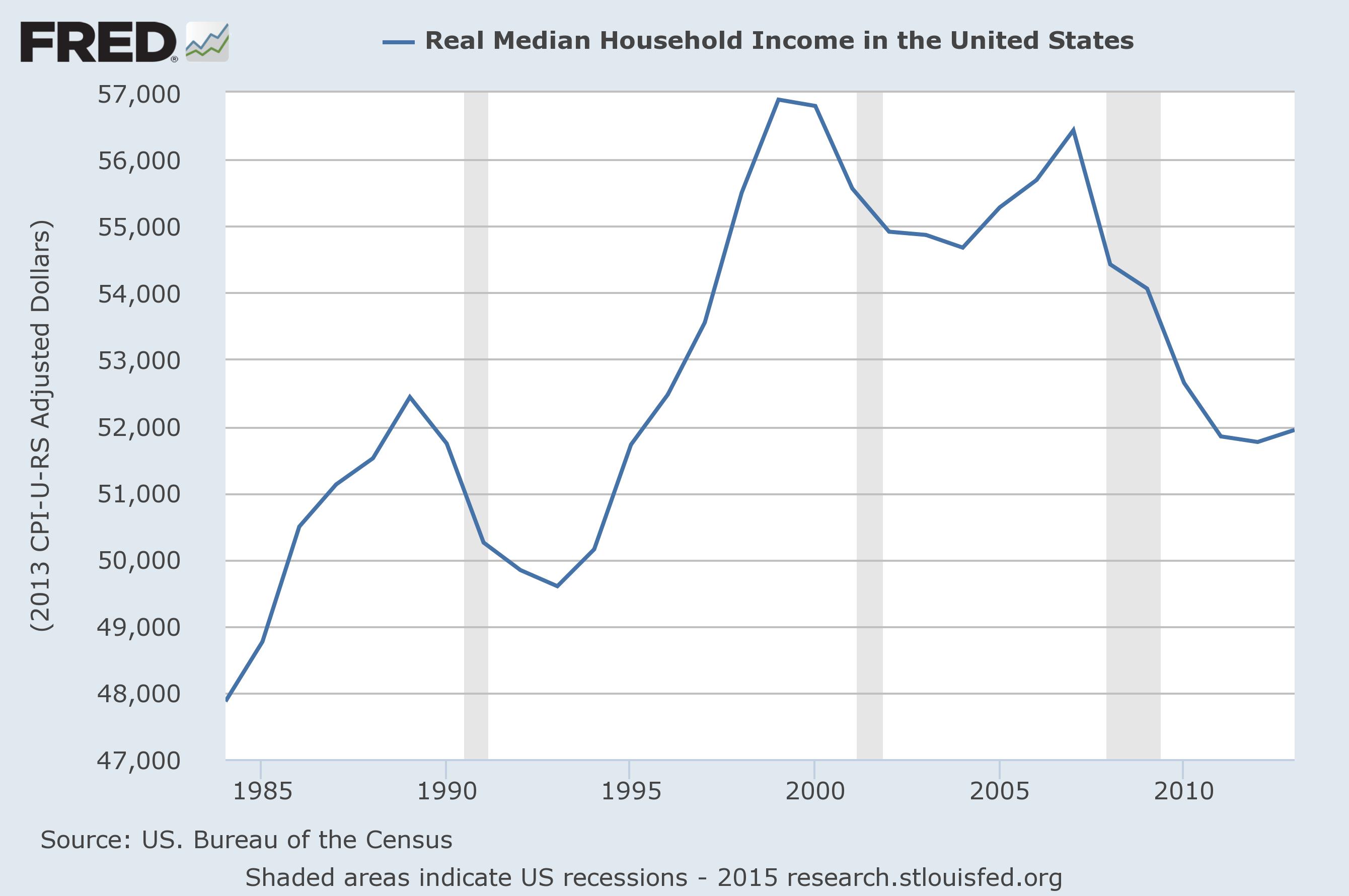
Chart-Housold Income Trend

Published by the Federal Reserve Bank of St. Louis. Accessed May 13, 2015.

—————

The Sentier Research monthly median household income data series is now available for March. The nominal median household income was down $307 month-over-month but up $1,104 year-over-year. That’s a -0.6% MoM decline and a 2.1% YoY increase.

Doug Short, Median Household Income Declined in March, Advisor Perspectives, April 23, 2015. Accessed May 13, 2015.

COMMENTS

Economists and journalists seem to have lost the ability to connect the dots. Repeatedly, they report the numbers but fail to talk about how they are connected in the real world.

Very few of us are isolated consumers. We are members of families and households, so household income is a much more meaningful indicator of ability to increase spending. In families and households we talk about what to buy and often share incomes, even if only through informal borrowing from each other.

Household income is a function of total hours worked by members of the household and wage levels. Thus, even if the take home pay of a member of a household is rising, if other members are working fewer hours or not at all, then household income can actually decline.

Unemployment is not the only source of declining work hours for a household. Withdrawing from the labor force is another way that household income can decline substantially, even while the wages of those who are formally counted in the labor force continue to rise. For a very long time, the labor force participation rate in the U.S. has been falling. With every tick downward, the number of earning hours for households ticks downward.  This takes its toll on household income and ability to spend.

When we think about the people who withdraw from the labor force, the retirement of baby boomers readily comes to mind. What tends not to come to mind is the number of middle and lower income households in which young people are neither working nor looking for work and the number of two-earner households in which one of the earners is working part-time or sporadically or taking a personal sabbatical until the chances of landing a job get better.

Slowly rising wages can do very little to lift consumer spending while labor force participation continues to decline.

Today’s Strengths are Tomorrow’s Weaknesses; Today’s New Hires are Tomorrow’s New Unemployed

In an a single world economy with decentralized policy making, stability for a nation’s economy is not achievable.

SOURCE ITEMS

Cutbacks in demand from overseas customers and domestic energy producers led to the weakest growth in new orders since May 2013, prompting U.S. factories to slow the rate of hiring. At the same time, manufacturing is being underpinned by sustained spending from American consumers who are enjoying low prices at the gas pump.

Bloomberg News, Manufacturing in U.S. Expands at Slowest Pace in a Year, Bloomberg, March 2, 2015.

COMMENTS

Back in the Fall of 2014, economists hailed the strong dollar as evidence of a strong U.S. economy and only whispered warnings about the potential for lost foreign demand for U.S. goods. Similarly, they have hailed the shift in consumer spending that low oil prices allow, but only whisper warnings about the resulting job losses in the energy related industries.

Economists completely ignore the fact that a very large proportion of consumer goods that we American’s buy are produced abroad.  This matters because whatever job growth we get from the shifts from buying gasoline and heating oil to buying furniture, electronic goods, and trinkets will mostly be in lower-wage retail, not in higher-wage production. Moreover, when fuel prices begin to rise again, as they will, consumer spending will shift back into heating oil and gasoline, destroying the retail jobs that were so recently created and restoring jobs in energy industries.

Economists tell us that we have entered a period of positive economic trends; they have been doing this almost every year since the financial crisis of 2008. It’s wishful analysis because economic instability and volatility are build into the institutional structure of world economy.  So, if you just got a new job, don’t count on it lasting.

Diverging Nations, U.S. Employment Prospects: A Matter of Interpretation

SOURCE ITEMS

The economy grew at a sizzling 5% annual pace in the third quarter of last year. And more than 1.5 million jobs were created from June to November, the best six-month stretch since 1999-2000.

With that momentum, combined with falling gasoline prices, 2015 is likely to be a good year, notwithstanding Monday’s stock market sell-off.

The Editorial Board, More jobs is not enough: Our view, USA Today, January 5, 2015.

—————

In the coming year, “divergence” will be a major global economic theme, applying to economic trends, policies, and performance. As the year progresses, these divergences will become increasingly difficult to reconcile, leaving policymakers with a choice: overcome the obstacles that have so far impeded effective action, or risk allowing their economies to be destabilized.

Fortunately, there are ways to ensure that 2015’s divergences do not lead to economic and financial disruptions. Indeed, most governments – particularly in Europe, Japan, and the US – have the tools they need to defuse the rising tensions and, in the process, unleash their economies’ productive potential.

Mohamed A. El-Erian, A Year of Divergence, Project Syndicate, December 8, 2014.

—————

Taken together, the average 10-year bond yield of the U.S., Japan and Germany has dropped below 1 percent for the first time ever, according to Steven Englander, global head of G-10 foreign-exchange strategy at Citigroup Inc.

That’s not good news. The rock-bottom rates, which fall below zero when inflation is taken into account, show “that investors think we are going nowhere for a long time,” Englander wrote in a report yesterday.

Simon Kennedy, Free Money in Bond Markets Shows Global Economy Still Struggling, Bloomberg, January 6, 2015.

COMMENTS

One can explain the divergence among nations in terms of autonomous national economies in which global economic growth is nothing more than the sum of the growth of national economies. The economic growth divergence among nations is a function of differing national policy approaches, some correct, most incorrect (since most economies are either stagnating or growing well below rates economists deem achievable). If only all nations of the world adopted correct policies, all would be growing in harmony and at a rapid clip.

The alternative is to see what is called the U.S. economy as only a component of the world economy as a whole. The world economy is the only actual economic system and there is only one economic growth rate – the growth rate of the world economy as a whole. National policies have some effect on the global rate of economic growth, but much less effect than is commonly thought. Global parameters (such as resource and ecological limits, transportation bottlenecks, commodity price volatility, climate volatility, and institutional limits to global demand growth) have much more impact.

The economic growth divergence among nations is much less a matter of good and bad national policies than a matter of the impact of the interactions among various and changing national policies on the distribution of global economic growth among the world’s geopolitical population groups.

The interpretative difference is enormously important. The first interpretation suggests that the U.S. rate of growth did not increase in 2014 at the expense of economic growth in Europe, China, Brazil and other nations. It further suggests that the higher U.S. rate of economic growth is sustainable almost regardless of the courses of action taken by other nations (just as long as the U.S correctly modifies its policies in response to those other national courses of action).

The second suggests that a convergence can only take place through an alignment of national policies that produces a different distributional outcome for growth in the world economy. In such a scenario, the growth rates of the U.S. (and China) would have to fall so that the growth rates of the stagnating nations could rise. Given the lack of powerful global political institutions and the very low level of geopolitical cooperation (compared to the high level of economic integration in the world economy), a struggle among nations that is heated and dangerous is the likely scenario for a long time to come.

The implications for U.S. employment are obvious. Job growth in recent months should be seen as precarious. Our policy commitments to market freedom and investor dominance in economic matters puts job creation at the mercy of global economic growth volatility and divergence. At the moment U.S. workers are somewhat on the beneficial side of volatility and divergence. That will almost surely change.

The Slow-Growth World Economy and the Degradation of Formal Wage Employment

SOURCE ITEMS

“We think of the ‘new neutral’ as a natural evolution from the ‘new normal’,” Executive Vice President Richard Clarida said in a telephone interview, likening the firm’s new outlook to a car stuck in neutral gear. “The ‘new neutral’ looking forward is a story about a global economy that isn’t recovering, it’s a global economy that’s converging to trend rates of growth that will be sluggish.”

Mary Childs, Pimco’s ‘New Normal’ Thesis Morphs Into ‘New Neutral’, Bloomberg, May 13, 2014.

—————

What is new – and distressing – is that developing economies’ low-productivity segments are not shrinking; on the contrary, in many cases, they are expanding.

Dani Rodrik, The Growing Divide Within Developing Economies, Project Syndicate, APR 11, 2014.

—————

Formal employment creation in Colombia is taxed with social security contributions and payroll taxes that equal roughly 60% of the base salary for each worker.

Domingo Cavallo and Rodrigo Botero, Proposal – Incentives to Formal Employment: A Proposal for Colombia, Global Economic Symposium 2014.

—————

But if you’re not self-motivated, this world will be a challenge because the walls, ceilings and floors that protected people are also disappearing.

Thomas Friedman, It’s a 401(k) World, New York Times, April 30, 2013.

—————

America’s shadow economy includes activities that are actually illicit — prostitution and drug dealing — and more benign jobs like working construction for a day for cash, or even the $2 a kid that Kalmes gets for walking neighborhood children to the bus. Added together, economists estimate $2 trillion could be involved.

Joshua Zumbrun, Shadow Economy Shows Joblessness Less Than Meets U.S. Eye, Bloomberg, March 20, 2013.

—————

A study for the Small Business Administration, a government body, found that regulations in general add $10,585 in costs per employee.

Over-regulated America, The Economist, Feb 18th 2012.

—————

Informal employment in Californian construction has increased by 400 percent since 1972. The ranks of the informal swell with each economic recession, but most recently a larger share of workers have stayed in the informal sector because formal sector jobs have not been recovered. Four years after the end of the Great Recession, the industry has recovered only 66 percent of the jobs lost in the formal sector. –

Yvonne Yen Liu, Daniel Flaming, Patrick Burns, Sinking Underground: The Growing Informal Economy in California Construction, Economic Roundtable, September 2014.

—————

The result has been a downsizing of expectations. By almost two to one — 64 percent to 33 percent — Americans say the U.S. no longer offers everyone an equal chance to get ahead, according to the latest Bloomberg National Poll. The lack of faith is especially pronounced among those making less than $50,000 a year, with close to three-quarters in the Dec. 6-9 survey saying the economy is unfair.

Rich Miller and Michelle Jamrisko, Americans on Wrong Side of Pay Gap Run Out of Means to Cope, Bloomberg.com, By December 30, 2013.

COMMENTS

The legitimacy of a formal wage employment system for working people comes from an implicit guarantee that workers get a fair share of national income. This guarantee is necessarily implicit because to make it explicit would require imposing substantial constraints and costs on the owners and managers of business enterprises. Public policy would have to define the primary and overriding obligation of the private sector to be providing employment or income to all working people in place of the existing mandate to provide maximum income to investors.

In most of the world’s low wealth political jurisdictions, opposition to creating and strengthening formal wage employment systems is generally very strong, especially among the rich and powerful of those jurisdictions.   Both the rich and a majority of workers in those jurisdictions understand that their profits and jobs can be quickly eliminated in a world economy in which businesses and workers in other jurisdictions will underbid them if given the opportunity.

In the post World War II decades, the rich and powerful in the world’s affluent nations were less often actively opposed to high cost formal wage employment systems, preferring the cost of accommodation to the cost of ruthless government suppression of conflict.

This accommodative stance has been disappearing as economic globalization has dramatically increased the competition for resources and markets faced by owners and investors in wealthier jurisdictions like the U.S. In recent decades, the accommodative stances common to business communities across the affluent nations of the world have been replaced with aggressive political campaigns to substantially reduce the high costs of the formal wage employment systems. Working people in the world’s affluent nations have lost benefits, suffered wage reductions, lost union organization protections, lost funding for government agencies charged with monitoring workplace conditions and labor market practices, and become more exposed to exploitative and unsafe working conditions.

Working people have been nudged into and forced into less desirable forms of employment (including informal sector employment, family employment, self-employment in petty trades, coerced employment, and employment in illegal activities). In a reversal of trends a few decades ago, formal wage employment now accounts for a declining share of total employment.

This trend is likely to continue because global ecological and institutional conditions impose a structural ceiling on the global rate of growth. As a result, global competition will intensify and national economic policy efforts to restore high rates of economic growth will fail much more often than they succeed. Adopting accommodative relationships with working people will not reemerge as an option for even the most successful of the world’s businesses.

Formal wage employment standards will continue to deteriorate because the world’s business owners and investors will put more pressure on governments to cut tax revenues and weaken labor market and workplace regulations as they fight for global market shares. Working people in various places will attempt to resist but will mostly lose these battles because they are, at heart, global political battles in which owners and investors have a massive advantage.

At the moment, the world’s working people are fragmented and disorganized, both across and within nations. Despite global business competition, the world’s owners and investors are much better organized into a global political force. They fund large transnational organizations to develop and pursue shared goals (e.g., more trade, easier money, lower costs) to a far greater extent than do the world’s working communities.

In the long run, this could change, but not unless the world’s working people find ways to politically checkmate the world’s owners and investors. That may or may not happen. What is certain is that the future of work is up for grabs.

(For a perspective on the slowdown in global economic growth see my article, Replacing the Concept of Externalities to Analyze Constraints on Global Economic Growth and Move Toward a New Economic Paradigm.)