Scientists Map Key Component of World Economy

“We present the first investigation of the architecture of the international ownership network, along with the computation of the control held by each global player. We find that transnational corporations form a giant bow-tie structure and that a large portion of control flows to a small tightly-knit core of financial institutions. This core can be seen as an economic “super-entity” that raises new important issues both for researchers and policy makers. [from the abstract]

Remarkably, the existence of such a core in the global market was never documented before and thus, so far, no scientific study demonstrates or excludes that this international “super-entity” has ever acted as a bloc. However, some examples suggest that this is not an unlikely scenario. For instance, previous studies have shown how even small cross-shareholding structures, at a national level, can affect market competition in sectors such as airline, automobile and steel, as well as the financial one.”

Stefania Vitali, James B. Glattfelder, Stefano Battiston, The network of global corporate control, arXiv.org, July 2011

—————

“‘This is empirical evidence of what’s been understood anecdotally for years,’ says information theorist Brandy Aven of the Tepper School of Business at Carnegie Mellon in Pittsburgh.”

Rachel Ehrenberg,  Financial world dominated by a few deep pockets, ScienceNews, September 24th, 2011; Vol.180 #7 (p. 13)

———————–Comments———————–

This study does not show that the allocation of investments that create employment opportunities for the world’s people is managed almost exclusively for the benefit of the members of this super-entity and their managerial minions and political allies.

It does not show that this super-entity uses its power to pressure governments around the world, including U.S. federal and state governments, to implement policies that are not in the best interests of the people who must live under and with the policies of those governments.

It does show that there is an entity with the power to do such things.

Note: the study examined relationships among 43,000 transnational corporations and 600,508 economic actors connected by more than a million ownership ties.

Depreciate This: Good for the Stock Market, Bad for the Job Market

“Capital goods orders rose a robust 4.2 percent in August from July.

Core capital goods orders — nondefense bookings for items such as industrial machinery, power transmission equipment and computers, but excluding the auto and aircraft sectors — rose 1.1 percent.

‘We think large companies are so cash-rich that they can keep spending despite lower confidence. In competitive industries, the company which does not spend loses market share,’ he [Ian Shepherdson at High Frequency Economics] said.”

US capital goods orders shine in August, Breitbart.com, Sep 28, 2011

 —————

“The business spending … may be further supported by a December agreement between President Barack Obama and congressional Republicans. Companies will be able to depreciate 100 percent of capital equipment put in service by the end of this year.”

Bob Willis, Demand for U.S. Capital Goods Rises by Most in Three Months, Washington Post, Sep 28, 2011

 ———————–Comments———————–

From the standpoint of business leaders, the impact of investments in capital goods on employment opportunities is only a side effect.  If the investments contribute to job growth, they are happy to get the positive public relations bump.  If they undercut job growth, well, that’s just unavoidable collateral damage.

Yes, a burst of investments in capital goods can generate employment, but only in the short term.  Downstream, as those new computers, manufacturing robots, and assorted other high end technologies go live in workplaces, jobs will bleed out, more than offsetting short term job gains.

We now live in a world in which an accelerating global shift in the mix of humans and machines engaged in the production of goods and services is squeezing the life out of employment and income growth.  The pace at which machine energy is replacing human energy in the workplace is accelerating.  Machine energy has already replaced enormous amounts of human energy in agriculture, mining and manufacturing.  Today machine energy is increasingly replacing human energy used in thinking (evaluation and decision-making activities) in more and more fields of work, including professional fields.

Public policy cannot and should not stop innovation and the growing use of machines to supplement and replace humans in the workplace.  (Indeed, workers in many types of work are still exposed to dangers that can best be reduced by using more machines.)  But, use of tax write offs to encourage even faster displacement of workers by machines when done in the absence of a comprehensive policy approach to creating wealth and equitably distributing that wealth is extraordinarily wrongheaded.  Such unlinked use of tax write offs can only exacerbate the damage already being done to jobs and income in the U.S.

This kind of unlinked use of tax write offs is not just a U.S. practice.  Many of the world’s nations take the same approach to increasing market shares in very competitive global investment markets.  These nation by nation tax write off practices aggregate into a global economic force that increases wealth production and increases corporate profits, but also relentlessly destroys jobs and the incomes of families that depend on those jobs.

As of now the world does not have a comprehensive policy approach to managing the growth of the world economy.  More to the point, the world does not have global institutions with the power to coordinate economic policy-making across the world’s nations on behalf of the world’s people.  Thus, the ongoing global transition to more and more use of machines in place of people is both unmanaged and unmanageable.  The largely destructive aspects of this transition cannot yet be addressed and rectified.

In this context, the Obama administration’s 100 percent depreciation of new equipment can only become a 100 percent disaster for working families in the U.S. and in the rest of the world.

A World of Global Corporations Requires a World of Global Economic Policies

“General Motors Co. agreed Tuesday to deepen cooperation with its flagship Chinese partner on development of electric vehicle knowhow amid pressure from Beijing to hand over proprietary technology … GM, he said, makes a lot of money in the growing China market, and the partnership is an investment to keep that going.”

Elaine Kurtenbach, GM OKs electric vehicle cooperation with China, The Associated Press, carried online by the Lansing State Journal, September 20, 2011

—————

“Our second set of findings provides empirical support for the view of Sutton (2007a) and others who argue that emerging market economies benefit from globalization through the vertical transfer of capability from foreign to domestic firms. We find this effect to be substantial for all three types of innovation that we study, suggesting that the supply chain of multinational enterprises and international trade are an important means for domestic firms to raise their capability. Our third and fourth set of findings indicates that the effects of globalization on innovation are all-encompassing, rather than affecting only a subset of firms.

Yuriy Gorodnichenko Jan Svejnar Katherine Terrell, Globalization and Innovation in Emerging Markets, Other Versions PDF at website of Yuriy Gorodnichenko, March 23, 2009

—————

“The tests produced a large number of cointegrating vectors which implied a strong long run relationship between all markets. Thus, globalization seems to have greatly impacted international financial integration.”

From the abstract: Mohammed Ansari, Impact of globalization on stock market synchronization: some empirical evidence, International Journal of Commerce and Management, Volume 19 issue 3, 2009.

———————–Comments———————–

GM insists that its new deal with China will not give Chinese companies access to Volt technology.  But does that really matter.  Volt technology is already dated, the resulting jobs are in the pipeline; what matters is what comes next and GM is not obligated to develop new technologies in the U.S. or to use new technologies to produce vehicles in the U.S. – even though U.S. taxpayers are a key reason GM survived to produce the Volt and to sign a new technology development pack with China.

In the context of intense global competition, the world’s corporations can no longer afford to have national loyalties — to have them would undermine their access to the hugely expanded number of investment opportunities that globalization has created.  Today’s corporations must be ready at all times to abandon investments in one country to pursue more profitable investments in another country.

Although corporations and their leaders have become global citizens, most of the world’s people have not.  We live in and identify with nations.  We depend on national governments to protect and promote our economic welfare.  Very few of us move to other nations to pursue our economic interests in the way corporations do – we can’t afford to, national laws do not allow us to, and/or we don’t want to leave families and friends.

This puts the world’s people at an enormous disadvantage with regard to employment: we can’t count on the corporations that call our nations home to create jobs for us and we can’t shop the globe for jobs they do create.

In this new world, job creation must be the responsibility of our governments even more so than in the past.  And the world’s governments must cooperate to an unprecedented extent to foster sufficient global job and income growth to ensure opportunities for living wage employment for the citizens of every nation.

Over the course of the 20th century the U.S. people overcame huge policy differences among the member states to create a body of national policies covering banking, investments, workplace practices, rights of workers, and the responsibilities of businesses to the communities in which they operate.  The resulting uniformity of economic policies across states contributed enormously to the growth of a large and prosperous U.S. middle class and to a substantial reduction in poverty.

The same must now be done on a global scale to promote the growth of a global middle class and to reduce global poverty.  Without this global effort, the prosperity of the U.S. middle class will continue to deteriorate.

Fragmented and Weakened Global Governance Perpetuates the World’s Employment Crisis

“A second conclusion is that the multilateral system lacks coherence; that is, comparable and consistent disciplines in closely connected areas of international economic interaction. This is particularly notable between trade and finance. The existing system of global economic governance lacks effective multilateral disciplines over exchange rate, macroeconomic and financial policies, or for redress and dispute settlement regarding the negative impulses generated by such policies. In this respect, governance in money and finance lags behind that for international trade. This is a main source of strains in the trading system.”

 Yilmaz Akyüz, Global Rules and Markets: Constraints over Policy Autonomy in Developing Countries, Working Paper No. 87, Policy Integration and Statistics Department, International Labour Office, June 2008

 —————

“Economic integration and interdependence in the world today have reached an unprecedented level. As a result, the globalized economy cannot function for the benefit of all without international solidarity and cooperation. This was highlighted by the global financial and economic crisis that followed the collapse of big financial institutions, and it has underlined the need for developing approaches to new forms of global collaboration.”

Trade and Development Report, 2011: Post-crisis policy challenges in the world economy, United Nations Conference on Trade and Development

 —————

“Global investors increasingly view risk in binary terms: When things are looking calmer on the global economic front, stock markets rise across the world; when things look scarier, they fall. Instead of differentiating among the economies in the United States, Europe and Japan, market measures are moving closely in tandem.

Moreover, because major U.S. companies have operations around the globe, executives are more likely to try to offset weakness in their overseas operations by pulling back on hiring and capital investment domestically, even if the U.S. economy is proceeding apace.”

Neil Irwin, U.S. fortunes increasingly determined in Brussels, Frankfurt, Political Economy Blog,  Washington Post 09/06/2011

 —————

“Concurrent with the shift in power among nation-states, the relative power of various nonstate actors—including businesses, tribes, religious organizations, and criminal networks—is increasing. The players are changing, but so too are the scope and breadth of transnational issues important for continued global prosperity.

The diversity in type of actor raises the likelihood of fragmentation occurring over the next two decades, particularly given the wide array of transnational challenges facing the international community.”

By 2025, the international community will be composed of many actors in addition to nation-states and will lack an overarching approach to global governance.

Global Trends 2025: A Transformed World, National Intelligence Council, PDF version, November 2008

 —————

“Today, some 50,000 multinational enterprises and their 450,000 affiliates employ over 200 million people throughout the world. Their impact is felt in virtually every facet of industry, trade, services and business activities.”

Multinational Enterprises web page, International Labor Organization

———————–Comments———————–

Over the last several decades, the world’s distribution of economic power has shifted along several dimensions.

  • The distribution of power among nations has become more decentralized (the number of nation-states in the world has doubled since 1950, a number of weaker nations – notably the BRIC countries – Brazil, Russia, India, and China – have substantially increased their positions of power in the world economy, and with the cold war over, the most powerful nations have less ability to dictate foreign and domestic policies to weaker nations).
  • The number of economically competing geopolitical units in the world economy has increased dramatically (increasing numbers of bilateral and multilateral free trade agreements have exposed more and more of the world’s local businesses to global competitors; advances in transportation and communications technologies have brought more and more of the world’s state, provincial, and urban governments into virtual face-to-face competition for investments and jobs)
  • The distribution of economic power between the world of national and multinational governing institutions and the world of global business enterprises has shifted in favor of the business enterprises (.the expansion of the number of competing geopolitical actors in the world economy has increase the number and diversity of investment opportunities available to corporations and investors, increasing their power to play off one geopolitical entity against another and thus limit the willingness of governments at all levels to manipulate flows of capital and goods to favor their own citizens).

These shifts in power have wrought a destructive change in the global environment for job creation.

Business enterprises operate under very different mandates than do governments.  The core mandate for every business is to gain market share, not share market gains; to maximize profits for owners and shareholders, not to maximize general welfare.  In the pursuit of that core mandate business enterprises cannot increase employment, pay higher wages, create safer working conditions, pay taxes, or invest in parts of the world where the greatest need for jobs exist, if doing so will alter the balance of competitive advantages in favor of competitors.    Incurring avoidable costs seldom enhances competitiveness; cutting costs often does.

In a world in which governing institutions lack the power to organize and moderate competition so that it serves the general interest and in which the growth of markets is stagnant, fiercely combative and norm-breaking waves of competition among the world’s 50,000 global corporations and among the world’s millions of globally exposed local businesses and governments are inevitable.  Unrestrained job slashing frenzies in pursuit of lower costs are inevitable.  Waves of hiring that manage to materialize cannot be sustained.  High levels of unemployment and underemployment become the permanent state of affairs.
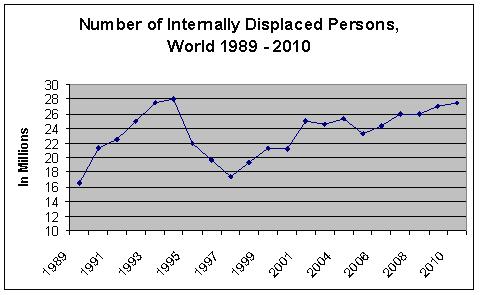
Multiple Trends Bring Increased Global Economic Instability

Internally Displaced Persons Trend

Data for chart provided by Internal Displacement Monitoring Center (IDMC). See Internal Displacement: Global Overview of Trends and Developments in 2010, March 2011.

—————

In the broader sense, the biggest question is whether we will be able to feed the world’s population going forward and how much it is going to cost us. Falling yields over the last few decades are raising concerns that current agricultural techniques are nearing their natural limit for productivity.

Global Economic Outlook Q2 2011: Navigating a world of turmoil, Deloitte Research, 2011.

—————

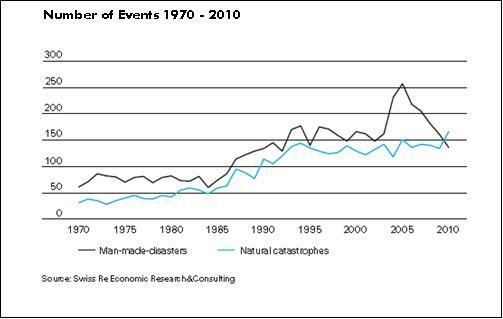
Disasters and Catastrophes 1970-2010

Chart source: Natural catastrophes and man made disasters in 2010, Swiss Reinsurance Company Ltd

—————

“The already stressed resource sector will be further complicated and, in most cases, exacerbated by climate change … Technological advances and policy decisions around the world … are likely to determine whether the globe’s temperature ultimately rises more than 2 degree centigrade—the threshold at which effects are thought to be no longer manageable.

For various reasons the US appears better able than most to absorb those shocks, but US fortunes also ride on the strength and resiliency of the entire international system, which we judge to be more fragile and less prepared for the implications of obvious trends like energy security, climate change, and increased conflict, let alone surprises.”

Global Trends 2025: A Transformed World, National Intelligence Council, PDF version, November 2008

—————

“Since the publication of the April 2011 Global Financial Stability Report (GFSR), financial risks have risen for three reasons … Third, notwithstanding some recent pullback in risk appetite, the prolonged period of low interest rates may push investors into riskier assets in a “search for yield.” This trend has the potential to build financial imbalances for the future, particularly in some emerging markets.

Global Financial Stability Report Market Update, International Monetary Fund,  Updated: June 20, 2011

———————–Comments———————–

Perhaps it is only a coincidence that the number of man-made disasters peaked just before the U.S. financial system went on life support and its troubles kicked off the Great Recession of 2008-09.  Perhaps it’s not.

In a world in which global markets and global investment flows tie each of us to everyone else, anything that happens is likely to bump into and jar everything else. Disruptive weather events, disruptive economic events, transformative investment shifts, and disruptive political events are not unconnected.

Thomas Friedman tells us the world is hot, flat, and crowded.  It is also becoming increasingly susceptible to spasms of destructive instability as global trends more frequently generate destabilizing conjunctures of economically costly events.

The world does not have adequate systems of governance for managing these destabilizing conjunctures, so as the world gets hotter, flatter, and more crowded, the more devastating these spasms of instability will be.

More on Computers With Master’s Degrees and Accelerating Job Losses

“Six decades into the computer revolution, four decades since the invention of the microprocessor, and two decades into the rise of the modern Internet, all of the technology required to transform industries through software finally works and can be widely delivered at global scale.

Agriculture is increasingly powered by software as well, including satellite analysis of soils linked to per-acre seed selection software algorithms

Health care and education, in my view, are next up for fundamental software-based transformation

many people in the U.S. and around the world lack the education and skills … This problem is even worse than it looks because many workers in existing industries will be stranded on the wrong side of software-based disruption and may never be able to work in their fields again. ”

Marc Andreessen (Hewlett-Packard board member), Why Software Is Eating The World, Wall Street Journal, August 20, 2011

—————

“Robots have the potential to replace humans in a variety of applications with far-reaching implications. … The development and implementation of robots for elder-care applications, and the development of human-augmentation technologies, mean that robots could be working alongside humans in looking after and rehabilitating people. A change in domestic and social responsibilities and a change in domestic employment

SRI Consulting Business Intelligence requirements could adversely affect lower income service-oriented workers.

By 2025 Internet nodes may reside in everyday things—food packages, furniture, paper documents, and more. … Streamlining—or revolutionizing—supply chains and logistics could slash costs, increase efficiencies, and reduce dependence on human labor.”

Disruptive Civil Technologies: Six Technologies with Potential Impacts on US Interests out to 2025,  Conference Report, National Intelligence Council, April 2008

———————–Comments———————–

See comments in the Reconnaissance Report for August 19, 2011 (immediately below).

Computers With Master’s Degrees Will Accelerate Service Sector Job Losses And Increase The Need For Non-Work Income Entitlements

Not Today's Business Computer“ARMONK, N.Y., – 18 Aug 2011: Today, IBM (NYSE: IBM) researchers unveiled a new generation of experimental computer chips designed to emulate the brain’s abilities for perception, action and cognition … cognitive computers are expected to learn through experiences, find correlations, create hypotheses, and remember – and learn from – the outcomes, mimicking the brains structural and synaptic plasticity.

IBM Unveils Cognitive Computing Chips, Press Release, IBM, August 18, 2011.

—————

“IBM sees multiple applications for these cognitive computing systems, which would fit in the size of a shoebox. Among potential uses:

  • Computers that could take in inputs such as texture, smell and feel to gauge whether food was outdated.
  • Financial applications to monitor trading and recognize patterns in a way today’s algorithms can’t.
  • Traffic monitoring.
  • And system monitoring for waterways and other natural resources.”

Larry Dignan, IBM creates cognitive semiconductors: A step toward right brain computers, ZDNet Blog Between the Lines, August 17, 2011.

—————

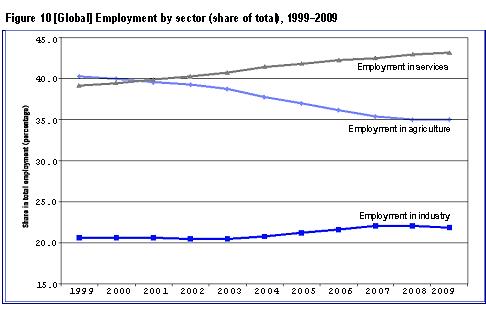
Global Employment By Sector, 1999-2009
Source: Global Employment Trends 2011, International Labor Org., p. 20

—————

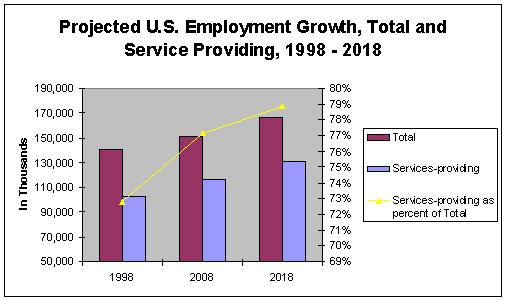
U.S. Employment Projections to 2018
Data Source: Rose A. Woods, Employment outlook: 2008–2018: Industry output and employment projections to 2018, Monthly Labor Review, November 2009.

———————–Comments———————–

The barriers to replacing intellectual and professional workers with machines are rapidly falling.  Already, computers are taking over customer service communications, digital archive research, teaching responsibilities, aspects of legal research, stock market trading, and other information gathering, information evaluation, and decision-making activities. With new computational technologies moving into the world’s workplaces almost everyday, the pace at which intellectual and professional work activities are being turned over to computers is accelerating.

The impact of this trend on global and U.S. employment can only be negative.  In every field of business, the world is crowded with competitors and the global rules governing competition are minimal and poorly enforced.  In this environment, no business leader can risk not looking at every new computational technology as a possible way to reduce labor costs faster than do competitors.

A very large proportion of the jobs that involve observation, evaluation, and decision-making activities are in service providing industries, including government, so the largest part of the negative employment impact of the accelerating use of computational technologies that emulate aspects of human thinking will be in this sector.  But the overall impact will be much greater.

Neither the agricultural sector, which is rapidly losing workers to automation, nor the industrial sector, which is already highly automated, will be able to absorb the very large numbers of workers likely to be displaced from service sector jobs.  Unemployment and underemployment will rise, and as they do non-work entitlements to income will have to play a much larger role in distributing the wealth created by the enormous and growing productive power of the world economy.

Otherwise, the future will be tragic.  The proportion of the world’s people living in poverty will increase, morbidity and preventable deaths will rise, the growth of the world’s middle class population will stagnate, and political upheavals and brutal governmental repressions will grow more numerous.

Policies of U.S. States Have Negligible Impact on Employment Growth

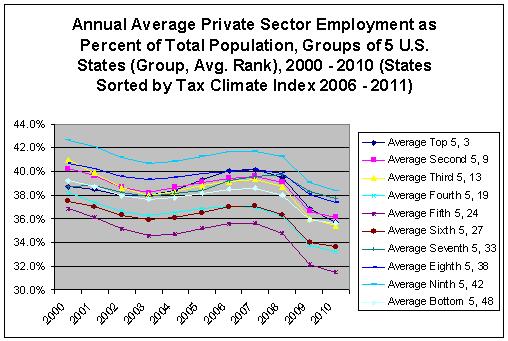
State Groups by Tax Rank
Data Sources: U.S. Bureau of Labor Statistics, U.S. Census, Tax Foundation.
States Top % By Tax Rank
Data Sources: U.S. Bureau of Labor Statistics, U.S. Census, Tax Foundation.
States Bottom 5 By Tax Rank
Data Sources: U.S. Bureau of Labor Statistics, U.S. Census, Tax Foundation.

Annual Change in Distribution of Percents of State Populations That Are Employed

2000 2001 2002 2003 2004 2005
Range 15.6% 14.5% 13.9% 14.0% 14.1% 14.5%
Minimum 30.9% 31.3% 30.9% 30.5% 30.6% 30.7%
Maximum 46.4% 45.8% 44.9% 44.5% 44.7% 45.2%
         
2006 2007 2008 2009 2010
Range 14.4% 14.3% 14.8% 16.0% 15.6%
Minimum 31.1% 31.1% 30.6% 28.7% 28.3%
Maximum 45.5% 45.4% 45.4% 44.6% 44.0%

———————–Comments———————–

What is striking in the first chart above (employment change for groups of states defined by Tax Climate Ranking) is that the patterns of change are so similar across the groups.  One might easily imagine the changes are choreographed.

This much unity of change is not consistent with the oft stated assertion that state policies have a large impact on state level employment change.  It is much more consistent with the proposition that state level employment change is driven primarily by economic forces that transcend state boundaries.

This interpretation is supported by variations within Tax Climate Ranking groups (second and third charts).  If state economic policies produced large employment effects, one would expect states with very different Tax Climate Rankings to proceed along visibly different employment change paths, while states with similar Tax Climate Rankings would proceed along similar employment change paths.  This isn’t the case.

The differences among the patterns of change for the closely ranked top ten states and among the patterns of change for the closely ranked bottom ten states appear to be greater than the differences among the patterns of change for groups of states.

Other employment change charts using the same formats  (not included here) display very similar patterns.  Again, patterns of change across groups are very similar  and differences within groups are as large as differences across groups.

For those charts the same employment change data were sorted differently.  One set of charts displays patterns of change for ten groups created by sorting the employment change data on percent of total population employed in 2000 (on the assumption that different initial employment levels might correspond to different policy histories and thus produce divergent change patterns).  The second set displays patterns for groups created by sorting the data on change in the percent of total population employed from 2000 to 2010 (on the assumption that differences among states in how well they performed over the decade might reflect policy differences other than Tax Climate that would produce noticeable differences in patterns of change).

The last item above, the table showing the distribution of percents of state populations employed,  offers more evidence that state employment levels change in unison.  Over the course of the decade the highest percent of population employed and the lowest percent change together, producing an almost constant range between highest to lowest.  Again, this is much more in keeping with conclusion that economic forces that transcend states in scope, not state policies, drive employment change at the state level.

A Plausible Explanation

It would be very surprising to find policy differences across states large enough to produce large differences in patterns of employment growth.

First, the states are part of a national governmental system in which constitutional provisions limit the policy options available to states, state governments are very similarly organized, and policy makers generally agree on the beneficence of the free enterprise system.  These factors inhibit the development of large policy differences among states.

Second, when a state enacts a policy or set of policies that seem to provide it with investment and employment growth advantages over other states, those other states adopt those or similar policies very quickly.  Thus, large policy differences will not persist.

Third, U.S. states are exposed to economic forces that are global in scope.  Global financial and production corporations move large volumes of money and commodities  across state and national boundaries.  So do many local businesses.  Ownership often transcends state and national boundaries.   States are subject to the policy rules of numerous  bilateral and multilateral trade and investment agreements entered into by the U.S.

These global economic forces are certainly powerful enough to overwhelm the effects of policies limited in scope to state boundaries and to wash away the employment change differences among states that policy differences might otherwise produce.

No Real U.S. Job Growth Until the World’s Middle and Lower Income Families See Real Income Growth

The distance between the richest and poorest countries has widened to a gulf. The richest country today (Liechtenstein) is three times richer than the richest country in 1970. The poorest country today (Zimbabwe) is about 25 percent poorer than the poorest country in 1970 (also Zimbabwe). It is sobering to see, amid enormous material prosperity in developed countries, that the real average income of people in 13 countries in the bottom quarter of today’s world income distribution is lower than in 1970.”

Human Development Report 2010 – 20th Anniversary Edition, The Real Wealth of Nations: Pathways to Human Development, p. 42.

Even with the economy in a funk and many Americans pulling back on spending, the rich are again buying designer clothing, luxury cars and about anything that catches their fancy. … Many high-end businesses are even able to mark up, rather than discount, items to attract customers who equate quality with price.

Stephanie Clifford, Even Marked Up, Luxury Goods Fly Off Shelves, New York Times, August 3, 2011.

Trends U.S. Blue Collar Earnings in Manufacturing

Chart source: Richard Wallick, Auto Industry Labor Costs in Perspective,  Bureau of Labor Statistics, Originally Posted: April 22, 2011.

———————–Comments———————–

Increased global spending on yachts, private planes, high end sports cars, multi-million dollar homes, $200 per person meals, and other luxury items does produce a number of new jobs in the world economy – but not many.

Income growth for the world’s middle and lower income working people does the heavy lifting for global job creation.  Increases in spending by middle and lower income families send huge numbers of the world’s global corporations, neighborhood businesses, and governments looking for new employees.

No real income growth for the world’s middle and lower income families translates into insufficient growth in demand for the increasing volumes of goods and services that can be produced by the world economy, and from there almost directly into no progress in the U.S. on reducing unemployment and underemployment.

The U.S. is deeply enmeshed in a demand starved world economy and U.S. economic policy does not directly address that aspect of our situation.

Global Technology and Education Trends Increase Global Competition for High End U.S. Jobs

“Taiwanese contract manufacturer Hon Hai Precision Industry Co. (2317.TW) said Tuesday it…plans to increase the use of robotic arms across its production lines to cope with rising demand for electronics and increasing costs…Hon Hai aims to increase robotic arms to 1 million units by 2013 from 10,000 currently…Hon Hai plans to increase automation on “dangerous and monotonous” tasks and to migrate more of its workers to “value-added” jobs such as product research and development.”

Lorraine Luk, Hon Hai Says To Increase Automation But Will Also Boost Work Force, Dow Jones Newswires, August 02, 201, published at FoxBusines,

“In 1998…Chinese universities and colleges produced 830,000 graduates a year. Last May, that number was more than six million and rising…the supply of those trained in accounting, finance and computer programming now seems limitless, and their value has plunged. Between 2003 and 2009…starting pay for college graduates stayed the same, although their wages actually decreased if inflation is taken into account.”

Andrew Jacobs, China’s Army of Graduates Struggles for Jobs, New York Times, December 11, 2010

“…among citizens between the ages of 25 and 34 in developed countries, America ranked 12th [for percentage of 25- to 34-year-olds with an Associate Degree or higher, 2007]. In this key demographic group, Canada, Korea, the Russian Federation, Japan, New Zealand, Ireland, Norway, Israel, France, Belgium and Australia are ahead of the United States. Also, Denmark and Sweden are close to parity with our nation.”

John Michael Lee, Jr. and Anita Rawls, The College Completion Agenda: 2010 Progress Report, CollegeBoard Advocacy and Policy Center,

“The world, in terms of choices available to educated, ambitious workers and entrepreneurs, is way bigger than just the United States, Japan and Europe.”

Paul Singer, founder of Elliot Management, as quoted in The Economic Manifesto of Elliott’s Paul Singer, By Evelyn M. Rusli and Azam Ahmed.

‘American jobs have been moving overseas for more than two decades. In recent years, though, those jobs have become more sophisticated — think semiconductors and software, not toys and clothes…[quoting Jeffrey Sachs, globalization expert and economist at Columbia University:] “What’s changed is that companies today are getting top talent in emerging economies, and the U.S. has to really watch out.”‘

Pallavi Gogoi, Many U.S. companies are hiring … overseas: One reason why U.S. unemployment remains as high as it is, Associated Press, 12/28/2010, published at MSNBC.

———————–Comments———————–

The U.S. is not alone in the world in the pursuit of high end jobs to grow middle class incomes and not likely to be successful enough in that endeavor to revitalize U.S middle class income growth.  The following global trends are moving strongly against high end job growth in the U.S. and the U.S. economic policy approach does not address these trends.

  • Rapid automation of production processes across the globe is increasing citizen pressure on the world’s governments to train more and more workers for high end jobs
  • Competition among the world’s numerous nations for investments that create high end jobs is intensifying as global employment growth stagnates
  • Expanding global investments in higher education are increasing competition among highly educated workers for an insufficient number of high end jobs
  • U.S.  corporations are taking advantage of the growing number of nations with educated workers to bargain with highly educated U.S. workers for wages and benefits concessions.