Employment Optimism? Really? This January was Worse than January 2011 and Adverse Global Economic Forces are Still in Play

ITEMS FOR YOUR CONSIDERATION
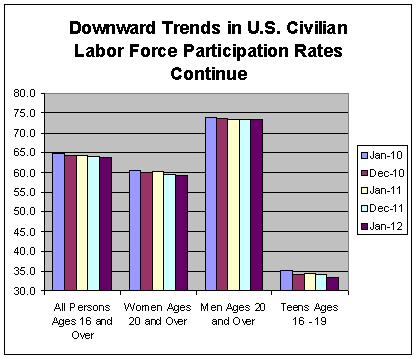
Downward Trends in U.S. Civ Labor Force ContinueData source: Labor Force Statistics from the Current Population Survey, Bureau of Labor Statistics

—————

Private Sector Job Growth is Dominated By Lower Wage Industries

Percent of Private Sector Job Growth By Selected Industries

Jan-11

Dec-11

Jan-12

Goods-Producing

30.3%

32.3%

31.5%

Private Service-providing

69.7%

67.7%

68.5%

Retail Trade

31.0%

2.8%

4.1%

Temporary Help Services

13.5%

3.8%

7.8%

Leisure and Hospitality

-6.7%

8.6%

17.1%

Other services

-5.9%

2.3%

2.7%

Total 4 Selected Service Providing

31.9%

17.5%

31.8%

Data source: Employment Situation Summary Table B, Employment News Release, Bureau of Labor Statistics, February 3, 2012.

—————

Job Cuts, January 2012 Greater than in January 2011

(Ten Industries with Highest Cuts)


January 2012

January 2011

Retail

12,426

5,755

Financial

7,611

2,822

Pharmaceutical

4,071

2,090

Entertainment/Leisure

3,910

1,545

Aerospace/Defense

3,634

3,167

Government/Non-Profit

3,021

6,450

Food

3,000

873

Consumer Products

2,464

1,783

Industrial Goods

2,230

1,874

Transportation

1,770

725

Data Source: 2012 Kicks Off With 28% Surge in Job Cuts, Press Release, Challenger, Gray & Christmas, February 2, 2012.

—————

January 2012 Purchasing Managers’ Index (PMI) for Manufacturing Lower than in  2010 and 2011

2010

January

April

July

Oct

56.7

59.0

55.7

57.0

2011

2012

January

April

July

Oct

January

59.9

59.7

51.4

51.8

54.1

Data source: table of Manufacturing Business PMI history, Institute for Supply Management. 

—————

“The man in charge of a firm with several hundred thousand staff around the world bemoaned that, ‘we live in a world where wealth creation is uncoupled from job creation. This once close connection is ruptured.'”

Tim Weber, Davos 2012: Youth unemployment ‘disaster’, BBC News website, January 28, 2012.

—————

SMBs in developing countries are keeping pace with their more developed counterparts when it comes to providing employees with smartphones, netbooks/mini notebooks, and media tablets. In some cases, they are actually more likely to provide these products to their staff.

The Consumerization of IT Helps Level the SMB Playing Field Across the World, IDC Says, Press Release, International Data Corporation (IDC), January 25, 2012.

—————

“This suggests that the labor market has changed in ways that prevent the cyclical bounceback in the labor market that followed past recessions. … Stricter market incentives to control costs in the face of stiff domestic and international competition may also be factors. In addition, anecdotal evidence suggests that recent employer reluctance to hire reflects an unusual degree of uncertainty about future growth in product demand and labor costs. These special factors are not readily addressed through conventional monetary or fiscal policies. But such policies may be able to offset the central obstacle of weak aggregate demand.”

Rob Valletta and Katherine Kuang, Why Is Unemployment Duration So Long?, Federal Reserve Bank of San Franscisco Economic Lettter, January 30, 2012.

COMMENTS

The only way to arrive at optimism about U.S. employment is to focus attention on indicators that are poorly related to unemployment changes (GDP growth, initial unemployment insurance claims, the traditional unemployment rate) and ignore global economic forces that continue to spell trouble for U.S. employment growth

Misleading indicators:

  • An uptick in the rate of GDP growth is misleading about employment growth because machines now play such a large role of in the production and sale of goods and services in the U.S.;  modest upswings in GDP can take place with almost no impact on employment
  • Initial claims for unemployment insurance (UI) get a lot of press, but only about 43 percent of unemployed workers receive UI; unemployment among workers who mostly do not qualify (many workers in retail and service industries) can rise or fall dramatically with little impact on initial claims
  • As is well known, the traditional unemployment rate is a downwardly biased measure of unemployment; it does not count as unemployed persons who have opted to do something other than look for work until prospects improve (e.g., going to school,  taking a self-financed sabbatical, making repairs to the house) and does count as employed persons who want full time employment but can only find part-time employment and persons who are working in jobs beneath their qualifications.

Global forces that undercut U.S. job growth are still in play:

  • Global and U.S. GDP growth rates will be modest through at least 2012 because of financial turmoil, lots of supply, and weak demand
  • The number of competing nations in the world economy has not diminished and very high levels of unemployment are pushing many nations to become even more aggressively competitive
  • Slow global market growth continues, which means the world’s global businesses must continue to relentlessly cut labor and other costs to survive
  • Emerging market countries with skilled workers, advanced production capacities, and much lower production costs will continue to outbid the U.S. for the investments that produce the most jobs per dollar of investment
  • Facing higher production costs in the U.S., much of the investment in the U.S. will continue to be in high tech, high profit activities that produce relative few jobs, and those jobs will be ones for which very few U.S. workers have the required skills.

The labor force participation rate, which is a better indicator of whether we should be optimistic about job growth, has been trending downward for many years.  Taken as a whole, economic signals indicate that this trend is locked in, whatever economists and reporters may wish to read into short term economic indicators.

The Transition To A Clean And Sustainable World Economy Will Change Job Descriptions, But It Will Not Increase Global Job And Income Growth

CONSIDER THE FOLLOWING ITEMS

“While there are conflicting views about whether any changes in total employment would be positive or negative, there are likely to be quite significant impacts in terms of shifting employment patterns between sectors as economic development shifts from “brown” to “green” economic sectors.”

Green Growth Studies: Energy, Preliminary Version, Organization for Economic Cooperation and Development (OECD), 2011.

—————

“Across the range of issues to be addressed, policy initiatives should be designed in terms of: cost-effectiveness, adoption and compliance incentives, and ability to cope with uncertainty and provide a clear and credible signal to investors.”

Towards Green Growth, Organization for Economic Cooperation and Development (OECD), 2011. 

—————

“Many countries are using a menu of policy incentives instead of a single policy approach. Policy makers realize that these incentives need to be coherent, stable and designed for the long-term to be able to attract the necessary funds for robust deployment and strong markets that ultimately will reduce the cost of renewable energy.”

Report of the Secretary-General – Promotion of new and renewable sources of energy (Advance unedited copy), UN Department of Economic and Social Affairs, Division for Sustainable Development, August 15, 2011.

COMMENTS

Global job and income growth are in trouble whether the world makes the transition to a cleaner and more sustainable economy slowly or quickly.  If the transition is done slowly the world will suffer large job and income losses due to the negative impact of environmental pressures on economic growth.  Losses will also occur because of a poorly designed “green” investment strategy.

If the transition is done quickly, job and income losses due to environmental pressures will be reduced, but more losses will be caused by the “green” investment strategy itself.

The current strategy for transitioning to a clean and sustainable global economy relies heavily on market competition and traditional governmental policy tools to put downward pressures on the costs of producing cleaner energy and to motivate business enterprises to create alternatives to resources that are being depleted.  Thus, the current strategy leaves the institutional forces that are slowly eroding global employment and income levels in tact.

At the core of those institutional forces are the scope and intensity of competition among business enterprises and governments.  Global scale communications, trade agreements, investment flows, and commodity flows now bring many more investors and business enterprises virtually face to face in the same markets.

Faced with many more competitors, business enterprises invest heavily in finding ways to reduce labor costs.  Moreover, governments abet these efforts by helping their domestic business enterprises with policy structures and financial subsidies that encourage investments in machines rather than workers.  In this economic environment, job destruction and wage reductions in some sectors and regions of the world economy generally outpace job creation and wage growth in other sectors and regions of the world economy.

An accelerated “green” transition will exacerbate the gaps between job creation and job destruction, wage growth and wage decline.  It will shift more investment funds to the energy sector, which is very machine and technology intensive.  More investment funds will also go to enterprises engaged in the development and production of resource alternatives, enterprises that tend to be more highly automated and employ fewer workers that the enterprises they replace.  The net result will be a further decline in global demand for workers and lower wages.

The transition to a clean and sustainable world economy can be done without harm to employment and income growth, but only by simultaneously reducing system wide downward pressures on job and income growth.  This can be done by making increased governmental management of global market forces and the increased use of governmental employment and income programs (to supplement private sector employment and compensation levels) components of the “green” transition strategy.

What Happens In Vegas Doesn’t Stay In Vegas: National Policies Have Global Consequences

“Thus, national policies affecting capital flows can transmit multilaterally. This transmission has not been fully appreciated by national policymakers. Further, they may not have incentives to take full account of the cross-border effects of their policies. Looking ahead, the upward trend in the volume of capital flows can be expected to continue, making it ever more important to address the associated cross-border risks.”

The Multilateral Aspects of Policies Affecting Capital Flows, International Monetary Fund, October 13, 2011.

—————

“These two-way capital flows created a complex web among markets and institutions, some regulated and some not. Against this background, case studies were prepared for European banks and U.S. money market mutual funds (MMMFs) and for German banks and U.S. mortgage-backed securities (MBSs). Another important case is that of the near failure of the American International Group (AIG), which turned out to have complex and systemically cross-border linkages with other global institutions and markets.”

The Multilateral Aspects of Policies Affecting Capital Flows – Background Paper, International Monetary Fund, October 24, 2011.

—————

“Why might we expect a rise in U.S. bond yields to raise bond yields in other countries? First, openness of financial markets and arbitrage opportunities may mean that interest rate shocks are transmitted across economies. Second, a closer real integration of two economies may imply that a monetary policy shock or an inflationary shock in one economy may lead investors to expect similar developments in another, thus inducing a significant transmission of shocks in bond markets and money markets.”

Vivian Z. Yue and Leslie Shen, International Spillovers on Government Bond Yields: Are We All in the Same Boat?, August 01, 2011, Blog at website of the Federal Reserve Bank of New York.

—————

“The trend toward greater diffusion of authority and power occurring for a couple decades is likely to accelerate because of the emergence of new global players, increasingly ineffective institutions, growth in regional blocs, advanced communications technologies, and enhanced strength of nonstate actors and networks.”

Global Trends 2025: A Transformed World, National Intelligence Council, PDF version, November 2008.

———————–Comments———————–

The words in the quotes above are dispassionate, but the realities to which they refer get in our faces every day.  The mix of global economic processes and competitive and uncoordinated national policy making creates a bubbling soup of chaotic change.  (Go-it-alone economic policy making by sub-national and regional governments surely contribute to this soup of chaotic change as well.)

This environment makes decision making and planning very difficult and prone to error for the majority of the world’s investors and business owners and managers. It destabilizes the global world of work and damages the families and communities that depend on that world.  And it confounds policy experts because it is not possible to find logic in the illogical.

Moreover, this environment plays into the hands of the bad actors in the world economy, who promote and thrive on the high volumes of misunderstandings and errors that now plague economic and policy decision making at every level of organization in the world economy.

For more on this topic see my post, Fragmented and Weakened Global Governance Perpetuates the World’s Employment Crisis, September 9, 2011. Also see the topic Economics and Economic Policy (under U.S. Economic Policy heading at right).