The Sharing Economy: Mobilizing Underutilized Assets or Degradation of Quality of Life in Times of Job Scarcity and Income Stagnation?

SOURCE ITEMS

PAUL SOLMAN: A peak efficiency economy, that is, putting idle resources to work, like a car, or your own idle time. Cook a meal for strangers on Feastly or work a freelance gig in your downtime on oDesk or Elance.

And speaking of idle, how about that empty space in your house? The app DogVacay lets you rent it out to bored canines. One of the most popular sharing economy platforms extends that idea to humans, Airbnb, now turning the hospitality industry on its head.

The new ‘sharing economy’ can enrich micro-entrepreneurs but at what cost? PBS NewsHour, October 10, 2014.

—————

Our indicators of leisure quality show that, despite increases in the quantity of leisure over this period (as reported by Aguiar and Hurst [2007 ] and others, and confirmed in Section 5 below), the quality of leisure has decreased for all groups.

Almudena Sevilla Sanz, José Ignacio Giménez, Nadal Jonathan Gershuny, Leisure Inequality in the US: 1965-2003, Sociology Working Papers, Department of Sociology, University of Oxford.

—————

But this is not by virtue of people wanting to work less — it’s by virtue of people being able to work less.

That’s an important distinction: being able to make a living and support your family by working 40 hours a week versus 80 hours a week.

Peter Diamandis, Evidence of Abundance #1: More Leisure, Less Work, Forbes, June, 27, 2014.

—————

Specifically, the allocation of time for less‐educated and highly educated adults started to diverge in 1985 (panel B of Table 6) and was dramatically different by 2003 (panel C of Table 6).
Taken together, the results of Table 6 and Figures 6a and 6b document an increase in the dispersion of leisure favoring less educated adults, particularly in the last 20 years. This corresponds to a period in which wages and consumption expenditures increased faster for highly educated adults.

Mark Aguiar and Erik Hurst, Measuring Trends in Leisure: The Allocation of Time over Five Decades, Working Papers, Federal Reserve Bank of Boston, January 2006.

—————

In economics, capital goods, real capital, or capital assets are already-produced durable goods or any non-financial asset that is used in production of goods or services. … Homes and personal autos are not usually defined as capital but as durable goods because they are not used in a production of saleable goods and services.

Capital (economics), Wikipedia, Accessed 10/11/2014.

—————

Around the world, working-age people with full-time jobs (and therefore weekends and distinct non-work time) are now a minority: According to a new survey of 136,000 people in 136 countries by Gallup, 26 per cent of working people “worked full-time for an employer in 2013.” In India, nearly three of four are informally employed, according to the national statistics agency, either doing day-by-day piecework or buying and selling things.

Doug Saunders, Work? Leisure? It’s all a blur these days, The Globe and Mail, Aug. 30 2014.

COMMENTS

The positive spin on the sharing economy is that people have unused assets they can turn into capital and income.  A spare room in the house or a car that is not always in use can be transformed into capital for a business. Non-work time can be turned into work time and thus into income.

But, what does it say about the quality of life when everything you own is seen as capital or potential capital and every waking hour is seen as potential work time? Only a generation ago, being middle class was understood to include owning things just for the pleasure of having and using them and to include having lots of time not a work to spend with family and friends enjoying our spacious homes, our comfortable cars, our hobbies, and our many wonderful toys.

The rise of the sharing economy must be put in the proper context: the globalization of competition for jobs and income, the technological destruction of higher end jobs, the permanent slow down in the growth of global wealth, and the steady increase in the world’s working age population. These forces brought the growth of middle class incomes in affluent countries to a halt over the last several decades, even while costs associated with middle class life continued to rise rapidly – costs for college, good health care, and higher end consumer goods.

The sharing economy seems new to many of us in affluent nations, but it has been a staple of human societies all along. It’s the technologies that Uber, Airbnb, and other sharing economy enterprises use that fool us into thinking the sharing economy is a modern or postmodern model of economic activity. For most of human history, people have engaged in peer to peer economic activities within the small populations their communication and transportation technologies could knit together.  For most of human history people have necessarily used every available asset. They have necessarily done work in the places where they live and seen their own time and the time of their children as potential income.  They have made almost no distinction between work and leisure.  Ironically, what we are now calling a different and promising future is in fact just a continuation of what has historically been typical.

In another form, the sharing economy could offer a promising future. In its present form, it is only another of the many ways in which the world’s middle income people adapt to their ongoing economic decline by undercutting each others’ wages.

The world’s peoples do have to adapt to emerging limits to the growth of affluence, but we should choose to implement new technologies in ways that create real forms of economic sharing not new forms of all against all competition.
Uber, Coops, Falling Standards of Living, and the Future of Work in the World Economy

SOURCE ITEMS

In addition, because Uber drivers are considered independent contractors, they are not entitled to benefits; their relationship with Uber is merely about their use of the company’s app that connects them to riders. As contractors, they have the flexibility to work when they want and as many hours as they choose, but they also have to cover any costs they incur. After adding up those costs, some drivers say, making a profit is nearly impossible.

Luz Lazo, Some Uber drivers say company’s promise of big pay day doesn’t match reality, Washington Post, September 6.

—————

Some 130 million Americans, for example, now participate in the ownership of co-op businesses and credit unions. More than 13 million Americans have become worker-owners of more than 11,000 employee-owned companies, six million more than belong to private-sector unions.

Gar Alperovitz, Worker-Owners of America, Unite! New York Times, December 14, 201.

—————

With nearly half of all services jobs in the OECD at risk of automation, the sharing economy can smooth the disruption caused to displaced workers as they upgrade their skills. Indeed, sharing-economy data can help governments identify those workers at greatest risk and support their retraining. … Those who are displaced will have far better prospects in the more prosperous and inclusive environment that the sharing economy promises to create.

Ayesha Khanna and Parag Khanna, Disciplining the Sharing Economy, Project Syndicate, September 25, 2014.

—————

Was my house cleaner — the one I’d hired through a company that has raised $40 million in venture-capital funding from well-respected firms like Google Ventures, the one who was about to perform arduous manual labor in my house using potentially hazardous cleaning chemicals — homeless?

He was, as it turned out. And as I told this story to friends in the Bay Area, I heard something even more surprising: Several of their Homejoy cleaners had been homeless, too. … Homejoy doesn’t employ any cleaners — like many of its peer start-ups, it uses an army of contract workers to do its customers’ bidding.

Kevin Roose, Does Silicon Valley Have a Contract-Worker Problem? New York Magazine, September 18, 2014.

—————

According to a Wells Fargo/Gallup survey of small-business owners conducted earlier this year, 56% of small-business owners, up from 45% in 2010, are either extremely or very satisfied with being a small-business owner. But fewer owners, 37%, say they feel extremely or very successful as a small-business owner — the lowest figure in a decade.

Coleen McMurray and Frank Newport, Small-Business Owners Satisfied, but Fewer Feel Successful, Gallup, September 30, 2014.

—————

Eighteen percent of all adults worldwide — or 29% of the global workforce — reported being self-employed in 2013. But rather than a positive sign of proactive entrepreneurial energy, high rates of self-employment can often signal poor economic performance. The self-employed are three times as likely as those who are employed full time for an employer to be living on less than $2 per day.

Ben Ryan, Nearly Three in 10 Workers Worldwide Are Self-Employed, Gallup, August 22, 2014.

—————

Self-employment higher than at any point over past 40 years … Average income from self-employment fallen by 22% since 2008/09

Self-employed workers in the UK – 2014, UK Office for National Statistics, August 20, 2014.

—————

Nearly one in three working Americans is an independent worker. That’s 53 million people – and growing. We’re lawyers and nannies. We’re graphic designers and temps. We’re the future of the economy.

About Us, Freelancers Union. Accessed October 4, 2014.

—————

The puzzle goes beyond earnings. Not only are the median earnings of the self-employed comparatively low, they have similar traits to those of salaried workers. … If the self-employed are a good proxy for “growth-creating innovators,” it is both puzzling that their cognitive abilities and noncognitive traits are similar to those of their salaried counterparts and that they earn less.

Ross Levine and Yona Rubinstein, Does Entrepreneurship Pay? The Michael Bloombergs, the Hot Dog Vendors, and the Returns to Self-Employment, Haas School of Business, University of California, Berkeley, July 2013.

—————

There, and in other countries with less well-developed social security systems and which suffered from large losses in (formal) employment, many previously economically inactive people returned to the labour market, often to take up informal employment in order to make up for the loss of household income.

Global Employment Trends 2014, International Labour Organization.

—————

Already we can see the contours of another economy in the shape of new communitarian movements through which local communities resist and respond to the multiple crises of global capitalism and innovate alternatives to meet economic needs…

Anup Dash, Toward an Epistemological Foundation for Social and Solidarity Economy, Occasional Paper 3, Potential and Limits of Social and Solidarity Economy, United Nations Research Institute for Social Development (UNRISD), March 2014.

COMMENTS

From time to time in the history of the capitalist world economy, its magic has faltered and then been restored. This time the magic will sporadically flicker on for a while here and there in the world economy, but it will not be restored. Conditions for a restoration are disappearing and will not come back.

The undoing of key elements of formal wage employment systems has been increasing the financial and emotional burdens on the world’s working people. The growth of these burdens is pushing the world’s communities of working people into a long-term period of economic uncertainties and crisis.

Around the world, formal (government regulated) wage employment systems are faltering. By necessity, the world’s workers are examining a wide range of possibilities for saving, improving, or changing their work life situations. At the same time, large numbers of organizing entrepreneurs are offering up a large variety of strategies, from coops to unions, to entrepreneurial self-employment, to political activism, to disengagement and resistance.

It is probably true to say that most of the world’s working people do not think of themselves as economic experimenters and do not want to be economic experimenters. In lower income parts of the world where formal wage employment systems have always been more promise than reality, most people probably want a formal wage employment system to become a reality where they are and in their lifetimes.

In the higher income parts of the world, most working people who have lost wages and benefits and job security still believe a return to “normal” scenarios of employment is possible and still look to mainstream economists and policy experts to make that return happen.

The world’s working families may not wish to be the inventors of a new world of work, but they face very limited options: nostalgically clinging to the past as the hope for the future; learning to live with less while psychologically acquiescing to the losses; or, struggling to secure employment and income security through means other than standard wage employment.

The possibility of nostalgically clinging to hope for a return to the past is fast disappearing. Acquiescence and inventiveness are really the only two options available. And in the realm of inventiveness, the paths taken include not only coops and various forms of independent self-employment and franchised self-employment, but also a wide range of criminal activities, including violent grabs for economic resources.

The future of work is not predictable in any specific sense, but we can be fairly certain that the spread of systems of formal wage employment that were created in the U.S. and Europe during the 20th century has come to an end. The belief that the global nation state system will soon produce safe, secure, and well paid (by western standards) jobs for the majority of the world’s workers is no longer plausible.

Other ways for the world’s working people to have safe, secure work at living wages must and are being created.

This Is No Time for Irrational Exuberance about Jobs at Living Wages – We’re in a New World of Work

SOURCE ITEMS

Eurozone GDP still hasn’t gotten back to its 2007 level, and doesn’t look like it will anytime soon. Indeed, it already wasn’t clear if its last recession was even over before we found out the eurozone had stopped growing again in the second quarter. And not even Germany has been immune: its GDP just fell 0.2 percent from the previous quarter.

Matt O’Brien, Worse than the 1930s: Europe’s recession is really a depression, Washington Post, August 20, 2014. Web 9/5/2014.

—————

Total nonfarm payroll employment increased by 142,000 in August … Manufacturing employment was unchanged in August, following an increase of 28,000 in July. Motor vehicles and parts lost 5,000 jobs in August, after adding 13,000 jobs in July. Auto manufacturers laid off fewer workers than usual for factory retooling in July, and fewer workers than usual were recalled in August. Elsewhere in manufacturing, there were job gains in August in computer and peripheral equipment (+3,000) and in nonmetallic mineral products (+3,000), and job losses in electronic instruments (-2,000).

Employment Situation Summary, U.S. Bureau of Labor Statistics, September 5, 2014. Web 9/5/2014.

—————

Today’s report also included revisions to first-quarter personal income. Wages and salaries rose by $131.3 billion, revised down from an initially reported $135.1 billion gain. They climbed by $103.6 billion in the second quarter.

Shobhana Chandra, Economy in U.S. Expands 4.2%, More Than Previously Forecast, Bloomberg, August 28, 2014.

—————

Almost 21 million people are victims of forced labour – 11.4 million women and girls and 9.5 million men and boys. … Almost 19 million victims are exploited by private individuals or enterprises and over 2 million by the state or rebel groups. … Forced labour in the private economy generates US$ 150 billion in illegal profits per year.

Facts and Figures, Forced labour, human trafficking and slavery, International Labour Organization, Web 9/5/2014.

—————

Comparing the first half of 2014 with the first half of 2007 (the last period of reasonable labor market health before the Great Recession), hourly wages for the vast majority of American workers have been flat or falling. And even since 1979, the vast majority of American workers have seen their hourly wages stagnate or decline…

Elise Gould, Why America’s Workers Need Faster Wage Growth—And What We Can Do About It, Economic Policy Institute, August 27, 2014. Web 9/5/2014.

COMMENTS

The U.S. is deeply tied to the rest of the world economy and the world economy is plagued by contradictory national economic policies, geopolitical instability, extreme weather conditions, and rising prices. These are chronic conditions that will continue to prevent the world economy from achieving a steady rate of economic growth high enough to grow jobs and incomes.

Slow economic growth combined with high levels of global income and wealth inequalities can only produce a steady stream of domestic and geopolitical disasters. Slow economic growth is probably a permanent feature of the 21st century world economy, so we have to learn to live with it. We can, however, do a lot to reduce economic inequalities.

STEM Education Falls Short: The Problem is Too Few Jobs, Not Too Little Education

SOURCE ITEMS

According to new statistics from the 2012 American Community Survey, engineering and computer, math and statistics majors had the largest share of graduates going into a STEM field with about half employed in a STEM occupation. Science majors had fewer of their graduates employed in STEM. About 26 percent of physical science majors; 15 percent of biological, environmental and agricultural sciences majors; 10 percent of psychology majors; and 7 percent of social science majors were employed in STEM.

 Census Bureau Reports Majority of STEM College Graduates Do Not Work in STEM Occupations, U.S. Census Bureau, July 2014.

 —————

Since cohort-wage profiles display a similar pattern, these findings appear to fit with a strong increase in demand for cognitive tasks in the 1990s followed by a decline in the 2000s.

 Paul Beaudry, David A. Green, and Benjamin M. Sand. The Declining Fortunes of the Young since 2000, American Economic Review, 2014

 —————

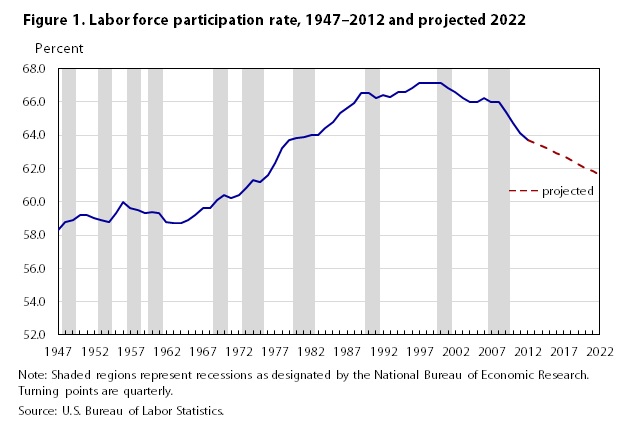
Chart-Labor Force Participation Rate Trend

The labor force is anticipated to grow by 8.5 million, an annual growth rate of 0.5 percent, over the 2012–2022 period. The growth in the labor force during 2012–2022 is projected to be smaller than in the previous 10-year period, 2002–2012, when the labor force grew by 10.1 million, a 0.7-percent annual growth rate.

 Labor force projections to 2022: the labor force participation rate continues to fall, Monthly Labor Review, December 2013.

 COMMENTS

We now live in a world economy in which economic processes and trends are global. Global economic growth is constrained and will continue to be into the foreseeable future. As a consequence, current patterns of investment, domestic and global, will not generate a sufficient number of jobs to produce anything near global full employment at living wages.

Economic activity in the U.S. does not constitute a separate economy, so U.S. economy policies cannot produce full employment and high wages in the U.S. while the rest of the world is stuck with high rates of unemployment and low wages.   Investment follows profits.  Profits are maximized by producing in low income places in the world economy and selling in high income places.  Unfettered transnational flows of capital and commodities combined with preventing low-skill working people from easily crossing national boundaries in search of work gives the world’s investors the legal framework with which to manage the world’s labor supply to their advantage.

1st Quarter 2014 Economic Decline: Not Unique and Not Due to Idiosyncratic Factors

SOURCE ITEMS

Gross domestic product fell at a 2.9 percent annualized rate, more than forecast and the worst reading since the same three months in 2009, after a previously reported 1 percent drop, the Commerce Department said today in Washington. It marked the biggest downward revision from the agency’s second GDP estimate since records began in 1976.

Jeanna Smialek, U.S. Economy Shrank in First Quarter by Most in Five Years, Bloombert.com, June 25, 2014.

—————

A combination of shrinking business inventories, terrible winter weather and a surprise contraction in health care spending drove the first-quarter decline, which is the worst since the first quarter of 2009, when the economy shrank at a 5.4 percent rate.

But the economy was hit by an unlikely combination of negative forces that conspired to turn what seemed set to be another quarter of so-so growth into a considerably more gloomy experience.

 Neil Irwin, Economy in First Quarter Was Worse Than Everybody Thought, New York Times, June 25, 2014.

—————

That’s one of the findings in a report published today called “Risky Business,” commissioned by some of America’s top business leaders to put price tags on climate threats. For example, by the end of the century, between $238 billion and $507 billion of existing coastal property in the U.S. will likely be subsumed by rising seas, and crop yields in some breadbasket states may decline as much 70 percent.

Tom Randall, Climate Forecast: A Heat More Deadly Than the U.S. Has Ever Seen, Bloomberg.com, June 24, 2014.

COMMENTS

Economists and other experts continue to describe economic bad news as temporary and to predict a return to “normal”. This is wishful thinking. The world we once knew is now on its head: frequent encounters with combinations of economic growth stopping events is the new normal.

  • Extreme weather is not temporary: we are well into a new weather world that is changing everything about what can be expected for growth in the world economy.
  • Reduced health care spending is not a surprise: any way you cut it, in the U.S. a huge part of health spending is funded by the federal government; cut federal spending and you cut health care spending.
  • Declining consumer spending is not temporary: consumer incomes have been stagnant or falling for decades, the labor force participation rate has been falling for decades, and neither trends in union membership nor trends in government wage protection and employment policies suggest that wages will rise and labor force participation will rise.
  • Geopolitical upheavals like the current insurgency in Iraq are here to stay: rising income and wealth inequalities have produced a world filled with hundreds of millions of people who are big losers; they are all looking for ways to reverse their fortunes.


A Gathering Consensus About the Limits to National Economic Policy?

SOURCE ITEMS

Despite the subsequent decision of the Group of 20 in 2009 on the need for rules to supervise what is now a globally integrated financial system, world leaders have spent the last five years in retreat, resorting to unilateral actions that have made a mockery of global coordination. Already, we have forgotten the basic lesson of the crash: Global problems need global solutions. And because we failed to learn from the last crisis, the world’s bankers are carrying us toward the next one.

Gordon Brown, Stumbling Toward the Next Crash, New York Times, Published: December 18, 2013.  (Gordon Brown, a Labour member of the British Parliament, is a former chancellor of the Exchequer and prime minister.)

—————

Nothing endangers globalization more than the yawning governance gap – the dangerous disparity between the national scope of political accountability and the global nature of markets for goods, capital, and many services – that has opened up in recent decades. When markets transcend national regulation, as with today’s globalization of finance, market failure, instability, and crisis is the result.

Dani Rodrik, National Governments, Global Citizens, Project Syndicate, March 12, 2013.  (Dani Rodrik is Professor of Social Science at the Institute for Advanced Study, Princeton, New Jersey.)

—————

Around the world, policies, technologies, and extended learning processes have combined to erode barriers to economic interaction among countries. Pick any indicator: trade relative to global GDP, capital flows relative to the global capital stock, and so forth – all are rising.

But economic policies are set at the national level, and, with a few notable exceptions like trade negotiations and the tracking of terrorist funding and money laundering, policymakers set goals with a view to benefiting the domestic economy. And these policies (or policy shifts) are increasingly affecting other economies and the global system, giving rise to what might be called “policy externalities” – that is, consequences that extend outside policymakers’ target environment.

Michael Spence, The Blurry Frontiers of Economic Policy, Project Syndicate, September 19, 2013.  (Michael Spence, a Nobel laureate in economics, is Professor of Economics at NYU’s Stern School of Business, Distinguished Visiting Fellow at the Council on Foreign Relations, Senior Fellow at the Hoover Institution at Stanford University, and Academic Board Chairman of the Fung Global Institute in Hong Kong.)

COMMENTS

In certain quarters of American society, one can find rejoicing over the condition of the U.S. economy.  Just today, the Federal Reserve began its long anticipated tapering of its bond buying program for stimulating the U.S. economy, citing enough economic progress to do so.

Given the quotes above, one has to wonder, however, whether a small change in Fed policy in the U.S. will have much effect one way or the other.   The bond buying program is only one in a global sea of public policy mechanisms that affect the U.S. economy.  And some of those other policy mechanisms are being manipulated by actors in the world economy that are quite powerful – the EU, China, the BRICS nations.

It must also be pointed out that the effects of the Fed’s decisions are not contained by U.S. political borders.  Those consequences are spread across the world economy through the global financial system, and some or many nations will be harmed by those effects.  Actions bring reactions and we do not know whether those reactions will conspire with Fed policy to improve employment and incomes in the U.S. or conspire against Fed policy to further damage employment and income growth in the U.S.

See my Blog Posts under Global Economic Governance for more sources and comments.

Tom Friedman’s Jobs World is Interesting But a Bit Flat

SOURCE ITEMS

In today’s hyperconnected world without walls — when more Indians, Chinese, computers, robots and software can perform more average blue-collar and white-collar jobs — the only high-wage jobs are increasingly high-skill jobs

Our kids face three big adjustments. First, to be in the middle class, they will need to be constantly improving their skills over their lifetime. Second, to do that, they will need a lot more self-motivation. … And third, countries that thrive the most will be the H.I.E.’s — the high imagination-enabling countries — that attract and enable talent to be constantly spinning off new ideas and start-ups, the source of most new good jobs.

Thomas Friedman, Can’t We Do Better?, New York Times, December 7, 2013.

 COMMENTS

Tom Friedman is almost always worth reading, but he has yet to acknowledge a societal development that is one of the most consequential for the world’s working families – the transformation of the role that work plays day in and day out in distributing the world economy’s newly created wealth.

Ironically, Friedman identifies the very forces that are undoing the role of work in distributing newly produced wealth, but fails to follow through. He takes us right to the door through which he could walk us to the real solutions to growing poverty and inequality.  He then turns away and offers up the same old failed conventional wisdom.

Friedman and so many others define the problem of low wage jobs and growing inequality as due to the inadequacies of workers (low skills, outdated skills, lack of drive).  They fail to seriously consider the possibility that the world of work is changing in such fundamental ways that no feasible amount of improvement in the skill levels of working people or change in their approaches to getting and keeping jobs can reverse the trend toward lower wages and greater poverty and  inequality.

As Friedman rightly notes, global integration and advancing productive technologies have great consequences for working families and societies, but not because they are creating demand for highly skilled workers and destroying demand for low skilled workers.  The core systemic change is that those forces are producing an enormous and growing surplus of labor, both skilled and unskilled.

The role of machine energy in the production of the world’s goods and services has advanced to such a large proportion of the combination of human energy and machine energy that the available human energy far exceeds the demand for human energy.  Even human thinking energy is being displaced by machine energy.

The trend shows up in the long term decline in the proportion of the world’s population that is employed.  Friedman and others apparently believe that this trend won’t eventually bring us to a point in time when more than half the world’s people are effectively outside the world of work.

How then will we distribute the world economy’s newly created wealth day after day?

The era in which employment could be the primary way in which a person could legitimately claim a fair share of the world economy’s income is nearly over.  Yet Friedman and other experts still have not asked the question in public of what will give a person a right to a fair share of income in this increasingly jobless world.

The world’s people desperately need a new kind of right to income, and until we invent that right, inequality will keep getting worse and more of the world’s people, including Americans, will be shoved into lives of destitution, begging, scavenging, and violence.

Job and Earnings Churning Is Not Job and Earnings Growth

Paul robs Peter, then Peter robs Paul.  Round and round and round.  And we all fall down.

SOURCE ITEMS

At the price of a doubling in unemployment and near-10 percent plunge in labor costs, the so-called peripheral euro nations are reviving manufacturing and trade. In Spain, exports reached a record 222.6 billion euros ($287 billion) in 2012.

Joblessness already tops 25 percent in both Spain and Greece…

Ford Motor Co. (F) (F) said at the end of last year it will increase capacity near Valencia as it shuts plants in the U.K. and Belgium. Peugeot (UG), which is cutting workers in its home market of France, is also lifting output in Spain and Portugal.

Simon Kennedy, Even Greece Exports Rise in Europe’s 11% Jobless Recovery, Bloomberg, March 21, 2013.

—————

Barely two years ago, Brazil’s rapid economic growth and expanding middle class made it the darling of financial markets …. With slow growth and stalled economic reforms, financial markets were about to write off Mexico as a lost cause.

So Brazil has become the star that disappoints, while Mexico is the underperformer that suddenly shines.

Andres Velasco, A Tale of Two Countries, Project Syndicate, March 14, 2013.

—————

Mexico’s minimum wage commission set the increase for 2012 at 4.2% for all three of the country’s geographic zones…

The increase brings the minimum wage in Mexico to 62.33 pesos ($4.60) a day for zone A, which includes Mexico City. The minimum wage is slightly lower in other geographic zones.

What is the minimum wage in Mexico?,Maquila Reference website.

—————

Perry sent letters to 26 gun and ammunition manufacturers earlier this month inviting them to consider a move to Texas if the states they currently operate in impose “restrictive laws” on their industry, according to a copy of the letter and list of the manufacturers provided to ABC News by the governor’s office.

“As you consider your options … you may choose to consider relocating your manufacturing operations to a state that is more business-friendly.  There is no other state that fits the definition of business-friendly like Texas,” Perry wrote, pointing out financial incentives the state offers companies.

Arlette Saenz, Rick Perry Invites Gun Manufacturers to Set Up Shop in Texas, ABC News, February 22, 2013.

—————

We find that products systematically tend to co-appear, and that product appearances lead to massive disappearance events of existing products in the following years…. This is an empirical validation of the dominance of cascading competitive replacement events on the scale of national economies, i.e. creative destruction.

Peter Klimek, Ricardo Hausmann, and Stefan Thurner, Empirical confirmation of creative destruction from world trade data, arxiv, December 13, 2011.

COMMENTS

A few years back, business was booming in Ireland and experts were hailing it as the land of smart policy.  Then things went south.  Overnight, the land of smart policy became the land of dumb policy.

The problem for the world’s nations isn’t whether a nation adopts smart policy or dumb policy. The problem is that the world economy is a system of trade and competition in which nations, provinces, states, and local governments design and implement policies to steal jobs and earnings from other nations, provinces, states, and local governments.  As a result, there is much less actual job and earnings growth in the world economy and much more inter-territorial migration of jobs and earnings (churning) than is typically claimed by the champions of global capitalism.

This has always been the case, but decades ago this reality was much less visible to Americans and Western Europeans because the churning took place at a much slower pace and the winners and losers were not so intimately connected to each other through global systems of communication and transportation.  Moreover, we were usually winners in the global job churning system, so we had little incentive see the churning.

In the interceding decades, the rate of inter-territorial movement of jobs and earnings has been accelerating.  Global communications and transportation systems have expanded and improved markedly, facilitating ever rising numbers of inter-territorial financial transactions and deal closings. In turn, job and earnings churning has and continues to accelerate.

As the churning accelerates, it is becoming more visible to Americans and Europeans.  One reason is that the same communications and transportation systems that are accelerating churning are also connecting the peoples affected by the churning more closely together.  More importantly, though, Americans and Europeans are now more often finding themselves on the losing side of the churning.  Seeing the churning has become more likely because not seeing the churning only leads to policies that work only over a short period of time that is growing increasingly shorter.

The best policy move for everyone is for the world’s leaders to put an end to global job and earnings churning.  In the U.S. we certainly must put an end to interstate job and earnings churning, or our political gridlock and policy floundering will likely pull us deeper into an accelerating spiral of economic and political disasters. 

February Job Numbers: Evidence for a Growth Trend or Just One More Outlier in an Era of Employment Volatility and Too Little Growth?

SOURCE ITEMS

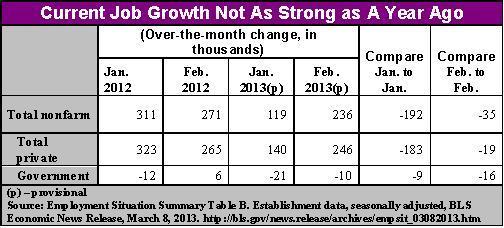
Chart-Current Job Growth Not as Strong as last yearSource: Employment Situation Summary Table B. Establishment data, seasonally adjusted, Bureau of Labor Statistics Economic News Release, March 8, 2013. 

—————

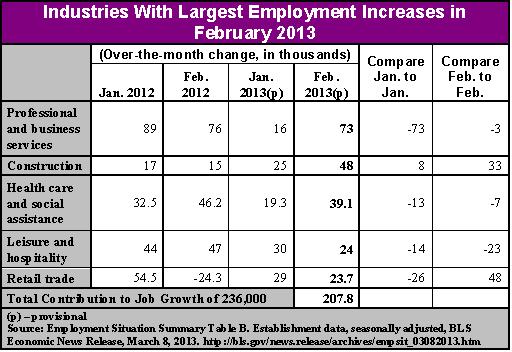
Chart-Industries with largest employ increases, feb 2013 Source: Employment Situation Summary Table B. Establishment data,seasonally adjusted, Bureau of Labor Statistics Economic News Release, March 8, 2013.

—————

Looking at a series of economic indicators, and going back to the costliest 18 hurricanes of postwar history along with the Northridge earthquake of 1994, Goldman’s research team found that retail sales, construction spending, and industrial production “show a clear dip in the month of the disaster, followed by a significant recovery within 1-3 months that typically takes their growth rate above that seen prior to the disaster.”

Agustino Fontevecchia, Despite $50B In Damages, Hurricane Sandy Will Be Good For The Economy, Goldman Says, Forbes, 11/06/2012.

—————

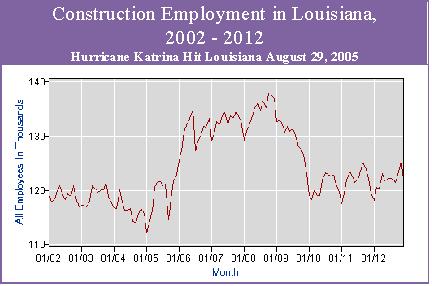
Chart-Construction employment in Louisiana, 2002-12  Chart generated by BLS State and Area Employment web site.

—————

The largest global disasters of 2012 were Hurricane Sandy (with a cost of $65 billion) and the year-long Midwest/Plains drought ($35 billion), according to the company’s Annual Global Climate and Catastrophe Report, which was prepared by Aon Benfield’s Impact Forecasting division.

Doyle Rice, Hurricane Sandy, drought cost U.S. $100 billion, USA TODAY,  January 25, 2013.

————— Chart-Major Disaster Declarations 1953-2011

Bruce R. Lindsay, Francis X. McCarthy, Stafford Act Declarations 1953-2011: Trends and Analyses, and Implications for Congress, Congressional Research Service, August 31, 2012

—————

Joel Naroff of Naroff Economic Advisors … expects average monthly job gains of 200,000-plus this year if the White House and Congress can agree to put off the budget cuts. If all the reductions occur, it likely would mean monthly gains of about 165,000, he says.

Paul Davidson, Employers add a stunning 236,000 jobs in Feb., USA TODAY, March 8, 2013.

COMMENTS

Stronger than usual February job growth is widely hailed as part of an economic recovery in the U.S. that many are seeing in recent positive market signals – rising housing prices and a flourishing stock market, for examples.  The explicit expectation is that we will not look back a year from now and see February’s 236,000 added jobs as only an outlier in year of mostly disappointing employment news.

It is possible that job growth will be strong this year, but it is unlikely.

Several factors involved in the production of February’s job growth numbers suggest that job growth numbers will bounce up and down in 2013 as they have in the past and leave the U.S with unemployment, underemployment, and labor force participation rates much as they are today.

Job growth is weaker this year than last

The first indicator that we should not put much stock in February job growth numbers is that job growth numbers for January and February 2012 were considerably better than the numbers for January and February 2013.  Yet 2012 ended with little progress toward getting Americans back to work.

Unpredictable weather events may be a factor in February job numbers

Both the Midwest/Plains drought and Hurricane Sandy damaged industries and destroyed property.  Smaller weather events, such as severe winter storms, have also done damage.

Rebuilding after Hurricane Sandy and repairs following winter storms could well have contributed to February job numbers.  In the case of Hurricane Sandy, which did $50 billion or more in damage, cleanup, redevelopment planning, negotiating insurance payments, and getting money flowing from government agencies may have pushed much of the impact on the demand for goods and services into 2013.  So, it is possible that:

  • the impact of Hurricane Sandy on the construction and retail industries is just now peaking
  • hospitality and leisure are still be benefiting from housing people displaced by the hurricane
  • Hurricane Sandy still has a significant impact on the demand for social services
  • some professional and business services, such as legal, architectural, engineering, document preparation and clerical, security and surveillance, cleaning, and waste disposal services, are part of recovery efforts related to Hurricane Sandy.

Employment related to Hurricane Sandy and winter storms will fall off as the year progresses.  Of course, other disasters and damaging weather events will strike.  But, when and where those events strike and how much demand for goods and services they will generate can’t be known.

It is fairly certain, though, that the impact of large and small natural disasters on employment will grow larger over the coming years, adding more volatility to month to month job growth numbers.

 Volatile government spending adds volatility to some private sector industries  

Although jobs in health care and social services are listed in the private sector, many of those jobs are paid for by grants and contracts from local, state, and federal government agencies.  The same is true for employment in most educational institutions and in many manufacturing business service industries that supply goods to government agencies.

Given the volatile political tugs-of-war over revenue and spending policies at all levels of government, jobs in industries with federal funding can come and go quickly.  Perhaps some of this effect is in the February job numbers.

A final note

 It is good to have job growth, but it is certainly less than optimal if a growing proportion of new jobs are associated with repairing and replacing the damaged wealth of those who already have it rather than creating new wealth to be shared with the very large number of Americans who have no net wealth at all.

Climate change and government gridlock are robbing both those of us with wealth and those of us without it.

The Annual Season of Spending Is Routinely Misinterpreted by Economists and Financial Experts, Creating Cycles of Hope and Disappointment

SOURCE ITEMS

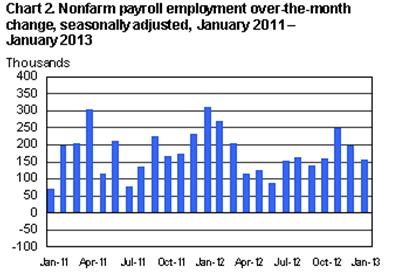
Chart-Employment-Over the month change, 2010-13

The Employment Situation for January 2013 News Release (PDF Version), Bureau of Labor Statistics, February 1, 2013.

—————

Chart-Quarter to quarter growth in real GDP

U.S. Bureau of Economic Analysis, January 20, 2013.

—————

Despite a moderate pick-up in output growth expected for 2013–14, the unemployment rate is set to increase again and the number of unemployed worldwide is projected to rise by 5.1 million in 2013, to more than 202 million in 2013 and by another 3 million in 2014.

Executive Summary, Global Employment Trends 2013, International Labour Organization, January 2013.

—————

As the global economy has gone from crisis to crisis in recent years, the cure has become part of the disease. In an era of zero interest rates and quantitative easing, macroeconomic policy has become unhinged from a tough post-crisis reality. Untested medicine is being used to treat the wrong ailment – and the chronically ill patient continues to be neglected.

Stephen S. Roach, Macro Malpractice, Project Syndicate, Sep. 30, 2012.

—————

The euro-area recession deepened more than economists forecast with the worst performance in almost four years as the region’s three biggest economies suffered slumping output.

The European data chimed with statistics in Japan, where the economy unexpectedly shrank last quarter as falling exports and a business investment slump outweighed improved consumption. GDP fell an annualized 0.4 percent, following a 3.8 percent fall in the previous quarter.

Marcus Bensasson, Euro-Area Economy Shrinks Most Since Depths of Recession, Bloomberg, February 14, 2013.

COMMENTS

Every year a spate of optimistic stories about the recovery from The Great Recession pour into American homes, offices and automobiles, as businesses and consumers rev up for the annual Season of Spending (and Hopeful Signs).  This season begins with the returns to school in August and September and ends with the post-holiday sales in early January.

Soon after the Season of Spending ends, the optimistic stories begin to disappear as the economists and financial experts to whom writers and commentators in the media turn for information begin to grudgingly acknowledge that all is not well, after all, in the land of beautiful spending.  The Season of Spending fades into memory and the artificially pumped up optimism of American business owners and consumers gives way to disappointment.

The annual cycle of positive and negative economic news is real, as the charts of over-the-month employment changes and quarter-to-quarter real growth in GDP illustrate[1].  But, the annual cycle of hope and disappointment is manufactured by influential economists and financial experts who either willfully ignore the flat trend line that cuts through the multi-year cyclical pattern, or worse, aren’t even aware of it.  Ignore the underlying trend line and every fall time spending spree becomes a new “morning in America.”

Instead of pumping up optimism each fall on the basis of positive economic signals that are demonstrably temporary, economists and financial experts should be pointing out that job growth is not accelerating and explaining why the level of job creation remains well below the level needed to restore full employment and grow incomes.  The trouble is, they can’t explain the trend line because it doesn’t make sense in traditional nation-centric models of employment growth.

The cyclical pattern of employment change in the U.S. is influenced by domestic spending, but the trend line around which U.S. employment change fluctuates is greatly influenced by world economic factors.  U.S. employment trends are a subset of global employment trends, which are embedded in global economic processes, investment trends, and spending trends.

The world economy is limping along and recent reports strongly indicate that little improvement will take place over the next couple of years.  GDP growth will be too slow to generate adequate employment growth, so unemployment and underemployment will rise.  In this context it is wishful thinking to suppose that this spring will not bring another round of disappointment about job and income growth in the U.S.


[1] This pattern makes sense given the seasonal pattern of spending by Americans.  The most difficult to resist pressures to spend are concentrated in the last five months of the year, the Season of Spending.  Parents have to pay school fees and buy backpacks, computers, new clothes, and even cars for their children.  During the holiday season, which follows close on the back to school season, spending increases because we all face powerful pressures from family and friends and advertisers, and because many of us have postponed optional spending until the holidays give us dispensation to empty out savings accounts and haul out the credit cards.