Employment Optimism? Really? This January was Worse than January 2011 and Adverse Global Economic Forces are Still in Play

ITEMS FOR YOUR CONSIDERATION
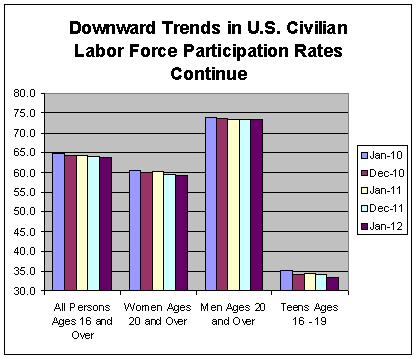
Downward Trends in U.S. Civ Labor Force ContinueData source: Labor Force Statistics from the Current Population Survey, Bureau of Labor Statistics

—————

Private Sector Job Growth is Dominated By Lower Wage Industries

Percent of Private Sector Job Growth By Selected Industries

Jan-11

Dec-11

Jan-12

Goods-Producing

30.3%

32.3%

31.5%

Private Service-providing

69.7%

67.7%

68.5%

Retail Trade

31.0%

2.8%

4.1%

Temporary Help Services

13.5%

3.8%

7.8%

Leisure and Hospitality

-6.7%

8.6%

17.1%

Other services

-5.9%

2.3%

2.7%

Total 4 Selected Service Providing

31.9%

17.5%

31.8%

Data source: Employment Situation Summary Table B, Employment News Release, Bureau of Labor Statistics, February 3, 2012.

—————

Job Cuts, January 2012 Greater than in January 2011

(Ten Industries with Highest Cuts)


January 2012

January 2011

Retail

12,426

5,755

Financial

7,611

2,822

Pharmaceutical

4,071

2,090

Entertainment/Leisure

3,910

1,545

Aerospace/Defense

3,634

3,167

Government/Non-Profit

3,021

6,450

Food

3,000

873

Consumer Products

2,464

1,783

Industrial Goods

2,230

1,874

Transportation

1,770

725

Data Source: 2012 Kicks Off With 28% Surge in Job Cuts, Press Release, Challenger, Gray & Christmas, February 2, 2012.

—————

January 2012 Purchasing Managers’ Index (PMI) for Manufacturing Lower than in  2010 and 2011

2010

January

April

July

Oct

56.7

59.0

55.7

57.0

2011

2012

January

April

July

Oct

January

59.9

59.7

51.4

51.8

54.1

Data source: table of Manufacturing Business PMI history, Institute for Supply Management. 

—————

“The man in charge of a firm with several hundred thousand staff around the world bemoaned that, ‘we live in a world where wealth creation is uncoupled from job creation. This once close connection is ruptured.'”

Tim Weber, Davos 2012: Youth unemployment ‘disaster’, BBC News website, January 28, 2012.

—————

SMBs in developing countries are keeping pace with their more developed counterparts when it comes to providing employees with smartphones, netbooks/mini notebooks, and media tablets. In some cases, they are actually more likely to provide these products to their staff.

The Consumerization of IT Helps Level the SMB Playing Field Across the World, IDC Says, Press Release, International Data Corporation (IDC), January 25, 2012.

—————

“This suggests that the labor market has changed in ways that prevent the cyclical bounceback in the labor market that followed past recessions. … Stricter market incentives to control costs in the face of stiff domestic and international competition may also be factors. In addition, anecdotal evidence suggests that recent employer reluctance to hire reflects an unusual degree of uncertainty about future growth in product demand and labor costs. These special factors are not readily addressed through conventional monetary or fiscal policies. But such policies may be able to offset the central obstacle of weak aggregate demand.”

Rob Valletta and Katherine Kuang, Why Is Unemployment Duration So Long?, Federal Reserve Bank of San Franscisco Economic Lettter, January 30, 2012.

COMMENTS

The only way to arrive at optimism about U.S. employment is to focus attention on indicators that are poorly related to unemployment changes (GDP growth, initial unemployment insurance claims, the traditional unemployment rate) and ignore global economic forces that continue to spell trouble for U.S. employment growth

Misleading indicators:

  • An uptick in the rate of GDP growth is misleading about employment growth because machines now play such a large role of in the production and sale of goods and services in the U.S.;  modest upswings in GDP can take place with almost no impact on employment
  • Initial claims for unemployment insurance (UI) get a lot of press, but only about 43 percent of unemployed workers receive UI; unemployment among workers who mostly do not qualify (many workers in retail and service industries) can rise or fall dramatically with little impact on initial claims
  • As is well known, the traditional unemployment rate is a downwardly biased measure of unemployment; it does not count as unemployed persons who have opted to do something other than look for work until prospects improve (e.g., going to school,  taking a self-financed sabbatical, making repairs to the house) and does count as employed persons who want full time employment but can only find part-time employment and persons who are working in jobs beneath their qualifications.

Global forces that undercut U.S. job growth are still in play:

  • Global and U.S. GDP growth rates will be modest through at least 2012 because of financial turmoil, lots of supply, and weak demand
  • The number of competing nations in the world economy has not diminished and very high levels of unemployment are pushing many nations to become even more aggressively competitive
  • Slow global market growth continues, which means the world’s global businesses must continue to relentlessly cut labor and other costs to survive
  • Emerging market countries with skilled workers, advanced production capacities, and much lower production costs will continue to outbid the U.S. for the investments that produce the most jobs per dollar of investment
  • Facing higher production costs in the U.S., much of the investment in the U.S. will continue to be in high tech, high profit activities that produce relative few jobs, and those jobs will be ones for which very few U.S. workers have the required skills.

The labor force participation rate, which is a better indicator of whether we should be optimistic about job growth, has been trending downward for many years.  Taken as a whole, economic signals indicate that this trend is locked in, whatever economists and reporters may wish to read into short term economic indicators.
The Transition To A Clean And Sustainable World Economy Will Change Job Descriptions, But It Will Not Increase Global Job And Income Growth

CONSIDER THE FOLLOWING ITEMS

“While there are conflicting views about whether any changes in total employment would be positive or negative, there are likely to be quite significant impacts in terms of shifting employment patterns between sectors as economic development shifts from “brown” to “green” economic sectors.”

Green Growth Studies: Energy, Preliminary Version, Organization for Economic Cooperation and Development (OECD), 2011.

—————

“Across the range of issues to be addressed, policy initiatives should be designed in terms of: cost-effectiveness, adoption and compliance incentives, and ability to cope with uncertainty and provide a clear and credible signal to investors.”

Towards Green Growth, Organization for Economic Cooperation and Development (OECD), 2011. 

—————

“Many countries are using a menu of policy incentives instead of a single policy approach. Policy makers realize that these incentives need to be coherent, stable and designed for the long-term to be able to attract the necessary funds for robust deployment and strong markets that ultimately will reduce the cost of renewable energy.”

Report of the Secretary-General – Promotion of new and renewable sources of energy (Advance unedited copy), UN Department of Economic and Social Affairs, Division for Sustainable Development, August 15, 2011.

COMMENTS

Global job and income growth are in trouble whether the world makes the transition to a cleaner and more sustainable economy slowly or quickly.  If the transition is done slowly the world will suffer large job and income losses due to the negative impact of environmental pressures on economic growth.  Losses will also occur because of a poorly designed “green” investment strategy.

If the transition is done quickly, job and income losses due to environmental pressures will be reduced, but more losses will be caused by the “green” investment strategy itself.

The current strategy for transitioning to a clean and sustainable global economy relies heavily on market competition and traditional governmental policy tools to put downward pressures on the costs of producing cleaner energy and to motivate business enterprises to create alternatives to resources that are being depleted.  Thus, the current strategy leaves the institutional forces that are slowly eroding global employment and income levels in tact.

At the core of those institutional forces are the scope and intensity of competition among business enterprises and governments.  Global scale communications, trade agreements, investment flows, and commodity flows now bring many more investors and business enterprises virtually face to face in the same markets.

Faced with many more competitors, business enterprises invest heavily in finding ways to reduce labor costs.  Moreover, governments abet these efforts by helping their domestic business enterprises with policy structures and financial subsidies that encourage investments in machines rather than workers.  In this economic environment, job destruction and wage reductions in some sectors and regions of the world economy generally outpace job creation and wage growth in other sectors and regions of the world economy.

An accelerated “green” transition will exacerbate the gaps between job creation and job destruction, wage growth and wage decline.  It will shift more investment funds to the energy sector, which is very machine and technology intensive.  More investment funds will also go to enterprises engaged in the development and production of resource alternatives, enterprises that tend to be more highly automated and employ fewer workers that the enterprises they replace.  The net result will be a further decline in global demand for workers and lower wages.

The transition to a clean and sustainable world economy can be done without harm to employment and income growth, but only by simultaneously reducing system wide downward pressures on job and income growth.  This can be done by making increased governmental management of global market forces and the increased use of governmental employment and income programs (to supplement private sector employment and compensation levels) components of the “green” transition strategy.

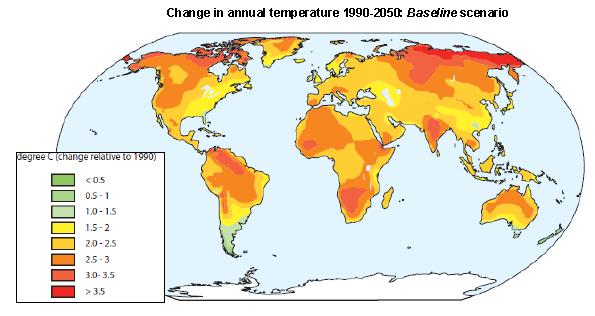
Climate Change Is Increasing Global Employment and Income Instability

From Key Findings on Climate Change, THE OECD ENVIRONMENTAL OUTLOOK TO 2050 (forthcoming, 2012), Organization for Economic Cooperation and Development.

—————

“New figures from the U.N. weather agency Monday showed that the three biggest greenhouse gases not only reached record levels last year but were increasing at an ever-faster rate, despite efforts by many countries to reduce emissions.”

Seth Borenstein , Greenhouse gases soar; scientists see little chance of arresting global warming this century, Washington Post (Associated Press), November 21, 2011.

 —————

Primary sectors such as agriculture, forestry and fisheries will be affected more severely than others. The attraction of tourist destinations will change. … Ski resorts at low and medium altitude could be affected by reduced snow cover …The likelihood of the development of extreme weather conditions will affect the insurance industry, which will be forced to pass on the rising cost of damages to other economic sectors … Jobs will be created in companies that can take advantage of opportunities created by climate policies and jobs will be lost in companies that cannot adapt.

Climate Change and Employment, European Trade Union Confederation.

—————

About 1.3 billion people, or 40 percent of the economically active people worldwide, work in agriculture, fishing, forestry, and hunting or gathering.

Human Development Report 2011, United Nations Development Programme.


———————–Comments———————–

In recent decades, the world’s communities and working families have faced increasing employment and income instability as the pace of technological change and the pace of transnational capital transfers have increased.  More and more communities see whole industries come and go; more and more working families now cope with recurring periods of unemployment and underemployment; increasingly, working people find themselves having to negotiate major job transitions (many of which require investments in retraining and many of which result in lower wages and benefits); larger numbers of workers become trapped in long-term unemployment.

Climate change is adding to global employment and income instability through its impacts on the global distribution of investment opportunities and risks.  Primary impact is on climate sensitive industries (e.g., agriculture, fisheries, forestry, tourism, insurance, health care — in response to changing disease threats, emergency services).  Changing global weather patterns are transforming local and regional mixes of market opportunities, production and distribution costs, and risks to communities across the world.  Older business models and technologies are being modified or abandoned and replaced with different business models and new technologies, and the responsibilities assigned to governments and non-profit organizations are being transformed, as the consequences of climate change accumulate.

The contribution of climate change to global employment and income instability extends well beyond the most climate sensitive industries.  Weather is totalitarian: every aspect of our lives is affected to some degree by its patterns and changes, from housing codes to travel decisions, from clothing requirements to food choices, from health care requirements to leisure activity decisions.  Thus, as the consequences of climate change accumulate, we will make large and small changes to the way we live.

In some parts of the world, the changes made will be substantial and rapid, generating newsworthy investment and employment upheaval.  In other parts of the world they may be minor.  But even minor individual changes, when made in a short time span, can aggregate into a force that unsettles business opportunities and demands made on governments.

Recent evidence suggests that climate change is accelerating.  As it does, the consequences of climate change will accumulate more rapidly, awareness of the consequences will increase, and corporations and investors will accelerate their efforts to respond to consequences already felt and prepare for those just ahead.  Global employment and income instability will increase all the more.

Overheated Global Competition Drives Job Growth Down

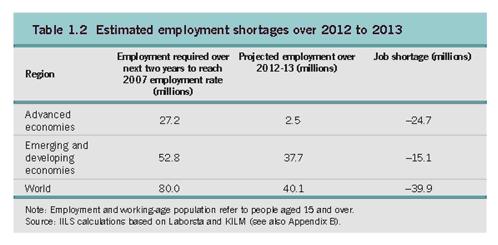
Estimated Job Shortage 2012-13

Table presented in World of Work Report 2011, International Labor Organization, October 31, 2011, Pg. 9.

—————

“Non-financial firms have increasingly invested in financial assets at the expense of physical assets. … This is particularly the case with firms in advanced economies, but in recent years, developing and emerging economies have started to exhibit similar trends. …   Empirical evidence shows that rising profitability in the financial sector has played an important role in drawing in investment from the non-financial sector towards the financial sector.”

World of Work Report 2011, ILO, October 31, 2011, pg. 41.

 —————

“The great thing about the new I.T. revolution, says Jeff Weiner, the C.E.O. of LinkedIn, is that ‘it makes it easier and cheaper than ever for anyone anywhere to be an entrepreneur’ and to have access to all the best infrastructure of innovation.”

Thomas Friedman, One Country, Two Revolutions, New York Times, October 22, 2011.

 —————

“… technology investments are playing an increasingly larger role in mid-market companies’ bottom line. Business process automation and technology improvements are the two top contributing factors to the jump in mid-market productivity; new hiring ranked fifth overall. …

“’Technology is on the mind of most mid-market executives,’ said McGee [Tom McGee, national managing partner, Deloitte Growth Enterprise Services, Deloitte LLP].  ‘ … 74 percent of respondents believe globalization is forcing U.S. companies to become more productive to stay competitive … and set themselves apart from the pack ‘”

Deloitte: Mid-Market Executives Increase Long-Term Investments Despite Economic Uncertainty, Deloitte Press Release, Oct. 10, 2011.

—————

“Despite representing only … 19 percent of employment [in 2007], multinational companies contributed 41 percent to overall productivity growth from 1990 to 2007.”

James Manyika et al, Growth and renewal in the United States: Retooling America’s economic engine, McKinsey Global Institute, February 2011.

—————

“His solution is to offer a new and altogether different kind of TV set, although in typical CEO fashion, he refuses to elaborate on what that might involve. He simply offers the assurance that a great deal of R&D investment is going into designing a new TV that could reverse Sony’s fortunes.”

Vlad Savov, Sony CEO Howard Stringer: Every TV set we make loses money, Washington Post (originally published in The Verge), Friday, November 11.

—————

“First, in a global economy, we need to be thinking more about the sources of apparent productivity growth. It matters greatly for wages and employment whether rising value-added per worker is being driven by domestic production improvements, supply chain efficiencies, or by productivity gains abroad. …

Second, government policies designed to increase incentives for business investment, such as accelerated expensing, may have the effect of increasing supply chain efficiency rather than domestic productivity. …

Third, we are effectively flying blind in terms of the effect of the global economy on US workers.”

Michael Mandel and Susan Houseman, Not all productivity gains are the same. Here’s why, What Matters, McKinsey & Company,  June 1, 2011.

———————–Comments———————–

The transformations in communications, transportation, transnational trade and investment flows, geopolitics, and access to advanced technologies that we summarize with the term globalization have greatly multiplied the number of businesses in every sector of the world economy competing for customers.

Moreover, companies are competing for a stagnant number of consumers and consumer dollars.   Although the buying power of working families is growing in the countries experiencing rapid economic growth (called the emerging economies), it is declining or barely growing in many of the advanced economies and in many other parts of the world.  This is greatly intensifying the competition among the worlds much larger number of competing business enterprises.

This environment of overheated competition puts enormous downward pressure on global job growth.  It drives the owners and managers of almost every business enterprise to pursue strategies that are good for the business but destructive to the world’s labor force much more aggressively than would be the case in an environment of moderated competitive pressures.  These strategies include:

  • Investments in financial assets as a way to park money that can’t be profitably invested in production of goods and services
  • Large investments in technologies that reduce work hours without reducing the capacity to meet existing customer demand
  • Large investments in product innovations designed to displace similar products rather than to create new products that meet new needs
  • Large investments in ad campaigns designed to lure current consumers to change consumption activities (e.g., switch from watching TV to playing video games)

The impact of these strategies on employment is fairly straight forward:

  • Profitable investment opportunities are in short supply, so money parked in financial assets is more likely to help generate financial bubbles than to generate new jobs
  • Productivity gains eliminate jobs when demand for products and services is not growing
  • Investments that only lure consumers to replace one product for another, to replace one consumer activity with another, and/or to buy the same product from a different company only move consumers around in the market place; the net effect on the labor force is job churning not job growth.

Overheated global competition will continue to do harm to global job growth until a global policy response creates a mechanism for market sharing and puts boundaries on the use of competitive strategies.  Without that response,  global rates of unemployment, underemployment, poverty, and political upheaval will continue to increase.  And the U.S. will not avoid sharing in these miseries.

How Many Professional Workers Can Ten Thousand Super Computers Supervise?

“A new supervising service called Humanoid launched today, backed by funding from Google Ventures. Humanoid will rent out armies of humans (they have 20,000 workers already signed up to start) for $4.99 per hour to develop software, supervised by an algorithm.”

Christie Nicholson, Google-backed robot overlords take over supervision of human workers, IBM SmartPlanet, November 2, 2011

 —————

“China has made its first supercomputer based on Chinese microprocessor chips, an advance that surprised high-performance computing specialists in the United States.

The Sunway system, which can perform about 1,000 trillion calculations per second — a petaflop — will probably rank among the 20 fastest computers in the world. More significantly, it is composed of 8,700 ShenWei SW1600 microprocessors, designed at a Chinese computer institute and manufactured in Shanghai.”

John Markoff, China Has Homemade Supercomputer Gain, New York Times, October 28, 2011

———————–Comments———————–

It is said that at some point accumulating quantitative change becomes a qualitative change — a spring rain lasting forty days and forty nights becomes something other than a rainy spring!  Has the world had its forty days and forty nights of global technological change? – if not, it has surely had at least thirty days and the pace of technological change is accelerating.  Imagine a world in which a hundred million people (working below the U.S. minimum wage and supervised by Humanoid and similar programs) are writing software code intended to displace professional workers in law, medicine, teaching, business management, consulting, and government.

The core question for the 21st century is this: how will the world’s nations create socially legitimate entitlements to income in an era when only a minority of the world’s working-age people can obtain income through work and most of those who do work are paid less than a living wage?

The False Promise of September Auto Sales

“Mr. Toprak said more consumers also were showing up at dealerships because their current vehicle had outlived its useful life and they had no choice but to buy a replacement.”

Nick Bunkley, U.S. Vehicle Sales Soared Nearly 10% in September, Despite Economic Gloom, New York Times, October 3, 2011

—————

“But other factors boosted truck sales. Small businesses must eventually replace aging fleets of work trucks…”

Associated Press, US auto sales rise in September as consumers buck trends and buy trucks, Washington Post, October , 2011

—————

“Personal income decreased $7.3 billion, or 0.1 percent, and disposable personal income (DPI) decreased $5.0 billion, or less than 0.1 percent, in August …Real disposable income decreased 0.3 percent in August, compared with a decrease of 0.2 percent in July.”

Personal Income and Outlays: August 2011, New Release, Bureau of Economic Analysis, U.S. Department of Commerce, September 30, 2011

—————

“But the companies will be able to contain their costs by not paying annual raises to their U.S. factory workers and by hiring thousands of new workers at lower wage rates.”

Dee-Ann Durbin and Tom Krisher (Associated Press), Ford to pay workers $6,000 bonus, Lansing State Journal, Oct. 4, 2011

—————

“Retailers are coming to terms with a new reality: the consumer who traded down during the recession and never came back.”

Ann Zimmerman, Frontier of Frugality, Wall Street Journal, October 4, 2011

———————–Comments———————–

September’s jump in vehicle sales did not signal a change in the behaviors of global investors, corporations, and governments that currently translate consumer decisions into employment and income outcomes.  Global investment decisions still favor machines over workers and still favor nations with low wages, weak regulations, corruptible government officials and/or growing populations of people with disposable income.  Global economic growth is still slowing; employment opportunities are still disappearing; opportunities for investors and corporations to pit desperate nations and workers against each other in bidding wars for investments and jobs are increasing.

In this context, September’s jump in vehicle sales can’t be read as good news for U.S. working families and small business owners.  The economic benefits will be minimal and short lived.

Consumers and small businesses locked themselves into loan payments that reduce other spending: Auto sales were driven by frustrations with aging vehicles and other factors, not by income growth that had increased savings for down payments and created extra spending capacity to cover new loan payments.  It is thus very likely that tens of thousands of families and small businesses are now locked into years of new auto loan payments they can’t afford.  And global circumstances virtually insure that family incomes in the U.S. will stay flat or even decline over the next year.   Consumers and small businesses must either reduce spending on other items or take on more debt.

More debt, of course, means a larger share of income goes to loan payments.  Sooner or later, unless incomes rise enough to offset loan payments, consumer demand and business-to-business demand will fall.

With the holiday season coming, retailers may be the first to see sales losses as consumers cut back on optional spending so they can make auto loan payments.

Employment and income benefits for U.S. families are minimized by global supply chains and global wage and benefit inequalities: These days, “made in the U.S.” really means assembled in the U.S.  Many of the parts that become a finished vehicle here are produced outside the U.S.  Thus, a jump in U.S. auto sales generates job and income growth in other nations as well as in the U.S.  Moreover, the U.S. share of total job and income growth from auto sales declines over time.

Because of huge wage and benefit inequalities across nations the families in other nations that get income increases as a result of U.S. auto purchases will spent most of their extra income on goods and services produced in the U.S. — in the emerging economies (e.g., Brazil, Russia, India, China) where many high tech consumer and business goods are produced more cheaply than in the U.S. and in low wage nations that produce all the other consumer basics (blankets, dinner ware, clothing, etc.) that are mostly not produced in the U.S. (except when produced by U.S. crafts people and a select few U.S. companies that market to wealthy and status conscious consumers).

Interest on loans goes into bloated investment funds, and from there to other nations and into financial bubbles: In the early days of a loan, the part of a loan payment that goes to interest is typically at its highest.   Thus, for the immediate future, September vehicle sales will be pumping cash into the hands of bankers and other investors.  Under current global circumstances, this does not benefit U.S. families

It has become well known that U.S. corporations and investors are aggressively pursuing investment opportunities in parts of the world with growing populations of middle class consumers.  It is thus very likely that a large part of the loan payments on the new vehicles will generate jobs outside the U.S. and strengthen global competitors to smaller U.S. businesses.

Concern about the formation of new financial bubbles has been mounting because the investment world is flush with cash and a stagnant world economy has reduced the number of sound investment opportunities.  Pumping more cash into the investment world under these circumstances can only increase the risk that cash rich but profit-hungry investors will herd themselves into unsound investment trends.

Depreciate This: Good for the Stock Market, Bad for the Job Market

“Capital goods orders rose a robust 4.2 percent in August from July.

Core capital goods orders — nondefense bookings for items such as industrial machinery, power transmission equipment and computers, but excluding the auto and aircraft sectors — rose 1.1 percent.

‘We think large companies are so cash-rich that they can keep spending despite lower confidence. In competitive industries, the company which does not spend loses market share,’ he [Ian Shepherdson at High Frequency Economics] said.”

US capital goods orders shine in August, Breitbart.com, Sep 28, 2011

 —————

“The business spending … may be further supported by a December agreement between President Barack Obama and congressional Republicans. Companies will be able to depreciate 100 percent of capital equipment put in service by the end of this year.”

Bob Willis, Demand for U.S. Capital Goods Rises by Most in Three Months, Washington Post, Sep 28, 2011

 ———————–Comments———————–

From the standpoint of business leaders, the impact of investments in capital goods on employment opportunities is only a side effect.  If the investments contribute to job growth, they are happy to get the positive public relations bump.  If they undercut job growth, well, that’s just unavoidable collateral damage.

Yes, a burst of investments in capital goods can generate employment, but only in the short term.  Downstream, as those new computers, manufacturing robots, and assorted other high end technologies go live in workplaces, jobs will bleed out, more than offsetting short term job gains.

We now live in a world in which an accelerating global shift in the mix of humans and machines engaged in the production of goods and services is squeezing the life out of employment and income growth.  The pace at which machine energy is replacing human energy in the workplace is accelerating.  Machine energy has already replaced enormous amounts of human energy in agriculture, mining and manufacturing.  Today machine energy is increasingly replacing human energy used in thinking (evaluation and decision-making activities) in more and more fields of work, including professional fields.

Public policy cannot and should not stop innovation and the growing use of machines to supplement and replace humans in the workplace.  (Indeed, workers in many types of work are still exposed to dangers that can best be reduced by using more machines.)  But, use of tax write offs to encourage even faster displacement of workers by machines when done in the absence of a comprehensive policy approach to creating wealth and equitably distributing that wealth is extraordinarily wrongheaded.  Such unlinked use of tax write offs can only exacerbate the damage already being done to jobs and income in the U.S.

This kind of unlinked use of tax write offs is not just a U.S. practice.  Many of the world’s nations take the same approach to increasing market shares in very competitive global investment markets.  These nation by nation tax write off practices aggregate into a global economic force that increases wealth production and increases corporate profits, but also relentlessly destroys jobs and the incomes of families that depend on those jobs.

As of now the world does not have a comprehensive policy approach to managing the growth of the world economy.  More to the point, the world does not have global institutions with the power to coordinate economic policy-making across the world’s nations on behalf of the world’s people.  Thus, the ongoing global transition to more and more use of machines in place of people is both unmanaged and unmanageable.  The largely destructive aspects of this transition cannot yet be addressed and rectified.

In this context, the Obama administration’s 100 percent depreciation of new equipment can only become a 100 percent disaster for working families in the U.S. and in the rest of the world.

A World of Global Corporations Requires a World of Global Economic Policies

“General Motors Co. agreed Tuesday to deepen cooperation with its flagship Chinese partner on development of electric vehicle knowhow amid pressure from Beijing to hand over proprietary technology … GM, he said, makes a lot of money in the growing China market, and the partnership is an investment to keep that going.”

Elaine Kurtenbach, GM OKs electric vehicle cooperation with China, The Associated Press, carried online by the Lansing State Journal, September 20, 2011

—————

“Our second set of findings provides empirical support for the view of Sutton (2007a) and others who argue that emerging market economies benefit from globalization through the vertical transfer of capability from foreign to domestic firms. We find this effect to be substantial for all three types of innovation that we study, suggesting that the supply chain of multinational enterprises and international trade are an important means for domestic firms to raise their capability. Our third and fourth set of findings indicates that the effects of globalization on innovation are all-encompassing, rather than affecting only a subset of firms.

Yuriy Gorodnichenko Jan Svejnar Katherine Terrell, Globalization and Innovation in Emerging Markets, Other Versions PDF at website of Yuriy Gorodnichenko, March 23, 2009

—————

“The tests produced a large number of cointegrating vectors which implied a strong long run relationship between all markets. Thus, globalization seems to have greatly impacted international financial integration.”

From the abstract: Mohammed Ansari, Impact of globalization on stock market synchronization: some empirical evidence, International Journal of Commerce and Management, Volume 19 issue 3, 2009.

———————–Comments———————–

GM insists that its new deal with China will not give Chinese companies access to Volt technology.  But does that really matter.  Volt technology is already dated, the resulting jobs are in the pipeline; what matters is what comes next and GM is not obligated to develop new technologies in the U.S. or to use new technologies to produce vehicles in the U.S. – even though U.S. taxpayers are a key reason GM survived to produce the Volt and to sign a new technology development pack with China.

In the context of intense global competition, the world’s corporations can no longer afford to have national loyalties — to have them would undermine their access to the hugely expanded number of investment opportunities that globalization has created.  Today’s corporations must be ready at all times to abandon investments in one country to pursue more profitable investments in another country.

Although corporations and their leaders have become global citizens, most of the world’s people have not.  We live in and identify with nations.  We depend on national governments to protect and promote our economic welfare.  Very few of us move to other nations to pursue our economic interests in the way corporations do – we can’t afford to, national laws do not allow us to, and/or we don’t want to leave families and friends.

This puts the world’s people at an enormous disadvantage with regard to employment: we can’t count on the corporations that call our nations home to create jobs for us and we can’t shop the globe for jobs they do create.

In this new world, job creation must be the responsibility of our governments even more so than in the past.  And the world’s governments must cooperate to an unprecedented extent to foster sufficient global job and income growth to ensure opportunities for living wage employment for the citizens of every nation.

Over the course of the 20th century the U.S. people overcame huge policy differences among the member states to create a body of national policies covering banking, investments, workplace practices, rights of workers, and the responsibilities of businesses to the communities in which they operate.  The resulting uniformity of economic policies across states contributed enormously to the growth of a large and prosperous U.S. middle class and to a substantial reduction in poverty.

The same must now be done on a global scale to promote the growth of a global middle class and to reduce global poverty.  Without this global effort, the prosperity of the U.S. middle class will continue to deteriorate.

Fragmented and Weakened Global Governance Perpetuates the World’s Employment Crisis

“A second conclusion is that the multilateral system lacks coherence; that is, comparable and consistent disciplines in closely connected areas of international economic interaction. This is particularly notable between trade and finance. The existing system of global economic governance lacks effective multilateral disciplines over exchange rate, macroeconomic and financial policies, or for redress and dispute settlement regarding the negative impulses generated by such policies. In this respect, governance in money and finance lags behind that for international trade. This is a main source of strains in the trading system.”

 Yilmaz Akyüz, Global Rules and Markets: Constraints over Policy Autonomy in Developing Countries, Working Paper No. 87, Policy Integration and Statistics Department, International Labour Office, June 2008

 —————

“Economic integration and interdependence in the world today have reached an unprecedented level. As a result, the globalized economy cannot function for the benefit of all without international solidarity and cooperation. This was highlighted by the global financial and economic crisis that followed the collapse of big financial institutions, and it has underlined the need for developing approaches to new forms of global collaboration.”

Trade and Development Report, 2011: Post-crisis policy challenges in the world economy, United Nations Conference on Trade and Development

 —————

“Global investors increasingly view risk in binary terms: When things are looking calmer on the global economic front, stock markets rise across the world; when things look scarier, they fall. Instead of differentiating among the economies in the United States, Europe and Japan, market measures are moving closely in tandem.

Moreover, because major U.S. companies have operations around the globe, executives are more likely to try to offset weakness in their overseas operations by pulling back on hiring and capital investment domestically, even if the U.S. economy is proceeding apace.”

Neil Irwin, U.S. fortunes increasingly determined in Brussels, Frankfurt, Political Economy Blog,  Washington Post 09/06/2011

 —————

“Concurrent with the shift in power among nation-states, the relative power of various nonstate actors—including businesses, tribes, religious organizations, and criminal networks—is increasing. The players are changing, but so too are the scope and breadth of transnational issues important for continued global prosperity.

The diversity in type of actor raises the likelihood of fragmentation occurring over the next two decades, particularly given the wide array of transnational challenges facing the international community.”

By 2025, the international community will be composed of many actors in addition to nation-states and will lack an overarching approach to global governance.

Global Trends 2025: A Transformed World, National Intelligence Council, PDF version, November 2008

 —————

“Today, some 50,000 multinational enterprises and their 450,000 affiliates employ over 200 million people throughout the world. Their impact is felt in virtually every facet of industry, trade, services and business activities.”

Multinational Enterprises web page, International Labor Organization

———————–Comments———————–

Over the last several decades, the world’s distribution of economic power has shifted along several dimensions.

  • The distribution of power among nations has become more decentralized (the number of nation-states in the world has doubled since 1950, a number of weaker nations – notably the BRIC countries – Brazil, Russia, India, and China – have substantially increased their positions of power in the world economy, and with the cold war over, the most powerful nations have less ability to dictate foreign and domestic policies to weaker nations).
  • The number of economically competing geopolitical units in the world economy has increased dramatically (increasing numbers of bilateral and multilateral free trade agreements have exposed more and more of the world’s local businesses to global competitors; advances in transportation and communications technologies have brought more and more of the world’s state, provincial, and urban governments into virtual face-to-face competition for investments and jobs)
  • The distribution of economic power between the world of national and multinational governing institutions and the world of global business enterprises has shifted in favor of the business enterprises (.the expansion of the number of competing geopolitical actors in the world economy has increase the number and diversity of investment opportunities available to corporations and investors, increasing their power to play off one geopolitical entity against another and thus limit the willingness of governments at all levels to manipulate flows of capital and goods to favor their own citizens).

These shifts in power have wrought a destructive change in the global environment for job creation.

Business enterprises operate under very different mandates than do governments.  The core mandate for every business is to gain market share, not share market gains; to maximize profits for owners and shareholders, not to maximize general welfare.  In the pursuit of that core mandate business enterprises cannot increase employment, pay higher wages, create safer working conditions, pay taxes, or invest in parts of the world where the greatest need for jobs exist, if doing so will alter the balance of competitive advantages in favor of competitors.    Incurring avoidable costs seldom enhances competitiveness; cutting costs often does.

In a world in which governing institutions lack the power to organize and moderate competition so that it serves the general interest and in which the growth of markets is stagnant, fiercely combative and norm-breaking waves of competition among the world’s 50,000 global corporations and among the world’s millions of globally exposed local businesses and governments are inevitable.  Unrestrained job slashing frenzies in pursuit of lower costs are inevitable.  Waves of hiring that manage to materialize cannot be sustained.  High levels of unemployment and underemployment become the permanent state of affairs.

More on Computers With Master’s Degrees and Accelerating Job Losses

“Six decades into the computer revolution, four decades since the invention of the microprocessor, and two decades into the rise of the modern Internet, all of the technology required to transform industries through software finally works and can be widely delivered at global scale.

Agriculture is increasingly powered by software as well, including satellite analysis of soils linked to per-acre seed selection software algorithms

Health care and education, in my view, are next up for fundamental software-based transformation

many people in the U.S. and around the world lack the education and skills … This problem is even worse than it looks because many workers in existing industries will be stranded on the wrong side of software-based disruption and may never be able to work in their fields again. ”

Marc Andreessen (Hewlett-Packard board member), Why Software Is Eating The World, Wall Street Journal, August 20, 2011

—————

“Robots have the potential to replace humans in a variety of applications with far-reaching implications. … The development and implementation of robots for elder-care applications, and the development of human-augmentation technologies, mean that robots could be working alongside humans in looking after and rehabilitating people. A change in domestic and social responsibilities and a change in domestic employment

SRI Consulting Business Intelligence requirements could adversely affect lower income service-oriented workers.

By 2025 Internet nodes may reside in everyday things—food packages, furniture, paper documents, and more. … Streamlining—or revolutionizing—supply chains and logistics could slash costs, increase efficiencies, and reduce dependence on human labor.”

Disruptive Civil Technologies: Six Technologies with Potential Impacts on US Interests out to 2025,  Conference Report, National Intelligence Council, April 2008

———————–Comments———————–

See comments in the Reconnaissance Report for August 19, 2011 (immediately below).