February Job Numbers: Evidence for a Growth Trend or Just One More Outlier in an Era of Employment Volatility and Too Little Growth?

SOURCE ITEMS

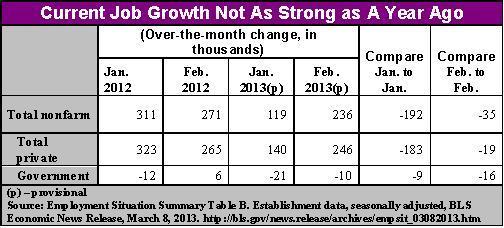
Chart-Current Job Growth Not as Strong as last yearSource: Employment Situation Summary Table B. Establishment data, seasonally adjusted, Bureau of Labor Statistics Economic News Release, March 8, 2013. 

—————
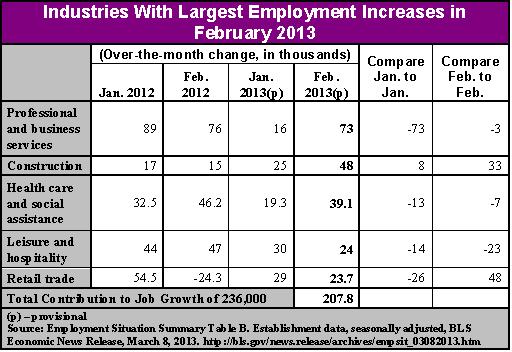
Chart-Industries with largest employ increases, feb 2013 Source: Employment Situation Summary Table B. Establishment data,seasonally adjusted, Bureau of Labor Statistics Economic News Release, March 8, 2013.

—————

Looking at a series of economic indicators, and going back to the costliest 18 hurricanes of postwar history along with the Northridge earthquake of 1994, Goldman’s research team found that retail sales, construction spending, and industrial production “show a clear dip in the month of the disaster, followed by a significant recovery within 1-3 months that typically takes their growth rate above that seen prior to the disaster.”

Agustino Fontevecchia, Despite $50B In Damages, Hurricane Sandy Will Be Good For The Economy, Goldman Says, Forbes, 11/06/2012.

—————
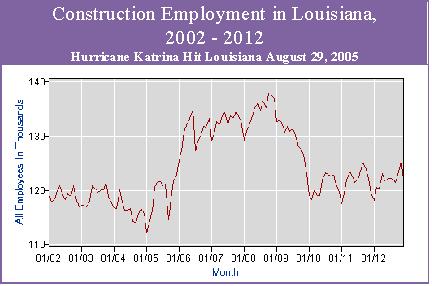
Chart-Construction employment in Louisiana, 2002-12  Chart generated by BLS State and Area Employment web site.

—————

The largest global disasters of 2012 were Hurricane Sandy (with a cost of $65 billion) and the year-long Midwest/Plains drought ($35 billion), according to the company’s Annual Global Climate and Catastrophe Report, which was prepared by Aon Benfield’s Impact Forecasting division.

Doyle Rice, Hurricane Sandy, drought cost U.S. $100 billion, USA TODAY,  January 25, 2013.

————— Chart-Major Disaster Declarations 1953-2011

Bruce R. Lindsay, Francis X. McCarthy, Stafford Act Declarations 1953-2011: Trends and Analyses, and Implications for Congress, Congressional Research Service, August 31, 2012

—————

Joel Naroff of Naroff Economic Advisors … expects average monthly job gains of 200,000-plus this year if the White House and Congress can agree to put off the budget cuts. If all the reductions occur, it likely would mean monthly gains of about 165,000, he says.

Paul Davidson, Employers add a stunning 236,000 jobs in Feb., USA TODAY, March 8, 2013.

COMMENTS

Stronger than usual February job growth is widely hailed as part of an economic recovery in the U.S. that many are seeing in recent positive market signals – rising housing prices and a flourishing stock market, for examples.  The explicit expectation is that we will not look back a year from now and see February’s 236,000 added jobs as only an outlier in year of mostly disappointing employment news.

It is possible that job growth will be strong this year, but it is unlikely.

Several factors involved in the production of February’s job growth numbers suggest that job growth numbers will bounce up and down in 2013 as they have in the past and leave the U.S with unemployment, underemployment, and labor force participation rates much as they are today.

Job growth is weaker this year than last

The first indicator that we should not put much stock in February job growth numbers is that job growth numbers for January and February 2012 were considerably better than the numbers for January and February 2013.  Yet 2012 ended with little progress toward getting Americans back to work.

Unpredictable weather events may be a factor in February job numbers

Both the Midwest/Plains drought and Hurricane Sandy damaged industries and destroyed property.  Smaller weather events, such as severe winter storms, have also done damage.

Rebuilding after Hurricane Sandy and repairs following winter storms could well have contributed to February job numbers.  In the case of Hurricane Sandy, which did $50 billion or more in damage, cleanup, redevelopment planning, negotiating insurance payments, and getting money flowing from government agencies may have pushed much of the impact on the demand for goods and services into 2013.  So, it is possible that:

  • the impact of Hurricane Sandy on the construction and retail industries is just now peaking
  • hospitality and leisure are still be benefiting from housing people displaced by the hurricane
  • Hurricane Sandy still has a significant impact on the demand for social services
  • some professional and business services, such as legal, architectural, engineering, document preparation and clerical, security and surveillance, cleaning, and waste disposal services, are part of recovery efforts related to Hurricane Sandy.

Employment related to Hurricane Sandy and winter storms will fall off as the year progresses.  Of course, other disasters and damaging weather events will strike.  But, when and where those events strike and how much demand for goods and services they will generate can’t be known.

It is fairly certain, though, that the impact of large and small natural disasters on employment will grow larger over the coming years, adding more volatility to month to month job growth numbers.

 Volatile government spending adds volatility to some private sector industries  

Although jobs in health care and social services are listed in the private sector, many of those jobs are paid for by grants and contracts from local, state, and federal government agencies.  The same is true for employment in most educational institutions and in many manufacturing business service industries that supply goods to government agencies.

Given the volatile political tugs-of-war over revenue and spending policies at all levels of government, jobs in industries with federal funding can come and go quickly.  Perhaps some of this effect is in the February job numbers.

A final note

 It is good to have job growth, but it is certainly less than optimal if a growing proportion of new jobs are associated with repairing and replacing the damaged wealth of those who already have it rather than creating new wealth to be shared with the very large number of Americans who have no net wealth at all.

Climate change and government gridlock are robbing both those of us with wealth and those of us without it.
The Annual Season of Spending Is Routinely Misinterpreted by Economists and Financial Experts, Creating Cycles of Hope and Disappointment

SOURCE ITEMS

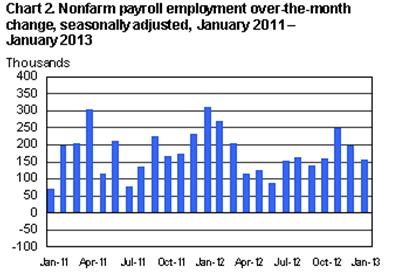
Chart-Employment-Over the month change, 2010-13

The Employment Situation for January 2013 News Release (PDF Version), Bureau of Labor Statistics, February 1, 2013.

—————

Chart-Quarter to quarter growth in real GDP

U.S. Bureau of Economic Analysis, January 20, 2013.

—————

Despite a moderate pick-up in output growth expected for 2013–14, the unemployment rate is set to increase again and the number of unemployed worldwide is projected to rise by 5.1 million in 2013, to more than 202 million in 2013 and by another 3 million in 2014.

Executive Summary, Global Employment Trends 2013, International Labour Organization, January 2013.

—————

As the global economy has gone from crisis to crisis in recent years, the cure has become part of the disease. In an era of zero interest rates and quantitative easing, macroeconomic policy has become unhinged from a tough post-crisis reality. Untested medicine is being used to treat the wrong ailment – and the chronically ill patient continues to be neglected.

Stephen S. Roach, Macro Malpractice, Project Syndicate, Sep. 30, 2012.

—————

The euro-area recession deepened more than economists forecast with the worst performance in almost four years as the region’s three biggest economies suffered slumping output.

The European data chimed with statistics in Japan, where the economy unexpectedly shrank last quarter as falling exports and a business investment slump outweighed improved consumption. GDP fell an annualized 0.4 percent, following a 3.8 percent fall in the previous quarter.

Marcus Bensasson, Euro-Area Economy Shrinks Most Since Depths of Recession, Bloomberg, February 14, 2013.

COMMENTS

Every year a spate of optimistic stories about the recovery from The Great Recession pour into American homes, offices and automobiles, as businesses and consumers rev up for the annual Season of Spending (and Hopeful Signs).  This season begins with the returns to school in August and September and ends with the post-holiday sales in early January.

Soon after the Season of Spending ends, the optimistic stories begin to disappear as the economists and financial experts to whom writers and commentators in the media turn for information begin to grudgingly acknowledge that all is not well, after all, in the land of beautiful spending.  The Season of Spending fades into memory and the artificially pumped up optimism of American business owners and consumers gives way to disappointment.

The annual cycle of positive and negative economic news is real, as the charts of over-the-month employment changes and quarter-to-quarter real growth in GDP illustrate[1].  But, the annual cycle of hope and disappointment is manufactured by influential economists and financial experts who either willfully ignore the flat trend line that cuts through the multi-year cyclical pattern, or worse, aren’t even aware of it.  Ignore the underlying trend line and every fall time spending spree becomes a new “morning in America.”

Instead of pumping up optimism each fall on the basis of positive economic signals that are demonstrably temporary, economists and financial experts should be pointing out that job growth is not accelerating and explaining why the level of job creation remains well below the level needed to restore full employment and grow incomes.  The trouble is, they can’t explain the trend line because it doesn’t make sense in traditional nation-centric models of employment growth.

The cyclical pattern of employment change in the U.S. is influenced by domestic spending, but the trend line around which U.S. employment change fluctuates is greatly influenced by world economic factors.  U.S. employment trends are a subset of global employment trends, which are embedded in global economic processes, investment trends, and spending trends.

The world economy is limping along and recent reports strongly indicate that little improvement will take place over the next couple of years.  GDP growth will be too slow to generate adequate employment growth, so unemployment and underemployment will rise.  In this context it is wishful thinking to suppose that this spring will not bring another round of disappointment about job and income growth in the U.S.


[1] This pattern makes sense given the seasonal pattern of spending by Americans.  The most difficult to resist pressures to spend are concentrated in the last five months of the year, the Season of Spending.  Parents have to pay school fees and buy backpacks, computers, new clothes, and even cars for their children.  During the holiday season, which follows close on the back to school season, spending increases because we all face powerful pressures from family and friends and advertisers, and because many of us have postponed optional spending until the holidays give us dispensation to empty out savings accounts and haul out the credit cards.

The ‘All’ in ‘We’re All in This Together’ Is the Whole World

ITEMS FOR YOUR CONSIDERATION

… that if you just “work hard and play by the rules” you should expect … a decent life and a chance for your children to have a better one. There is just one problem: It’s out of date.

… when Clinton first employed his phrase in 1992, the Internet was just emerging, virtually no one had e-mail and the cold war was just ending. In other words, we were still living in a closed system, a world of walls, which were just starting to come down. It was a world before Nafta and the full merger of globalization and the information technology revolution, a world in which unions and blue-collar manufacturing were still relatively strong, and where America could still write a lot of the rules that people played by.

That world is gone. It is now a more open system.

 Thomas Friedman, New Rules, New York Times, : September 8, 2012.

—————

Anybody with an idea and a little expertise can set assembly lines in China into motion with nothing more than some keystrokes on their laptop. A few days later, a prototype will be at their door, and once it all checks out, they can push a few more buttons and be in full production, making hundreds, thousands, or more….“Three guys with laptops” used to describe a Web startup. Now it describes a hardware company, too.

Voilà, a Factory in Your Garage, Reading File, New York Times, February 6, 2010.

—————

Both cyclical and structural effects appear evident in the recession, suggesting that some features of the U.S. economy can benefit from stimulatory monetary and fiscal policy, while others are more permanently damaged and unlikely to respond to such policies.

 Eric Swanson, Structural and Cyclical Economic Factors, Economic Newsletter, Federal Reserve Bank of San Francisco, June 11, 2012.

—————

After all, borders are not impermeable. On the contrary, globalization – the immense flow across borders of people, ideas, greenhouse gases, goods, services, currencies, commodities, television and radio signals, drugs, weapons, emails, viruses (computer and biological), and a good deal else – is a defining reality of our time. Few of the challenges that it raises can be met unilaterally; more often than not, cooperation, compromise, and a degree of multilateralism are essential.

Richard N. Haass (Director of Policy Planning for the US State Department (2001-2003), To the Victors Go the Foils, Project Syndicate, Apr. 25, 2012.

COMMENTS

When there are no limits to competition, competition destroys the commons – whether that commons is arable land, fish stocks in the ocean, the earth’s breathable air, or the economy in which all the world’s working people must earn an income sufficient to support a family and contribute to the well-being of their communities.

Structural factors that rob working people of living wage jobs are not confinedto the U.S., are not confined to any nation. There are national and local variations, but, fundamentally, the structural problems are global in scope and must be addressed through globally coordinated efforts.

A global system in which one nation outdoes others for a few years, and then another nation outdoes others for a few years, while the global trend is greater hardship for the greater number, is not one the American people should want and it is not one in which a high standard of living can be sustained.

The Global Policy Crisis Keeps Growing Because We’ve Never Seen This Kind of World Economic Crisis

ITEMS FOR YOUR CONSIDERATION

But it is no accident that so many of the world’s economies are sputtering at the same time, or that so many people around the globe are angry. … One reason for the synchronized gloom, of course, is the synchronization of the global economy. … Rather, we are all, both together and apart, trying to figure out three big questions. … The first is how nation-states fit into a globalized world economy.

Chrystia Freeland, The three questions of global importance, Reuters, June 21, 2012.

—————

In an era of globalization, there are no innocent bystanders. There are certainly no oases of prosperity in the face of yet another major shock in the global economy. America’s growth mirage is an important case in point.

Stephen S. Roach, The Great American Mirage, Project Syndicate,  June 27, 2012.

—————

The possible conclusions are stark. One possibility is that those investing in financial markets expect economic policy to be so dysfunctional that the global economy will remain more or less in its current depressed state for perhaps a decade, or more. The only other explanation is that even now, more than three years after the US financial crisis erupted, financial markets’ ability to price relative risks and returns sensibly has been broken at a deep level, leaving them incapable of doing their job …

J. Bradford DeLong, The Perils of Prophecy, Project Syndicate, June 27, 2012.

—————

If we are to thrive as a global community of almost 10 billion – the projected population by 2050 – these new models are not optional, they are an absolute necessity.

From the Introduction, Outlook on the Global Agenda 2012, World Economic Forum.

—————

As a world economic crisis developed in 2008 and lasted longer than most economists predicted, it became increasingly clear that beliefs about macroeconomics and macroeconomic policy needed to be thoroughly examined. … By the end of this fascinating conference, we knew that we had entered a brave new world and that the crisis is generating enough questions to fill our research agendas for years to come.

From the Preface: Olivier J. Blanchard, David Romer, A. Michael Spence and Joseph E. Stiglitz, In the Wake of the Crisis: Leading Economists Reassess Economic Policy, MIT Press, 2012.

—————

We are living in very unusual times,” said Mohamed A. El-Erian, the chief executive of Pimco, the world’s largest bond manager. “History may not be as reliable a guide as it’s been in the past.”

Jeff Sommer, Flights to Safety Can’t Hide the Dangers, New York Times, May 12, 2012.

COMMENTS

A significant number of economists and policy experts have wondered whether this global economic crisis is different – for two reasons: very few experts saw such a severe crisis coming and, even after absorbing that surprise, very few expected the crisis to be so resistant to policy interventions and to persist for so long.

The crisis is different this time – because it is embedded in a confluence of historical developments that the world has never seen before.  It involves the following developments:

  • Global climate change is damaging agricultural, tourism, fishing, and other weather sensitive industries, forcing producers to invest in very costly efforts to move and/or modify productive activities
  • The scale and scope of global production is running up against absolute resource limits, substantially curtailing practices that once were common and allowed market based productive activities to increase at low cost:
    • discovering easy to extract oil, natural gas, and mineral  deposits
    • opening up frontiers (territories not organized under western models of political authority) to invading waves of farmers, miners, loggers, entrepreneurs, and investors
    • adapting to dwindling fish stocks by fishing farther from shore and deeper
    • finding and harvesting virgin forests
    • abandoning aging and polluted cities, rivers and lakes (increasingly costly to maintain) to build newer cities in regions where rivers and lakes are untarnished
  • The centuries long era of incorporating the world’s territories and peoples into the western system of nation-states and coercing and bribing the world’s peasants, tribal peoples, and unpaid family and community workers into labor and consumer markets has come to an end; this has all but eliminated one of the primary ways in which the growth of demand for goods and services generally kept pace with the growth of productive capacity
  • The global spread of advances in productive technology, which entails the substitution of machine energy for human energy and machine thinking for human thinking, is slowing the growth of demand for goods and services by reducing opportunities to gain income through work.

This confluence emerged in recent decades and has permanently damaged the capacity of the world economy to generate the large pulses of consumer demand that historically called forth the productive investment responses that produced pulses of demand for labor.  The pulses of demand for labor increased wages and moved families from the ranks of the poor into the ranks of the middle class.  Over the longer term, more wealth was also pumped into the hands of the people at the top, preparing those people to respond to the next pulse of consumer demand.

Today, there is no mechanism for generating that heartbeat of economic growth.  The confluence of forces has damaged both phases of the cycle.

On the demand side, the first response to the confluence was a massive increase in global debt levels.  Debt growth sustained the growth of demand.  However, debt growth had to come to an end.

Today, with global debt levels very high and with global corporations wielding enormous political power in the world economy, it is not politically feasible to generate a Keynesian pulse of global consumer demand (either by massively expanding global debt levels or by  redistributing a large amount of wealth from the affluent to the have-nots).  But, even if the world economy’s leaders did find a way to generate a large pulse of consumer demand, it would largely fail to restart world economic growth.

On the supply side, the productive investment responses to a large pulse of consumer demand can no longer produce the employment and income gains that they produced in the past.  The ratio of machine energy to human energy in the world economy is so high now that demand for labor would not increase sufficiently to drive up global wage levels to the degree that was the case in the past.  Moreover, and more importantly for the long run, increasing the production of goods and services in the context of a world of resource limits that are becoming more difficult to overcome will drive up consumer prices. Whatever wage gains are realized will be offset by a higher cost of living..

From time to time in the history of the capitalist world economy, its magic has faltered and then been restored. This time the magic will sporadically flicker on for a while here and there in the world economy, but it will not be restored.  Something else will happen.

Hard Working? Creative? Strong Language and Computer Skills? Earn Up to $4 Per Hour in the New Global Labor Force

ITEMS FOR YOUR CONSIDERATION

The job didn’t pay much: four bucks an hour if you really hustled. But for Catherine Fraser, a recent community college graduate from Mountain View looking to pick up a little extra spending cash, the work was a hoot.

… said analyst Martin Schneider with 451 Research. “Like manufacturing has done forever, crowd-labor lets us break down a job into tiny components, where one bit of fact-checking or writing a few sentences is now the equivalent of gluing that chip onto a computer board.”

… The larger question — and one with huge global implications as crowd-sourcing redefines and in some cases kills traditional jobs and long-established labor-management models — is whether the crowd-labor pool could essentially become one big worldwide digital sweatshop. While industry studies show average hourly earnings across all categories range from about $7 in India to $16 in Western Europe, the fast-growing segment of micro-taskers earn half that on average, and some make only $1.50 an hour.

Patrick May, ‘Crowd labor’ helps spur social networking revolution, San Jose Mercury News, Updated: 05/01/2012.

—————

Series Index May

Series Index Apr

Rate of Change

Employment Index

50.8

54.2

Slower

Business Activity/Production

55.6

54.6

Faster

New Orders

55.5

53.5

Faster
Source: May 2012 Non-Manufacturing ISM Report On Business, Institute for Supply Management, June 5, 2012

—————

For Great Wall, a private sector Chinese car maker that employs 50,000 workers, the Swiss robots and other machinery that line its bright factory floor produce more than cost savings. The company hopes they will help it build cars good enough to compete with the global auto makers.

According to Nomura, 28 percent of factory machines in China use numerical controls – one measure of automation. That may be far lower than Japan’s 83 percent, but China is growing far faster than Japan did at a comparable stage of development, says Ge Wenjie, a machinery analyst with Nomura.

In other words, China may soon be known less for cheap Christmas toys and more for high-end medical equipment, luxury cars and jet engines.

By Don Durfee, Analysis: Robots lift China’s factories to new heights, Reuters, June 3, 2012.

—————

Unit labor costs fell in 23 of 47 service-providing industries, the most since 2003 …

Output per hour increased in 32 of the 47 [service-providing industries] industries studied.  In most of these industries, productivity rose as output growth was accompanied by declines or more modest increases in hours.  Several  industries posted double-digit productivity gains as a result: local as well as long-distance general freight trucking; refrigerated warehousing and storage; radio and television broadcasting; wireless telecommunications carriers; and travel agencies.

In a few industries, productivity rose despite falling output.  In industries such as postal service; couriers and messengers; video tape and disc rental; photofinishing; and newspaper, book, and directory publishers, rising labor productivity reflected declines in both labor hours and output, with hours falling more rapidly than output.

Productivity and Costs by Industry: Selected Service-Providing and Mining Industries, 2010, Economic News Release, U.S. Bureau of Labor Statistics, May 31, 2012.

COMMENTS

During the 20th century each new generation of U.S. workers faced declining employment opportunities in agriculture, mining, and manufacturing.  But those lost employment opportunities were offset by growing employment opportunities in government and private service sector industries.

This is no longer the case.  Job growth in government and service sector industries has slowed considerably.  Moreover, some government agencies and service sector industries are embracing new production technologies and becoming job shedders themselves.

The hallmark of the first half of the 21st century may well be a decades long global employment crisis.  National governments are still trying to apply economic remedies carried over from the 20th century in a world that is vastly different.  National economic sovereignty is gone.  Rich and poor nations alike are now joined at the economic hip in a single world economy.

Sticking with the “each nation goes it alone” strategy for addressing the global employment crisis isn’t working.  Rather than getting increasing prosperity, U.S. working families and local business owners are getting a larger share of the world’s very high level of poverty.

The practical alternative for the U.S. is to join with the world’s other nations to build institutions that coordinate national economic policies and set minimum global standards for corporate behavior, working conditions, wages and benefits.

Globalization cannot be undone, so there is no other choice.

Time is Running Out for the “All News is Good News” Spin on U.S. Employment Prospects

ITEMS FOR YOUR CONSIDERATION

Payrolls climbed by 69,000 last month, less than the most- pessimistic forecast in a Bloomberg News survey, after a revised 77,000 gain in April that was smaller than initially estimated, Labor Department figures showed today in Washington. The median estimate called for a 150,000 May advance. The jobless rate rose to 8.2 percent from 8.1 percent, while hours worked declined.

Timothy R. Homan, Employment in U.S. Increased 69,000 in May, Bloomberg, June 1, 2012.

__________

The proportion of Americans in their prime working years who have jobs is smaller than it has been at any time in the 23 years before the recession, according to federal statistics, reflecting the profound and lasting effects that the downturn has had on the nation’s economic prospects. … The percentage of workers between the ages of 25 and 54 who have jobs now stands at 75.7 percent, just a percentage point over what it was at the downturn’s worst, according to federal statistics.

Before the recession the proportion hovered at 80 percent.

Peter Whoriskey, Job recovery is scant for Americans in prime working years, Washington Post, May 29, 2012.

__________

A gauge of manufacturing in the 17-nation euro zone fell to a three-year low of 45.1 in May, indicating a 10th month of contraction, while unemployment reached 11 percent, the highest on record. China’s Purchasing Managers’ Index dropped to 50.4 from 53.3, the weakest production growth since December.

Simon Kennedy, Global Growth Heads for Lull as Europe Output Shrinks,  Bloomberg, June 1, 2012

__________

Markit chief economist Chris Williamson attributed the [manufacturing] slowdown to “a near-stagnation of export orders, reflecting deteriorating demand in many overseas markets, notably the euro zone but also emerging markets such as China.”

Steven C. Johnson with editing by Chizu Nomiyama, Weak export demand slows May manufacturing growth: Markit, Reuters, June 1, 2012.

__________

“We are living in very unusual times,” said Mohamed A. El-Erian, the chief executive of Pimco, the world’s largest bond manager. “History may not be as reliable a guide as it’s been in the past.”

Jeff Sommer, Flights to Safety Can’t Hide the Dangers, New York Times, May 12, 2012.

COMMENTS

Since the official end of the Great Recession, economists, with very few exceptions, have reiterated optimism about U.S. job growth following economic news releases, whether the news was good or bad.  This optimism was and is untenable.

Even after decades of economic globalization, U.S. economists continue to make the mistake of treating nation to nation variations on larger global employment themes as though they are largely autonomous national employment themes.  This mistake leads economists to carry forward into the current era a trust in nation-based economic analysis tools and nation-based economic policy formulations that were developed for an economic era that is all but gone.

Until U.S. economists revise their analytical approach and policy formulations to fit the global economic era in which we all now live, Americans will continue to be fed hopes about U.S. employment trends that are largely destined to be disappointed.

In Bill Clinton’s 1992 presidential campaign the phrase, “It’s the economy, stupid”, was used as a reminder to campaign workers to stay on message.  It became fairly well known outside the campaign and is still occasionally quoted.

Long ago, U.S. economists should have revised that phrase to “It’s the world economy, stupid.”

The Rapid Global Deployment of Increasingly Smarter Machines Overturns Traditional Economic Policy Assumptions About Employment Growth and Income Distribution

ITEMS FOR YOUR CONSIDERATION

Last week Amazon, the online retailer, announced it was buying a robot maker called Kiva Systems for $775 million in cash. … Kiva Systems’ orange robots are designed to move around warehouses and stock shelves.

Or, as the company says on its Web site, using “hundreds of autonomous mobile robots,” Kiva Systems “enables extremely fast cycle times with reduced labor requirements.”

Nick Bilton, Disruptions: At Amazon, the Robot World Comes a Little Closer, New York Times, March 25, 2012.

—————

The value of the global industrial robot-system market will double to $41 billion by 2020, according to an estimate by Christine Wang, an analyst at Daiwa Capital Markets in Hong Kong. Global unit sales last year jumped about 30 percent to a record 150,000 units, the IFR said.

Reuter, the Kuka CEO, said higher wages in China make investing in robots a simple trade off.

“It comes down to the question: at what cost can a robot do the job more efficiently?”

Richard Weiss, Kuka Robots Invade China as Wage Gains Put Machines Over Workers, Bloomberg, April 12, 2012.

__________

This is the potential of the “Internet of Things”: billions and billions of devices and their components connected to one another via the Internet. 50 billion devices by 2020, according to companies like Ericsson.

The basic building block of the Internet of Things is machine-to-machine communication (M2M), devices equipped to communicate without the intervention of humans.

Large scale M2M users may offer their services dozens of countries, selling the same devices globally.

Rudolf Van der Berg, The Internet of things, OECD Insights,  January 31, 2012.

__________

IBM says Watson’s skills — interpreting queries in natural language, consulting vast volumes of unstructured information quickly, and answering questions with a defined level of confidence — can be applied to many industries. It has already sold the technology to WellPoint Inc. (WLP), the U.S. insurer, and Citigroup Inc. (C), and expects to generate billions in new revenue by 2015 from putting Watson to work.

… Martin Kohn, IBM’s chief medical scientist, said in an interview. Using Watson “we have access to much more information than we could possibly accomplish by reading on our own, or even 100 people reading.”

Beth Jinks,  IBM’s Watson to Help Memorial Sloan-Kettering With Cancer, Bloomberg, March 22, 2012.

__________

There is reason to believe that code kernels for the first Turing-intelligent machine have already been written.

“Two revolutionary advances in information technology may bring the Turing test out of retirement,” wrote Robert French, a cognitive scientist at the French National Center for Scientific Research, in an Apr. 12 Science essay. “The first is the ready availability of vast amounts of raw data — from video feeds to complete sound environments, and from casual conversations to technical documents on every conceivable subject. The second is the advent of sophisticated techniques for collecting, organizing, and processing this rich collection of data.”

Brandon Keim, Artificial Intelligence Could Be on Brink of Passing Turing Test, Wired, April 12, 2012.

COMMENTS

The prevailing U.S. policy approach to creating jobs and distributing income reflects the traditional optimism of economists about long term employment and income distribution trends.  It treats employment growth and the widespread distribution of income through private sector payrolls as beneficial side effects of economic growth that require little attention from government.  The primary concern for government is providing optimal conditions for private sector investment.

The general optimism of economists about employment and income distribution includes a specific optimism about the impact of technology driven productivity growth.  Economists generally acknowledge that the implementation of new production technologies reduces the demand for labor in the industries in which those technologies are introduced.  But, they go on to argue that the workers who are displaced (or their children) find work in new industries (also created by the new technologies).  The net result is greater wealth for society and no permanent upward trend in unemployment.

Assumptions Underlying This Optimism Are Obsolete

In the past, this logic worked fairly well in the U.S.  Today, however, three key assumptions underlying this logic are violated in the real world.

The first assumption is that technological innovations will not be implemented faster than displaced workers can retrain for and find alternative work in emerging industries.  This assumption is no longer operative because unprecedented efficiencies in research and development fields, unprecedented fluidity of capital flows, and unprecedented levels of global competition are generating employment displacement and new skill requirements faster than human institutions can respond.

The second is that global market institutions will always evolve fast enough to keep the global capacity to consume growing as fast as the global capacity to produce grows.  The expanding role of debt financed consumption in the growth of global markets in recent decades and the prolonged duration of the financial and economic crisis that began in 2008 because of the tightening of credit show that this assumption is at least questionable.

The third assumption is that machines can displace only a small portion of human work activity.  This is no longer true.  Recent years have brought businesses massive increases in computing power, lower cost high capacity information storage, and computer programs that use highly sophisticated computational algorithms.  These hardware and software advances are now being deployed to mimic an expanding range of human work activities.

Job Creation and Income Distribution Must Become Direct Goals of  U.S. Economic Policy

If the assumptions on which economists rest their optimism about employment growth and income distribution are now obsolete, then public policies that succeed in stimulating private sector investment growth are unlikely to produce the employment growth and income distribution outcomes needed by the majority of people.  Creating good jobs and implementing policies that widely distribute incomes must become direct goals of government policy making, rather than secondary goals.

To continue with the current focus only on providing optimal conditions for private sector investment will only bring us more of what we now have: declining middle class incomes, more families living in poverty, and too much wealth owned and controlled by too few people.

Where Will They All Work?

“Consider Stanford’s experience: Last fall, 160,000 students in 190 countries enrolled in an Artificial Intelligence course taught by Mr. Thrun and Peter Norvig, a Google colleague. An additional 200 registered for the course on campus, but a few weeks into the semester, attendance at Stanford dwindled to about 30, as those who had the option of seeing their professors in person decided they preferred the online videos, with their simple views of a hand holding a pen, working through the problems.

Besides the Artificial Intelligence course, Stanford offered two other MOOCs last semester — Machine Learning (104,000 registered, and 13,000 completed the course), and Introduction to Databases (92,000 registered, 7,000 completed). And this spring, the university will have 13 courses open to the world, including Anatomy, Cryptography, Game Theory and Natural Language Processing.”

Tamar Lewin, Instruction for Masses Knocks Down Campus Walls, New York Times, March 4, 2012.

COMMENTS

Stanford is only the tip of a global iceberg of educational capacity growth that is beginning to dump huge numbers of well educated workers into the world economy.

A big question for state university systems:  If you are the son or daughter of a middle class family in China or India or Kenya or Peru, why settle for an online education at State U. when universities of the caliber of Stanford, MIT, and Harvard offer unlimited enrollment opportunities?

For more on this issue, see my previous post:

Too Many Well Educated Workers: a Global Problem and a U.S. Policy Dilemma, February 29, 2012

U.S. Workers Are Settling Into a Global Era of Fewer Good Jobs and Declining Incomes

ITEMS FOR YOUR CONSIDERATION

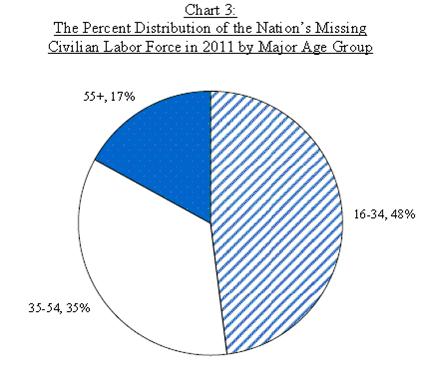
Chart-Missing Civilian Labor Force
Source: Andrew Sum, et al (see citation below quote)

“Following 2007, the pool of hidden unemployed has risen steadily and strongly from 4.7 million in 2007 to close to 6.5 million in 2011; a rise close to 1.8 million or 40%. This was the third largest annual average number of hidden unemployed in the 45 year history for which such data exist dating back to 1967.”

Andrew Sum, Mykhaylo Trubskyy, with  Sheila Palma, The Great Recession of 2007-2009, the Lagging Jobs Recovery, and the Missing 5-6 Million National Labor Force Participants in 2011: Why We Should Care, Northeastern University Center for Labor Market Studies, January 2012

—————

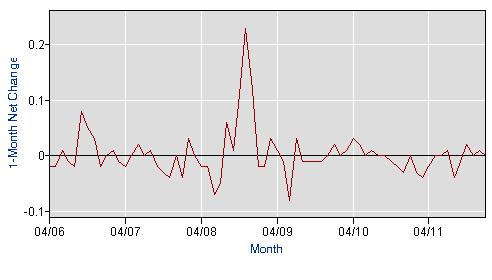
Change in Average Hourly Earnings of U.S. Employees, 2006 – 2011

Chart-Average Hourly EarningsSource: Historical Data, Current Employment Statistics, Bureau of Labor Statistics.

—————

“Spain’s jobless rate for people ages 16 to 24 is approaching 50 percent. Greece’s is 48 percent, and Portugal’s and Italy’s, 30 percent. Here in Britain, the rate is 22.3 percent, the highest since such data began being collected in 1992. (The comparable rate for Americans is 18 percent.)

Thomas Landon, For London Youth, Down and Out Is Way of Life, New York Times, February 15, 2012

—————

Looking at the changes within countries over time, the overall long-term trend is obvious: the majority of countries have witnessed increases in low-wage employment over the past 15 years. Overall, figure 20 shows that, since the second half of the 1990s, low pay has increased in about two-thirds of countries for which data are available (25 out of 37 countries). … While it is too soon for an assessment of the short-term effect of the crisis on low pay (since few countries have published their data on low pay in 2009), there is little reason to believe that a global recession will have brought about any improvement in the overall situation of low-paid workers.

Global Wage Report 2010/11: Wage policies in times of crisis, International Labour Organization, December, 2010

COMMENTS

In a free market economy, buyers and sellers negotiate prices.  When buyers have lots of choices and sellers don’t, buyers have the leverage to push prices downward.

We have seen this in the U.S. housing market: huge numbers of houses are on the market and an army of builders are waiting in the wings to put even more houses on the market – the ratio of sellers to buyers is very high.  Thus, even though houses are beginning to sell a little better, prices are still falling.

The same thing has happened in the global labor market: the ratio of available workers (sellers) to employers with jobs to fill (buyers) is very high, and it will stay high.  There are several structural reasons:

  • the integration of national economies into a single world economy based on free market principles has made huge numbers of unemployed and underemployed workers newly available to the world’s major employers and many intermediate size employers
  • expanding national education systems are producing a growing supply of skilled workers for the global labor market
  • the global economic crisis of 2008-2009 produced large numbers of business failures and consolidations, reducing the number of employers competing for the growing global supply of workers
  • the production of a given volume of goods and services continues to require fewer and fewer workers as machines and computers do more of the brute work and more of the routine thinking
  • global consumption of goods and services is not growing fast enough to reduce the ratio of available workers to available jobs.

Thus, even though hiring in the U.S. is beginning to get a little better, the bargaining position of U.S. workers, even those who are unionized, continues to deteriorate.  Given this trend, either real U.S. wages and incomes will decline much further, or rates of unemployment, underemployment, and non-participation of working age people in the workforce will remain high.

Employment Optimism? Really? This January was Worse than January 2011 and Adverse Global Economic Forces are Still in Play

ITEMS FOR YOUR CONSIDERATION

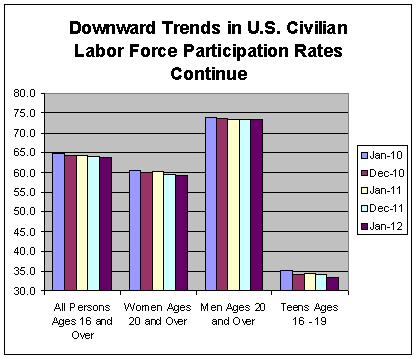
Downward Trends in U.S. Civ Labor Force ContinueData source: Labor Force Statistics from the Current Population Survey, Bureau of Labor Statistics

—————

Private Sector Job Growth is Dominated By Lower Wage Industries

Percent of Private Sector Job Growth By Selected Industries

Jan-11

Dec-11

Jan-12

Goods-Producing

30.3%

32.3%

31.5%

Private Service-providing

69.7%

67.7%

68.5%

Retail Trade

31.0%

2.8%

4.1%

Temporary Help Services

13.5%

3.8%

7.8%

Leisure and Hospitality

-6.7%

8.6%

17.1%

Other services

-5.9%

2.3%

2.7%

Total 4 Selected Service Providing

31.9%

17.5%

31.8%

Data source: Employment Situation Summary Table B, Employment News Release, Bureau of Labor Statistics, February 3, 2012.

—————

Job Cuts, January 2012 Greater than in January 2011

(Ten Industries with Highest Cuts)


January 2012

January 2011

Retail

12,426

5,755

Financial

7,611

2,822

Pharmaceutical

4,071

2,090

Entertainment/Leisure

3,910

1,545

Aerospace/Defense

3,634

3,167

Government/Non-Profit

3,021

6,450

Food

3,000

873

Consumer Products

2,464

1,783

Industrial Goods

2,230

1,874

Transportation

1,770

725

Data Source: 2012 Kicks Off With 28% Surge in Job Cuts, Press Release, Challenger, Gray & Christmas, February 2, 2012.

—————

January 2012 Purchasing Managers’ Index (PMI) for Manufacturing Lower than in  2010 and 2011

2010

January

April

July

Oct

56.7

59.0

55.7

57.0

2011

2012

January

April

July

Oct

January

59.9

59.7

51.4

51.8

54.1

Data source: table of Manufacturing Business PMI history, Institute for Supply Management. 

—————

“The man in charge of a firm with several hundred thousand staff around the world bemoaned that, ‘we live in a world where wealth creation is uncoupled from job creation. This once close connection is ruptured.'”

Tim Weber, Davos 2012: Youth unemployment ‘disaster’, BBC News website, January 28, 2012.

—————

SMBs in developing countries are keeping pace with their more developed counterparts when it comes to providing employees with smartphones, netbooks/mini notebooks, and media tablets. In some cases, they are actually more likely to provide these products to their staff.

The Consumerization of IT Helps Level the SMB Playing Field Across the World, IDC Says, Press Release, International Data Corporation (IDC), January 25, 2012.

—————

“This suggests that the labor market has changed in ways that prevent the cyclical bounceback in the labor market that followed past recessions. … Stricter market incentives to control costs in the face of stiff domestic and international competition may also be factors. In addition, anecdotal evidence suggests that recent employer reluctance to hire reflects an unusual degree of uncertainty about future growth in product demand and labor costs. These special factors are not readily addressed through conventional monetary or fiscal policies. But such policies may be able to offset the central obstacle of weak aggregate demand.”

Rob Valletta and Katherine Kuang, Why Is Unemployment Duration So Long?, Federal Reserve Bank of San Franscisco Economic Lettter, January 30, 2012.

COMMENTS

The only way to arrive at optimism about U.S. employment is to focus attention on indicators that are poorly related to unemployment changes (GDP growth, initial unemployment insurance claims, the traditional unemployment rate) and ignore global economic forces that continue to spell trouble for U.S. employment growth

Misleading indicators:

  • An uptick in the rate of GDP growth is misleading about employment growth because machines now play such a large role of in the production and sale of goods and services in the U.S.;  modest upswings in GDP can take place with almost no impact on employment
  • Initial claims for unemployment insurance (UI) get a lot of press, but only about 43 percent of unemployed workers receive UI; unemployment among workers who mostly do not qualify (many workers in retail and service industries) can rise or fall dramatically with little impact on initial claims
  • As is well known, the traditional unemployment rate is a downwardly biased measure of unemployment; it does not count as unemployed persons who have opted to do something other than look for work until prospects improve (e.g., going to school,  taking a self-financed sabbatical, making repairs to the house) and does count as employed persons who want full time employment but can only find part-time employment and persons who are working in jobs beneath their qualifications.

Global forces that undercut U.S. job growth are still in play:

  • Global and U.S. GDP growth rates will be modest through at least 2012 because of financial turmoil, lots of supply, and weak demand
  • The number of competing nations in the world economy has not diminished and very high levels of unemployment are pushing many nations to become even more aggressively competitive
  • Slow global market growth continues, which means the world’s global businesses must continue to relentlessly cut labor and other costs to survive
  • Emerging market countries with skilled workers, advanced production capacities, and much lower production costs will continue to outbid the U.S. for the investments that produce the most jobs per dollar of investment
  • Facing higher production costs in the U.S., much of the investment in the U.S. will continue to be in high tech, high profit activities that produce relative few jobs, and those jobs will be ones for which very few U.S. workers have the required skills.

The labor force participation rate, which is a better indicator of whether we should be optimistic about job growth, has been trending downward for many years.  Taken as a whole, economic signals indicate that this trend is locked in, whatever economists and reporters may wish to read into short term economic indicators.