Future of Stock Market Investments and Jobs

Stock markets are places for investing money with the expectation that stock values will increase over time.  If the values increase, a person can withdraw their money from the stock markets at a later date and realize a substantial increase in wealth.  That increase in wealth is a share of the profits the companies listed on the stock markets are able to earn.  Those profits, in turn, are dependent on the total increase in wealth that the whole economy has produced.  Thus, the long term growth in stock market values depends on the long term growth of sharable real wealth. 

The historical trend in sharable real wealth growth is strongly related to the long term growth in the consumption of energy by humans.  It has also been strongly dependent on the ability of producers of wealth to discard waste cheaply and avoid paying for the damaging unintended consequences of expanding wealth production.  For sharable real wealth to continue to grow, both the energy trend must continue and the downside costs to producing wealth must continue to be cheap.  Energy production can certainly continue to expand, but the downside costs of using that energy to produce more sharable wealth are rapidly rising because managing climate change damage, resource depletion, ecosystem destruction, and popular anger is taking a bigger and bigger bite out of total wealth production.

If we are not already at the end of the era of expanding real wealth production in the world-economy, we are getting close.  As a result, the stock markets have or are about to enter a cul-de-sac from which there is no escape in the foreseeable future.  Middle class people around the world are making more and more demands on their governments to protect their wealth from extreme weather events, resource depletion, ecosystem destruction, and civil unrest, and to restore the wealth they have already lost to those destructive forces.  In these circumstances, company profits cannot grow as fast as they did in the past unless real wealth production increases more rapidly or the demands from middle class people are not met.  Accelerating wealth production also accelerates climate change, resource depletion, ecosystem destruction, and popular anger.  It rapidly adds to the costs of managing all the damage, especially popular anger (via policing and military spending).  On the other hand, assigning a greater share of the wealth being produced to meeting the demands of middle class people has to cut into the profits of the companies listed on the stock markets.  Down either path lies the stagnation of profits and the resulting stagnation of stock values. Down either path are real losses for the world’s middle classes.

Various governments are grappling with this stock market cul-de-sac by coupling an immediate reduction in middle class and working class standards of living with promises of great times yet to come.  In the U.S., the Trump administration is taking this short term fix to its extreme – inflicting immediate economic pain and possibly inducing a recession that will wipe out wealth for millions of middle class and near middle class families while calling the economic pain necessary medicine that will pay off handsomely for Americans. 

Much of the wealth loss is showing up, and will continue to show up, in the deteriorating wages, benefits, and conditions of work.  Attacking unions and reducing U.S. federal government jobs and programs is undercutting standards of work, workplace safety, wages, and benefits, all of which give companies more wiggle room for protecting profit rates for a while longer.  So does reducing taxes and regulations on corporations and the wealthy.  The Trump administration strategy may help corporations and investors avoid hitting the brick wall at the end of the stock market cul-de-sac for a few more years, but the collision is inevitable.

Fading Middle Class Jobs and Decline of Representative Democracy

The institutions of representative democracy and middle class jobs are deeply entwined, so much so that the diminishing of one is accompanied by the diminishing of the other.  This entwinement is rooted in the rise of middle class populations in Europe and North American over the course of the Industrial Revolution (roughly 1700s through 1900s).  The rising affluence of those middle class populations shifted the balances of power between and among ruling class populations and middle class populations and gave rise to the formation of new nation-based political coalitions. 

When the Industrial Revolution kicked off in England in the early 1700s (with the invention of a usable steam engine), achieving affluence became available to a growing proportion of England’s population.  Expanding populations of owners of capital, agricultural lands and new industries and expanding populations of agricultural, manufacturing, industrial, service, and government workers created new flows of income and new and expanding stocks of modern wealth.  Demands for and conflicts over the expanding flows of income and wealth spread and intensified.  Representative democracy was an institutional compromise among the ruling classes and the emerging classes of middle affluence worker/consumer populations.  The royalty gave up a bit of their claimed total control of wealth and the rising middle class populations obtained institutional mechanisms for redressing grievances and making demands.

As the wealth producing technologies and cultural practices of the Industrial Revolution spread to the Americas and then other parts of the world, the world’s middle class populations formed, diversified, and grew in more and more nations, eventually to include populations of high wage industry, government, and science workers.  Popular demands for participation in the high level decisions about producing and distributing wealth came with those trends.  Middle class populations that formed in the world’s colonies not only agitated and fought for representative democracy institutions they also agitated and fought for national independence.  By the middle of the 20th century, demands for representative democracy were global and almost every government on the planet claimed to be a representative democracy, even though many of those claimed democracies were clearly shams and worse.  Despite the growth of popular demands for participation in government decision making, well functioning representative democracies never became the dominant forms of government for the world’s people. 

The Accumulating Costs of Representative Democracy

As middle class populations gained representational footholds in national governments, the costs for maintaining well functioning representative democracy institutions increased and increasingly fell on ruling class populations.  The expenses tied to assembling representatives and paying their salaries and expenses are not a problem for ruling class populations.  Those costs are easily passed along to the middle and poverty class populations in a nation.  Rather, the major expenses for ruling class populations are the income and wealth redistributions required to maintain the contentment of the very large populations of middle and poverty class populations represented in the institutions of government while still holding onto sufficient control over wealth production and distribution institutions (including government institutions) to ensure that their shares of income and wealth meet their growing expectations for income, accumulated wealth, domestic and geopolitical power, and status enhancement.  Satisfying these two competing worlds of expectations is enormously costly, so only the more affluent nation-based ruling class populations have been willing to tolerate a functioning representative democracy for very long.[1]

The Decline of Representative Democracies in the 21st Century

It is widely observed that the institutions of representative democracy are in trouble, not only in the weaker nations where they have always been fragile, but now in the affluent nations of Western Europe and North America.  Given the association of the growth of middle class populations (and the increasing affluence of those populations) with the spread of representative democracies since the 1700s, this should not be surprising.  The world’s middle class populations are no longer growing and most of the existing middle class populations are no longer obtaining real improvements in their standards of living.  A growing number of those populations are experiencing net losses of income and wealth.[2]  The response of many in those populations is not unusual in the history of the modern world-economy: a turn against the time consuming practices of democracy and to the promises of a quick restoration of income and wealth growth made by proponents of authoritarian rule.  Needless to say, the spread of those promises is paid for by the ruling class populations that have only tolerated the institutions of democracy and now see that if they actively and successfully subvert popular belief in democracy, they won’t have to.  

Just as the Great Depression intensified conflict over incomes and wealth that resulted in governmental upheavals (e.g., the New Deal in the U.S. and fascism in Germany, Italy, Spain and elsewhere in Europe), the expanding domain of necessary expenses relative to incomes and wealth for the world’s middle class populations has intensified conflict and governmental upheavals in our own time.  However, unlike the income and wealth recoveries of middle class populations after the Great Depression and WWII and the return to a long phase of growth of middle class populations in the world, no such recoveries will happen this time. 

The Earth’s Inescapable Growth Limits and the Impoverishment of Middle Class Jobs

The period in the history of the modern world-economy we are now entering will not be like the long period of recovery and renewal from the 1950s into the 1990s.  A fundamental characteristic of middle class jobs – the growth of income and wealth faster that the rising costs of living and working and the routine deterioration of tangible wealth (homes, cars, workplaces, equipment, etc.) cannot continue for all middle class populations.  In fact, that characteristic of middle class jobs is already history for large numbers of the world’s middle class people.  The inescapable reason is that the earth-system conditions that allowed the Industrial Revolution to produce increases in incomes and wealth by exploiting earth-system processes and shunting away costs over such a long expanse of time and over so much of the earth no longer exist. 

The carrying capacity of the earth-system is finite and global economic activities are now up against some of its most formidable carrying capacity limits.  Before the last quarter of the 20th century, those limits were generally thought to be finite supplies of resources such as oil, arable land, and certain rare minerals.  We have managed to outmaneuver those kinds of limits by deploying technological fixes and can probably continue to do so for a while longer.  However, technological fixes have brought us more rapidly up against much more intractable earth-system limits: the earth-system’s slow rates of processing the vast waste flows from human economic activities (e.g., carbon, industrial chemicals, spent nuclear fuel).  Those limits are not as easily overcome through the deployment of technological fixes.  Over time, successes with such fixes will become increasingly difficult to achieve because they add to the waste flows earth-system processes already cannot handle.  Rather than decreasing the number and scale of human encounters with earth-system limits, deploying those kinds of fixes add to their exponential growth. 

The Fate of Representative Democracies

The repercussions from our encounters with the carrying capacity limits inherent in the earth-system are rapidly rising expenses relative to the incomes and wealth savings of middle class populations.  Extreme weather events, more frequent and more devastating forest fires, massive rainstorms that generate instant floods, species kill-offs due to diseases (e.g., bird flu devastation of commercial chicken populations in the U.S.), losses of arable lands, and forced adaptations to changing agriculture conditions are adding rising costs to the costs of living for everyone faster than incomes can keep up.  Inevitably, standards of living are declining for many of the world’s populations, including middle class populations.

As costs are rising, ruling class populations are forging ways to shift those costs away from themselves.  They are doing this, in part, by taking advantage of the growing insecurities of middle class populations to organized ruling class-middle class coalitions of support for authoritarian government policies.  In general, most middle class people find it very difficult to accept the reality that adapting to earth-system limits requires middle class life to have fewer modern forms of comfort and convenience and to include more physical work both on the job and at home.  Consequently, those who are finding themselves on the slippery slope downward are susceptible to the arguments for authoritarian policies that accelerate government decision making and exclude certain populations from voting, access to good jobs, and rights to government assistance programs.  As always, the leaders of ruling class populations divide and conquer by identifying populations to include and exclude using identity characteristics (race, gender, nationality, religion, residence status, dialect, etc.) and promising the included populations that they get the spoils of the ensuing political battles while the excluded take the brunt of the general decline in living standards.

All is not lost.  While middle class jobs and representative democracies are very unlikely to survive in their current forms, ruling class authoritarian governments can only protect some middle class populations from rising costs and dramatic job changes over the short term.  During that time, the excluded populations will grow and become better organized and more powerful.  The domestic and geopolitical upheavals we are now experiencing will continue and probably become more widespread and intense.  Many will be very violent (like the wars in Ukraine, Gaza and the Democratic Republic of Congo) or marginally violent (like the political skirmishes with injuries and some deaths we have seen recently in affluent nations).  Eventually, the excluded populations will become well enough positioned to counter the power of ruling populations and create new forms of democracy and new forms of work that are well aligned with earth-system limits.


[1] The world’s ruling class populations are organized into numerous industry factions and nation-based coalitions.  The more affluent of those nation-based coalitions are the ones that have tolerated representative democracy institutions most successfully.  Being the most economically successful, they have been more inclined to accept the high costs required for representative democracies to function well.  Less affluent nation-based ruling class coalitions strenuously and often violently resist representation concessions because such concessions threaten their smaller shares of global income and wealth.

[2] Restoration phrases like Build Back Better and Make America Great Again recently used in political campaigns in the U.S. are not just political slogans, they are acknowledgements that middle class conditions of life are not meeting expectations. 

Our Era of Chronic Inflation and Ongoing Job Deterioration

Inflation is “a gradual loss of purchasing power that is reflected in a broad rise in prices for goods and services over time.”[1]  It is a market economy phenomenon that arises when demand for goods and services exceeds the supply of those goods and services.  Rising incomes can offset some or all of the purchasing power loss, but not everyone in a population will get sufficient income growth to do so.  Political tensions inevitably grow as inflation persists and more people lose purchasing power.

In the long history of the capitalist modern world-economy, periods of inflation have been generated by supply chain disruptions that cause the expansion of production to fall behind the expansion of demand — disruptions usually caused by economic and shooting wars, by production encounters with food production or mineral extraction barriers (e.g., exhaustion of crop lands, depletion of deposits of coal, oil, or other critical resources), and occasionally by a pandemic or labor shortage.  However, in time wars and pandemics end and technological breakthroughs and mineral deposit discoveries restore the growth of resource inputs into production.  Supply side growth catches up with demand side growth.  

In the past, restoring the balance between supply and demand worked because the carrying capacity of the earth-system could handle intensified extraction of minerals, intensified harvesting of plants and animals, and intensified dumping of pollutants into the air and water without generating destructive phenomena that most humans could not escape.  As populations grew and more powerful technologies were developed and implemented and mass marketing transformed more and more of the world’s people into consumers with unlimited appetites for everything modern, the expansion of production capacity could generally keep pace with or catch up with and sometimes outpace the growth of demand.  The relationship between supply and demand cycled through periods of imbalance and balance. 

That capacity in the capitalist modern world-economy for governments and capitalists to restore balance following a period of imbalance came to an end in the late 20th century.  Human activities finally pushed the the earth-system beyond its carrying capacity limits.

Chronic Inflation

The capitalist modern world-economy has entered into a unique era of processes and trends that interact to form two conjunctural forces that make inflation chronic.  The key processes and trends in this conjuncture are continuing world population growth, expected to reach 10.3 billion in the 2080s,[2] continuing consumer and business demand growth as all of the world’s people continue to aspire to western middle class lifestyles, the intensifying development of mineral extraction and food and shelter production technologies as producers race to keep up with growing demand, and the accelerating impingement of the earth-system’s carrying capacity limits on production expansion.  One conjunctural force is the combination of population growth with consumption aspirations built into middle class cultures and constantly reinforced by global marketing campaigns.  The other conjunctural force is the accelerating rise in living costs generated by the mutually reinforcing interactions between the world’s production activities and the carrying capacity limits of the earth-system.  Every increase in production brings with it an intensification of costly repercussions from the earth-system[3] and further stimulation of unrelenting demand growth.  In the other direction, the growing number and intensity of costly repercussions from the earth-system create political pressures to accelerate the development and implementation of technologies intended to reduce costs and ameliorate damages, while still satisfying popular expectations for lifestyle improvements.  This is a vicious cycle of systemic destructiveness that is now driving inflation and will not relent for decades.

More and More Bad Jobs

In this era of chronic inflation, the only way to rebalance supply and demand is to bring down demand so that the production of goods and services does not have to continue to expand and consequently intensify the costly repercussions from the overtaxed earth-system.  In theory, this could be done equitably.  However, the capitalist modern world-economy is a strongly top-down social-system; inequalities of wealth and power are enormous and growing.  The wages and working conditions of working people and the economic protections for the poor are already being diminished by public and private institutions and will continue to be.  Moreover, and more ominously for the fate of representative democracy, the wages and working conditions of many currently middle class workers will almost certainly come under increasing attack, as the rich and their well-heeled hirelings (managers, lawyers, and politicians) take actions to protect their wealth and purchasing power from the ravages of chronic inflation. 

Of course, as inflation and adverse policies cut away at the world’s middle classes, resistance movements will grow and make stronger and stronger demands for more political accountability, limits on profits, and higher taxes on the wealthy.  Those efforts, which are piecemeal now, are being met with brutal suppression and if history is a guide, will continue to be for the foreseeable future.  The niceties of democracy will not be allowed to get in the way of the interests of the rich and their economic and political friends.  History also tells us that at some point suppression fails. As participation in resistance movements grows and global coordination among resistance movements increases, the moment of suppression failure will arrive.  For now, the global forces of suppression are powerful and growing, so that global moment of defeat for the forces of suppression is almost certainly decades away.   


[1] Jason Fernando, “What is Inflation,” Investopedia, Updated September 27, 2024.  https://www.investopedia.com/terms/i/inflation.asp.

[2] “Growing or shrinking? What the latest trends tell us about the world’s population”,  United Nations July 11, 2024.  https://news.un.org/en/story/2024/07/1151971.

[3] Such as higher costs for extracting minerals, higher costs for replacing property destroyed by extreme weather events, higher costs for maintaining the fertility of croplands, higher costs for adapting lifestyles and production activities to rapidly changing environmental and geopolitical conditions.

The Future of Work for Most of Us is Survival Work

In our memories of recent jolts to daily life, the 9/11 attacks, the 2008 financial meltdown, the Fukushima nuclear disaster, the 2004 tsunami that killed more than 230,000 people across 14 countries, the destruction of life and property by hurricane Katrina along the coast of the Gulf of Mexico, and many others, stand out.  COVID19 stands out differently.  All the others were massive jolts to particular people in particular places.  COVID19 is one of a growing wave of destructive events that will sweep over large parts of the world’s population, and sometimes everyone.  We are in the early stages of a massive wave of destructive events that will in one to two generations alter the entirety of our modern way of life.

We are used to thinking in terms of us and them, us and the weather, us and the oceans, us and other living things, yet our lives are connected to everything, literally everything, that makes up this globalized and overworked planet. Perhaps waves of extreme climate events, pandemics, and species die-offs are not the only waves of devastating events that climate change is visiting upon all living things on this planet. Perhaps even the seemingly solid earth itself is not untouchable by climate change.

A British scientist argues that global warming could lead to a future of more intense volcanic eruptions and earthquakes. And while some dismiss his views as preposterous, he points to a body of recent research that shows a troubling link between climate change and the Earth’s most destructive geological events.

The most solid evidence for climatic influence on geology comes from the end of the last ice age, around 12,000 years ago, says McGuire, who is a volcanologist and professor of geophysical and climate hazards at University College London. Analysis of volcanic deposits, published in the past decade by several authors, has found that this period of rapid climate change, when ice sheets retreated from much of the planet, coincided with a sudden outburst of geological activity. The incidence of volcanic eruptions in Iceland increased around 50-fold for about 1,500 years, before settling back to previous levels.

Fred Pearce, Could a Changing Climate Set Off Volcanoes and Quakes? Yale Environment 360, May 7, 2012.

The earthquakes in Turkey and Syria are another stark indicator of the future of work in 21st century.  News reports say more than 45 countries have offered to help Turkey and Syria with rescue efforts, thousands of rescue workers are on the scene, more than 21,000 have been killed and tens of thousands are homeless.  The number of people who are now unavailable to do the usual work of everyday life is small for a planetary human population of 8 billion people, but they have to be added to all the other workers being shifted out of lines of work that contribute to expanding affluence and the growth of a global middle class.  More and more workers are being drawn away to do the work of preventing, preparing for, and recovering from wars, hurricanes, tornadoes, earthquakes, mass shootings, and other disasters.

This shift is cutting deeply into the flows of human, animal, and machine energy that are available for all the things we want.  Climate change and the impacts of a too large and still growing human population on the earth’s many ecosystems and even its geology are forging a world of work that is not the work we really want to be doing.  No end to this ongoing shift in the tasks of work is in sight.

Green Jobs But Not Green Prosperity

SOURCE ITEMS

Our statistical analysis shows that, to avoid a climate catastrophe, the future must be radically different from the past. Climate stabilization requires a fundamental disruption of hydrocarbon energy, production and transportation infrastructures, a massive upsetting of vested interests in fossil-fuel energy and industry, and large-scale public investment—and all this should be done sooner than later.

Hence, if past performance is relevant for future outcomes, our results should put to bed the complacency concerning the possibility of “green growth.” There is no decoupling of growth and consumption-based CO2 emissions – “green growth” is a chimera. 

Enno Schröder and Servaas Storm, Why “Green Growth” Is an Illusion, Institute for New Economic Thinking, Dec 5, 2018.

COMMENTS

The evidence is accumulating that rapid economic growth is becoming a thing of the past, a brief moment in human history made possible by fossil fuels.  Our true earth-system energy income is the daily flow of solar power.  Briefly, we were able to jack up that energy income by using fossil fuels.  That time is ending.  The use of fossil fuels will decline, either because we choose to slow climate change and species extinctions or because continuing to overtax the earth-system’s current life producing processes slams the world-economy against the wall of massive climate and ecosystem paybacks.

For most of human history, jobs were tied to the solar energy flows.  In the affluent nations of our current world, most of our jobs are tied to fossil fuel energy income.  As fossil fuel use declines, our machine worlds (the one at work and the one at home) will have to shrink.  Our work lives will change and change again.  Slowly or rapidly, but inevitably, a transformation of the world of work and everything else about our lives is visible on the horizon.

Work and the Transition to a Solar Future: A Perspective

Societal change is an unavoidable constant.  The totality of humans, other species, and physical earth systems constitute a single economy (the Inclusive World Economy) that is continuously evolving.  This global process of change is driven by the constant flow of energy from the sun.  Energy must do what it does: change the materials it interacts with and change the forms in which it presents itself.  Materials must do what they do: interact with the flows of energy, be changed, and facilitate the transformation of energy forms into different energy forms. As part of this enormous configuration of processes I call the Inclusive World Economy, the world of work must continuously become different and we must become different in dynamic association with this process — but not necessarily in the ways or at the speed we expect or want.

We humans are among the vast array of material instruments through which the flow of solar energy drives change.  Work is the primary way in which we are instruments of change.  In the last several centuries we have vastly expanded and continue to expand the human role in the processes of change in the Inclusive World Economy.  We did this by borrowing solar energy from the past (stored as fossil fuels) and adding it to the flow of solar energy that daily fuels earth’s myriad systems.[1] This dramatic daily increase in the flow of energy through the Inclusive World Economy accelerated and continues to accelerate the global processes of societal and earth systems change, has changed and continues to change the way societal and earth systems change takes place, and has transformed and continues to transform us and almost everything about our planet.

We already know that we can’t keep increasing the use of fossil fuels to augment the daily flow of solar energy.  We have to dramatically limit our borrowing from past solar energy income.  More unsettling is the possibility that we must learn to share the budget of current solar energy flow with other species and with various earth system processes – such as cleansing water through solar powered processes – to a much greater extent than we now think.  We just do not know how much solar energy we can divert from other species and processes in the Inclusive World Economy without generating a new round of system level changes that are both massive and destructive to human wellbeing.

In a large, complex, and dynamic system, system level change can remain evolutionary even while subsystems are going through deep and far reaching change and components are being created and destroyed at a rapid pace.  This is what is now happening in the Inclusive World Economy.  Species are being destroyed; whole communities of people are losing their ways of life; institutions that have been central to our wellbeing are losing there effectiveness and new institutional arrangements are popping up; planetary threats that we have never encountered before have emerged.  The effects of climate change, species loss, limits to vital resources like fresh water and arable land, and conflicts over these things are multiplying and coming faster and faster.

Not surprisingly, the world’s institutional arrangements, which we took for granted only a few decades ago, are becoming dysfunctional in various ways and being subjected to mounting attacks from various quarters.  This is happening to the world of work, where big changes are under way and conflicts over these changes are growing.  The pay and benefits associated with high end jobs are disappearing; protections against harmful work environments are being weakened; more and more jobs involve the work of repairing the damages inflicted by climate change, wars, and illegal business operations.  The world’s stock of wealth (including its people) is growing older, forcing us to devote much more of our work activity to fighting the ordinary ravages of time.

Everything in the Inclusive World Economy is connected, so this is a very dynamic situation.  No one can escape this global upheaval, so everyone is or will be forced to respond to and manage the specific forms in which these massive and life-altering global crises visit us.  As we take actions to respond, every other part of the Inclusive World Economy will change in response to our actions.   Ironically, as we do more to respond to the crises by exerting more technological control over other species and earth systems rather than adapting our own activities to the laws of the universe as they operate in the Inclusive World Economy, the more we accelerate the intensification of the crises.  Unwittingly and carelessly, we have pushed the Inclusive World Economy into a new and dangerous era of change.

In this increasingly hostile global environment, many of us are already struggling with life-altering consequences of these global crises.  Where this is happening, working people are experimenting with old and new ways of making a living and old and new ways of protecting their work opportunities. They have no choice.  But, some of these efforts only work for the short term because they propagate effects through the dynamic processes at work in the Inclusive World Economy to intensify crises and create new ones.

The future of work is uncertain, but at the moment bad outcomes look more likely than good outcomes.  Rising support for authoritarian governments that divide the world’s workers into categories and help one category by taking from the others is accelerating the destruction of the very institutions we need to respond to global crises effectively.  Much more importantly, though, the world’s leaders continue to strongly embrace the idea that the economic growth “miracle” of the last two centuries has no end in sight.  If only we make the right policy choices,  they continue to claim, the material riches of the world can continue to grow, everyone can enjoy a share of those riches, and the crises will wither away like so many storm clouds.

From the perspective of the Inclusive World Economy, the end of the material growth miracle is right in front of us.  The era of fossil fuel energy is coming to an end, the world’s material riches are beginning to diminish, and the world of work is changing quickly.  A shift to solar energy, no matter how successful and complete, will not sustain the material wealth miracle created by massive fossil fuel energy flows.  The only choice before us is how we make the shift to a world of less.  For now, a democratic and equitable shift seems very out of reach, but an authoritarian and inhumane transition is not inevitable.  An inclusive perspective, attention to the limits of a solar future, and hard and careful political work can move the world in the direction of a much more desirable future than the one now looming darkly on the horizon.


[1] In economics we borrow from future income to augment current income.  In the case of energy, however, we can borrow from past solar energy income.

Hurricane Harvey: Good News for Jobs; Bad News for Wealth

SOURCES

Harvey to be costliest natural disaster in U.S. history, with an estimated cost of $160 billion

USAToday Headline, August 30, 2017.

COMMENTS

The massive destruction of property caused by hurricane Harvey will certainly increase demand for goods and services – for building materials, machinery, and appliances for countless construction projects; for health care services and disaster related government services; and for countless personal items that have been lost.  Even though the disruption of Gulf Coast businesses and industries has idled workers in that area, the longer term impact on job growth will be large and positive.  The U.S. might finally see wage growth and more people coming back into the labor force.

Yet, there is a catch.  Massive destruction like we have seen with hurricanes Katrina, Sandy, and Harvey reduces the total wealth in the U.S.  On average, the quality of life in the U.S. declines.  That means that most if not all of the added jobs will only only contribute to replacing lost wealth, not adding to the total stock of wealth.  (It is also worth adding that many of the goods that go into restoring the lost wealth will be imported, so some disaster induced job growth will be exported to low wage parts of the world.)

The bigger point is that we have to see Harvey’s impact on job growth as part of an epochal change in  job growth for the U.S. and for the world economy.  Three forces are coming together to accelerate the destruction of existing wealth in the world economy: climate change, which is producing more extreme weather events and putting negative pressures on the world’s agricultural industries; increasing civil strife and wars, which are destroying massive amounts of existing wealth in some places and forcing up the costs of protecting existing wealth everywhere on the planet; and the aging of the massive amount of wealth items produced and put in place over the course of the 20th century, which is accelerating the rates at which those items of existing wealth must be repaired and replaced.  These forces are transforming global employment.

In these historical circumstances, there will be plenty of jobs for the world’s people, but they will all be devoted to protecting existing wealth (military and policing forces, home security services, property insurance services, etc.) and to replacing wealth that is being lost.  Plenty of jobs, but a very big social justice question is emerging in this era of no net wealth growth: how do we fairly allocate jobs and income when trickle down wealth growth has come to an end?

A Return to Full Employment With Mixed Signals: This Time is Different for the World of Employment

SOURCE ITEMS

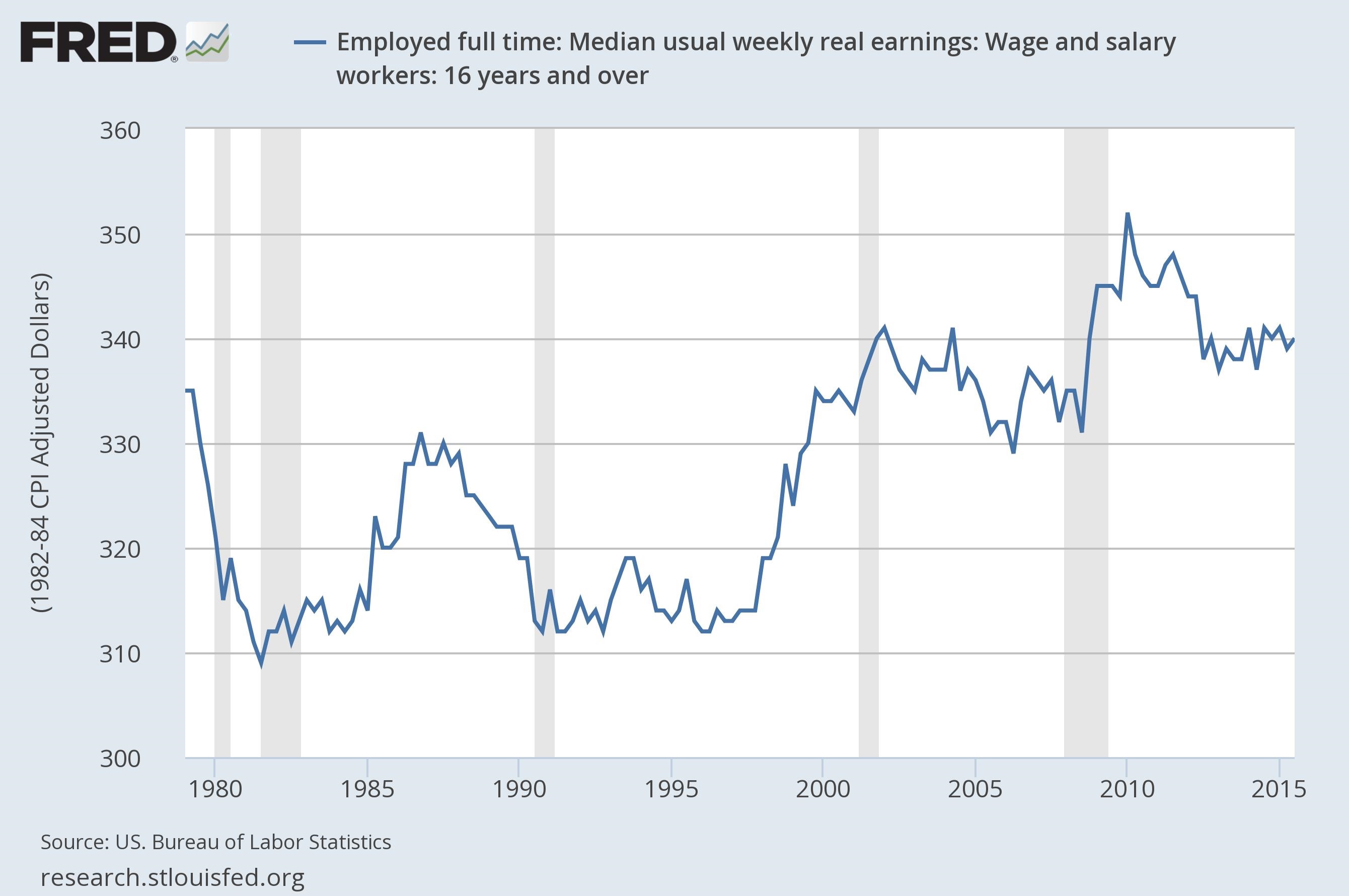
Chart-Employed Full Time Trend

St. Louis Federal Reserve, Accessed December 13, 2015.

—————

The Netherlands seems to be undergoing a sort of industrial revolution in reverse, with jobs moving from factories to homes. The Dutch labor market has the highest concentration of part-time and freelance workers in Europe, with nearly 50% of all Dutch workers, and 62% of young workers, engaged in part-time employment – a luxury afforded to them by the country’s relatively high hourly wages.

Sami Mahroum and Elif Bascavusoglu-Moreau, Is Jobless Growth Inevitable? Project Syndicate, March 25, 2015. Accessed December 13, 2015.

 —————

Inequality, exclusion, and duality became more marked in countries where skills were poorly distributed and many services approximated the textbook “ideal” of spot markets. The United States, where many workers are forced to hold multiple jobs in order to make an adequate living, remains the canonical example of this model.

Dani Rodrik, The Evolution of Work, Project Syndicate, December 9, 2015. Accessed December 13, 2015.

—————

Forced labor permeates supply chains that stretch across the globe, from remote farms in Africa and the seas off Southeast Asia to supermarkets in America and Europe. Almost 21 million people are enslaved for profit worldwide, the UN says, providing $150 billion in illicit revenue every year.

Erik Larson, These Lawyers Want Slave Labor Warnings on Your Cat Food, Bloomberg, December 10, 2015. Accessed December 13, 2015.

—————

Over all, the Labor Department data painted a picture of an economy that is growing steadily and creating jobs at a healthy pace, even as wage gains remain subdued and many Americans are still stuck on the sidelines of the recovery.

Nelson D. Schwartz, Robust Jobs Report All but Guarantees Fed Will Raise Rates, New York Times, December 4, 2015. Accessed December 13, 2015.

—————

In reality, the 35-hour workweek has become mostly symbolic, because a multitude of loopholes allow companies to work around the law. French employees work an average of 40.5 hours a week — more than the 40-hour average in the European Union — and have high productivity.

Liz Alderman, Smart Car Standoff Pits Social Progress Against Global Competition, New York Times, December 12, 2015. Accessed December 13, 2015.

COMMENTS

A question emerged after 2008 that unsettled the field of economics and is still unanswered: is this time different? Was the financial crisis of 2008 an economic crisis of a unique kind in the history of capitalism; or was it just a very severe version of a routine kind of economic crisis?

This phrase gained currency from the publication of the book, This Time is Different: Eight Centuries of Financial Folly, by Carmen Reinhart Kenneth Rogoff.[1] They argue that the financial crisis of 2008 is not different. But others disagree.

In a 2012 article, Lawrence King et al make the argument that this time is different because it is the result of a level of financial liberalization and a degree of free market economics that did not exist before the 1970s.[2]

A few of our world’s best and brightest economists expressed their uncertainty and sense that this time is different in this way:

“As a world economic crisis developed in 2008 and lasted longer than most economists predicted, it became increasingly clear that beliefs about macroeconomics and macroeconomic policy needed to be thoroughly examined. … we knew that we had entered a brave new world…”[3]

Different Seems More Likely Than the Same

After 2008 optimism about a return to robust economic growth has been the rule. But actual economic growth has not rewarded that optimism. A few economists have been trying to explain this poor record.

Robert J. Gordon, professor of economics at Northwestern University, recently asserted that “It is time to raise basic questions about the process of economic growth, especially the assumption – nearly universal since Solow’s seminal contributions of the 1950s (Solow 1956) – that economic growth is a continuous process that will persist forever.” He went on to propose that U.S. economic growth may grind to a halt because the kinds of technological innovations that drove rapid U.S. economic growth are not on the horizon.[4]

Professor Gordon was speaking only about the U.S., but the logic would apply to all of the world’s affluent nations.  Moreover, the World Bank and other global institutions have repeatedly warned of below par levels of global economic growth, in some cases for years to come.

Weighing anecdotal evidence, some discernible trends, and expert opinion, it seems reasonable to conclude that this time is different for economic growth.

That means this time is almost certainly different for the world of employment.

A Different World of Employment

In mainstream theories of economic development, the future of work is directly tied to the future of economic growth. Economic growth is the engine that pushes us toward the ever expanding prosperity goals that make for widespread affluence: high profits, high wages, and full employment. When economic growth slows down something has to give in the world of employment.  We are trapped in a long period of slow economic growth, so the employment trends of the past cannot continue.

We can be fairly certain that workers in the U.S. and other affluent nations will not experience the kind of return to full employment with high wage conditions we have known in the past. In the context of global competition and slow economic growth,  the world’s economic and political leaders are pressing hard to cap and reduce wage bills at all levels of employment. We have entered into an era of global degradation of employment.

In affluent nations they  are forcing working people to choose between fewer jobs and fewer hours at higher compensation levels or more jobs and more hours with lower wages and less valuable benefits.  In the rest of the world, where such a choice has seldom existed in any meaningful sense,  global competition and slow economic growth mean an end to the dream of jobs that will deliver better lives.  Everywhere, employment rights and workplace protections are falling away.

What we don’t know quite yet is how the ongoing degradation of the world of employment will play out in national and global politics. At the moment it appears that the world’s political and economic leaders have chosen to promote a free-for-all battle struggle among working people by defining rights to crumbs from the capitalist table using the old reactionary lines of difference – race, ethnicity, gender, religion, and nation. And, at the moment, too many workers in affluent nations are falling into this trap, as shown by the rise of Trumpism in the U.S., the growth of reactionary movements across Europe, and the destruction of governing institutions that embody common interests, and the rise of militaristic movements intent on redrawing national boundaries.

Intentionally engendering antagonisms can’t solve the fundamental problems for global economic growth, so the right wing policies can have only one ultimate outcome – a global catastrophe in multiple forms. Hopefully, this  will become clear to the world’s working people well before such a catastrophe becomes unavoidable.

———————-

[1] Carmen M. Reinhart and Kenneth Rogoff, This Time is Different: Eight Centuries of Financial Folly, Princeton University Press, 2009.

[2] Lawrence King, Michael Kitson, Sue Konzelmann and Frank Wilkinson Making the same mistake again—or is this time different? Cambridge Journal of Economics 2012, 36, 1–15 doi:10.1093/cje/ber045.

[3] From the Preface: Olivier J. Blanchard, David Romer, A. Michael Spence and Joseph E. Stiglitz, In the Wake of the Crisis: Leading Economists Reassess Economic Policy, MIT Press, 2012.

[4] Robert J. Gordon, Is US economic growth over? Faltering innovation confronts the six headwinds, VOX, September 11, 2012. http://www.voxeu.org/article/us-economic-growth-over.

1st Quarter 2014 Economic Decline: Not Unique and Not Due to Idiosyncratic Factors

SOURCE ITEMS

Gross domestic product fell at a 2.9 percent annualized rate, more than forecast and the worst reading since the same three months in 2009, after a previously reported 1 percent drop, the Commerce Department said today in Washington. It marked the biggest downward revision from the agency’s second GDP estimate since records began in 1976.

Jeanna Smialek, U.S. Economy Shrank in First Quarter by Most in Five Years, Bloombert.com, June 25, 2014.

—————

A combination of shrinking business inventories, terrible winter weather and a surprise contraction in health care spending drove the first-quarter decline, which is the worst since the first quarter of 2009, when the economy shrank at a 5.4 percent rate.

But the economy was hit by an unlikely combination of negative forces that conspired to turn what seemed set to be another quarter of so-so growth into a considerably more gloomy experience.

 Neil Irwin, Economy in First Quarter Was Worse Than Everybody Thought, New York Times, June 25, 2014.

—————

That’s one of the findings in a report published today called “Risky Business,” commissioned by some of America’s top business leaders to put price tags on climate threats. For example, by the end of the century, between $238 billion and $507 billion of existing coastal property in the U.S. will likely be subsumed by rising seas, and crop yields in some breadbasket states may decline as much 70 percent.

Tom Randall, Climate Forecast: A Heat More Deadly Than the U.S. Has Ever Seen, Bloomberg.com, June 24, 2014.

COMMENTS

Economists and other experts continue to describe economic bad news as temporary and to predict a return to “normal”. This is wishful thinking. The world we once knew is now on its head: frequent encounters with combinations of economic growth stopping events is the new normal.

  • Extreme weather is not temporary: we are well into a new weather world that is changing everything about what can be expected for growth in the world economy.
  • Reduced health care spending is not a surprise: any way you cut it, in the U.S. a huge part of health spending is funded by the federal government; cut federal spending and you cut health care spending.
  • Declining consumer spending is not temporary: consumer incomes have been stagnant or falling for decades, the labor force participation rate has been falling for decades, and neither trends in union membership nor trends in government wage protection and employment policies suggest that wages will rise and labor force participation will rise.
  • Geopolitical upheavals like the current insurgency in Iraq are here to stay: rising income and wealth inequalities have produced a world filled with hundreds of millions of people who are big losers; they are all looking for ways to reverse their fortunes.


Debt Got Us Here; More Debt Will Keep Us Here

ITEMS FOR YOUR CONSIDERATION

The Federal Reserve opened a new chapter Thursday in its efforts to stimulate the economy, saying that it intends to buy large quantities of mortgage bonds, and potentially other assets, until the job market improves substantially.

Binyamin Appelbaum, Fed Ties New Aid to Jobs Recovery in Forceful Move, New York Times, September 13, 2012.

 COMMENTS

The likely outcome of the Federal Reserve’s new round of bond buying is another round of investment bubbles, another financial crisis, and another round of concentrating the world’s wealth in the hands of fewer and fewer people.

The underlying problems are 1) income growth for the majority of the world’s people and 2) downward pressure on global GDP growth from limits to the earth’s carrying capacity.

The tradeoff between job growth (which is dependent on rapid GDP growth) and high rates of inflation is a problem tied directly to the finite carrying capacity of the earth.  We started hitting those limits in the 20th century.

Debt growth in the 1970s, 1980s and 1990s worked fairly well as a way to sidestep stagnant income growth for the majority of the world’s middle class people, but it no longer works because of the carrying capacity problem.  As the world economy is currently structured, a jump in global demand from debt growth or from a radical redistribution of wealth sufficient to push job growth to acceptable levels would push prices toward the stratosphere.

The solution to the world’s employment problems is not more debt and it is not classical redistribution of wealth, its a global economic transformation that ends the tradeoff between employment and inflation.