The Global Policy Crisis Keeps Growing Because We’ve Never Seen This Kind of World Economic Crisis

ITEMS FOR YOUR CONSIDERATION

But it is no accident that so many of the world’s economies are sputtering at the same time, or that so many people around the globe are angry. … One reason for the synchronized gloom, of course, is the synchronization of the global economy. … Rather, we are all, both together and apart, trying to figure out three big questions. … The first is how nation-states fit into a globalized world economy.

Chrystia Freeland, The three questions of global importance, Reuters, June 21, 2012.

—————

In an era of globalization, there are no innocent bystanders. There are certainly no oases of prosperity in the face of yet another major shock in the global economy. America’s growth mirage is an important case in point.

Stephen S. Roach, The Great American Mirage, Project Syndicate,  June 27, 2012.

—————

The possible conclusions are stark. One possibility is that those investing in financial markets expect economic policy to be so dysfunctional that the global economy will remain more or less in its current depressed state for perhaps a decade, or more. The only other explanation is that even now, more than three years after the US financial crisis erupted, financial markets’ ability to price relative risks and returns sensibly has been broken at a deep level, leaving them incapable of doing their job …

J. Bradford DeLong, The Perils of Prophecy, Project Syndicate, June 27, 2012.

—————

If we are to thrive as a global community of almost 10 billion – the projected population by 2050 – these new models are not optional, they are an absolute necessity.

From the Introduction, Outlook on the Global Agenda 2012, World Economic Forum.

—————

As a world economic crisis developed in 2008 and lasted longer than most economists predicted, it became increasingly clear that beliefs about macroeconomics and macroeconomic policy needed to be thoroughly examined. … By the end of this fascinating conference, we knew that we had entered a brave new world and that the crisis is generating enough questions to fill our research agendas for years to come.

From the Preface: Olivier J. Blanchard, David Romer, A. Michael Spence and Joseph E. Stiglitz, In the Wake of the Crisis: Leading Economists Reassess Economic Policy, MIT Press, 2012.

—————

We are living in very unusual times,” said Mohamed A. El-Erian, the chief executive of Pimco, the world’s largest bond manager. “History may not be as reliable a guide as it’s been in the past.”

Jeff Sommer, Flights to Safety Can’t Hide the Dangers, New York Times, May 12, 2012.

COMMENTS

A significant number of economists and policy experts have wondered whether this global economic crisis is different – for two reasons: very few experts saw such a severe crisis coming and, even after absorbing that surprise, very few expected the crisis to be so resistant to policy interventions and to persist for so long.

The crisis is different this time – because it is embedded in a confluence of historical developments that the world has never seen before.  It involves the following developments:

  • Global climate change is damaging agricultural, tourism, fishing, and other weather sensitive industries, forcing producers to invest in very costly efforts to move and/or modify productive activities
  • The scale and scope of global production is running up against absolute resource limits, substantially curtailing practices that once were common and allowed market based productive activities to increase at low cost:
    • discovering easy to extract oil, natural gas, and mineral  deposits
    • opening up frontiers (territories not organized under western models of political authority) to invading waves of farmers, miners, loggers, entrepreneurs, and investors
    • adapting to dwindling fish stocks by fishing farther from shore and deeper
    • finding and harvesting virgin forests
    • abandoning aging and polluted cities, rivers and lakes (increasingly costly to maintain) to build newer cities in regions where rivers and lakes are untarnished
  • The centuries long era of incorporating the world’s territories and peoples into the western system of nation-states and coercing and bribing the world’s peasants, tribal peoples, and unpaid family and community workers into labor and consumer markets has come to an end; this has all but eliminated one of the primary ways in which the growth of demand for goods and services generally kept pace with the growth of productive capacity
  • The global spread of advances in productive technology, which entails the substitution of machine energy for human energy and machine thinking for human thinking, is slowing the growth of demand for goods and services by reducing opportunities to gain income through work.

This confluence emerged in recent decades and has permanently damaged the capacity of the world economy to generate the large pulses of consumer demand that historically called forth the productive investment responses that produced pulses of demand for labor.  The pulses of demand for labor increased wages and moved families from the ranks of the poor into the ranks of the middle class.  Over the longer term, more wealth was also pumped into the hands of the people at the top, preparing those people to respond to the next pulse of consumer demand.

Today, there is no mechanism for generating that heartbeat of economic growth.  The confluence of forces has damaged both phases of the cycle.

On the demand side, the first response to the confluence was a massive increase in global debt levels.  Debt growth sustained the growth of demand.  However, debt growth had to come to an end.

Today, with global debt levels very high and with global corporations wielding enormous political power in the world economy, it is not politically feasible to generate a Keynesian pulse of global consumer demand (either by massively expanding global debt levels or by  redistributing a large amount of wealth from the affluent to the have-nots).  But, even if the world economy’s leaders did find a way to generate a large pulse of consumer demand, it would largely fail to restart world economic growth.

On the supply side, the productive investment responses to a large pulse of consumer demand can no longer produce the employment and income gains that they produced in the past.  The ratio of machine energy to human energy in the world economy is so high now that demand for labor would not increase sufficiently to drive up global wage levels to the degree that was the case in the past.  Moreover, and more importantly for the long run, increasing the production of goods and services in the context of a world of resource limits that are becoming more difficult to overcome will drive up consumer prices. Whatever wage gains are realized will be offset by a higher cost of living..

From time to time in the history of the capitalist world economy, its magic has faltered and then been restored. This time the magic will sporadically flicker on for a while here and there in the world economy, but it will not be restored.  Something else will happen.

Hard Working? Creative? Strong Language and Computer Skills? Earn Up to $4 Per Hour in the New Global Labor Force

ITEMS FOR YOUR CONSIDERATION

The job didn’t pay much: four bucks an hour if you really hustled. But for Catherine Fraser, a recent community college graduate from Mountain View looking to pick up a little extra spending cash, the work was a hoot.

… said analyst Martin Schneider with 451 Research. “Like manufacturing has done forever, crowd-labor lets us break down a job into tiny components, where one bit of fact-checking or writing a few sentences is now the equivalent of gluing that chip onto a computer board.”

… The larger question — and one with huge global implications as crowd-sourcing redefines and in some cases kills traditional jobs and long-established labor-management models — is whether the crowd-labor pool could essentially become one big worldwide digital sweatshop. While industry studies show average hourly earnings across all categories range from about $7 in India to $16 in Western Europe, the fast-growing segment of micro-taskers earn half that on average, and some make only $1.50 an hour.

Patrick May, ‘Crowd labor’ helps spur social networking revolution, San Jose Mercury News, Updated: 05/01/2012.

—————

Series Index May

Series Index Apr

Rate of Change

Employment Index

50.8

54.2

Slower

Business Activity/Production

55.6

54.6

Faster

New Orders

55.5

53.5

Faster
Source: May 2012 Non-Manufacturing ISM Report On Business, Institute for Supply Management, June 5, 2012

—————

For Great Wall, a private sector Chinese car maker that employs 50,000 workers, the Swiss robots and other machinery that line its bright factory floor produce more than cost savings. The company hopes they will help it build cars good enough to compete with the global auto makers.

According to Nomura, 28 percent of factory machines in China use numerical controls – one measure of automation. That may be far lower than Japan’s 83 percent, but China is growing far faster than Japan did at a comparable stage of development, says Ge Wenjie, a machinery analyst with Nomura.

In other words, China may soon be known less for cheap Christmas toys and more for high-end medical equipment, luxury cars and jet engines.

By Don Durfee, Analysis: Robots lift China’s factories to new heights, Reuters, June 3, 2012.

—————

Unit labor costs fell in 23 of 47 service-providing industries, the most since 2003 …

Output per hour increased in 32 of the 47 [service-providing industries] industries studied.  In most of these industries, productivity rose as output growth was accompanied by declines or more modest increases in hours.  Several  industries posted double-digit productivity gains as a result: local as well as long-distance general freight trucking; refrigerated warehousing and storage; radio and television broadcasting; wireless telecommunications carriers; and travel agencies.

In a few industries, productivity rose despite falling output.  In industries such as postal service; couriers and messengers; video tape and disc rental; photofinishing; and newspaper, book, and directory publishers, rising labor productivity reflected declines in both labor hours and output, with hours falling more rapidly than output.

Productivity and Costs by Industry: Selected Service-Providing and Mining Industries, 2010, Economic News Release, U.S. Bureau of Labor Statistics, May 31, 2012.

COMMENTS

During the 20th century each new generation of U.S. workers faced declining employment opportunities in agriculture, mining, and manufacturing.  But those lost employment opportunities were offset by growing employment opportunities in government and private service sector industries.

This is no longer the case.  Job growth in government and service sector industries has slowed considerably.  Moreover, some government agencies and service sector industries are embracing new production technologies and becoming job shedders themselves.

The hallmark of the first half of the 21st century may well be a decades long global employment crisis.  National governments are still trying to apply economic remedies carried over from the 20th century in a world that is vastly different.  National economic sovereignty is gone.  Rich and poor nations alike are now joined at the economic hip in a single world economy.

Sticking with the “each nation goes it alone” strategy for addressing the global employment crisis isn’t working.  Rather than getting increasing prosperity, U.S. working families and local business owners are getting a larger share of the world’s very high level of poverty.

The practical alternative for the U.S. is to join with the world’s other nations to build institutions that coordinate national economic policies and set minimum global standards for corporate behavior, working conditions, wages and benefits.

Globalization cannot be undone, so there is no other choice.

Time is Running Out for the “All News is Good News” Spin on U.S. Employment Prospects

ITEMS FOR YOUR CONSIDERATION

Payrolls climbed by 69,000 last month, less than the most- pessimistic forecast in a Bloomberg News survey, after a revised 77,000 gain in April that was smaller than initially estimated, Labor Department figures showed today in Washington. The median estimate called for a 150,000 May advance. The jobless rate rose to 8.2 percent from 8.1 percent, while hours worked declined.

Timothy R. Homan, Employment in U.S. Increased 69,000 in May, Bloomberg, June 1, 2012.

__________

The proportion of Americans in their prime working years who have jobs is smaller than it has been at any time in the 23 years before the recession, according to federal statistics, reflecting the profound and lasting effects that the downturn has had on the nation’s economic prospects. … The percentage of workers between the ages of 25 and 54 who have jobs now stands at 75.7 percent, just a percentage point over what it was at the downturn’s worst, according to federal statistics.

Before the recession the proportion hovered at 80 percent.

Peter Whoriskey, Job recovery is scant for Americans in prime working years, Washington Post, May 29, 2012.

__________

A gauge of manufacturing in the 17-nation euro zone fell to a three-year low of 45.1 in May, indicating a 10th month of contraction, while unemployment reached 11 percent, the highest on record. China’s Purchasing Managers’ Index dropped to 50.4 from 53.3, the weakest production growth since December.

Simon Kennedy, Global Growth Heads for Lull as Europe Output Shrinks,  Bloomberg, June 1, 2012

__________

Markit chief economist Chris Williamson attributed the [manufacturing] slowdown to “a near-stagnation of export orders, reflecting deteriorating demand in many overseas markets, notably the euro zone but also emerging markets such as China.”

Steven C. Johnson with editing by Chizu Nomiyama, Weak export demand slows May manufacturing growth: Markit, Reuters, June 1, 2012.

__________

“We are living in very unusual times,” said Mohamed A. El-Erian, the chief executive of Pimco, the world’s largest bond manager. “History may not be as reliable a guide as it’s been in the past.”

Jeff Sommer, Flights to Safety Can’t Hide the Dangers, New York Times, May 12, 2012.

COMMENTS

Since the official end of the Great Recession, economists, with very few exceptions, have reiterated optimism about U.S. job growth following economic news releases, whether the news was good or bad.  This optimism was and is untenable.

Even after decades of economic globalization, U.S. economists continue to make the mistake of treating nation to nation variations on larger global employment themes as though they are largely autonomous national employment themes.  This mistake leads economists to carry forward into the current era a trust in nation-based economic analysis tools and nation-based economic policy formulations that were developed for an economic era that is all but gone.

Until U.S. economists revise their analytical approach and policy formulations to fit the global economic era in which we all now live, Americans will continue to be fed hopes about U.S. employment trends that are largely destined to be disappointed.

In Bill Clinton’s 1992 presidential campaign the phrase, “It’s the economy, stupid”, was used as a reminder to campaign workers to stay on message.  It became fairly well known outside the campaign and is still occasionally quoted.

Long ago, U.S. economists should have revised that phrase to “It’s the world economy, stupid.”

Things Come Undone: One Reason Global Economic Troubles Are Becoming Chronic

ITEMS FOR YOUR CONSIDERATION

We humans devise all sorts of methods for obstructing or “damming” the second law [of thermodynamics] for considerable periods of time. A mundane example: We paint iron to prevent it from rusting.

Frank L. Lambert (Professor Emeritus, Chemistry), Entropy Is Simple — If We Avoid The Briar Patches!, Occidental College website, February 2008.

__________

Our scenario shows that over the coming twenty years the world evolves from being mostly poor to mostly middle class. 2022 marks the first year more people in the world are middle class than poor. By 2030, 5 billion people – nearly two thirds of global population – could be middle class.

Homi Kharas and Geoffrey Gertz, The New Global Middle Class: A Cross-Over from West to East, Wolfensohn Center for Development, Brookings Institution, 2010.

COMMENTS

When we add a new person to the world we create a need to increase the amounts of energy and materials devoted to the production of food, clothing, shelter and other necessities that keep people alive.  We know this almost intuitively.

We are less aware of the fact that every time we add a new item of wealth (social or material) to the world we also create a need to increase the amounts of energy and materials devoted to maintaining our stock of wealth and to replacing items of wealth when they wear out or break.  We know that our cars malfunction and wear out, weeds grow in our gardens, our toys break, and alienated youth vandalize our buildings, but we tend to see these processes and events as personal or local losses, not as losses to our global stock of wealth.

Essentially, the world’s stock of wealth is an enormous and ongoing confrontation with natural forces that work to undo the things that we have done.  The more wealth the world’s people create, the larger and more costly that confrontation becomes.

This means that growing the world’s middle class (a class associated with enormous amounts of personal and social wealth) comes at the cost of devoting more and more of the world’s available energy and resources to repairing and replacing existing items of wealth.  The rates at which energy and materials are produced must continuously increase in order to produce enough to both maintain the existing level of wealth and add new wealth.

The world is finite.  At some point the rates at which energy and materials must be extracted from natural systems just to repair and replace existing items of wealth bump up against the natural and institutional limits to those rates of extraction.  Economic growth (net increases in global wealth) slows and then stops.

The global economic troubles that began with the 2008 financial crisis seem to have become chronic.  Most economists argue that the world economy continues to be troubled because the world’s governments are not pursuing the correct policies.  A few, though, admit to being perplexed by the persistence of the world’s economic troubles.

Perhaps the heart of the problem is that the world is already bumping up against limits.  Perhaps economic policies no longer work as well as they once did because the policy goal (economic growth) is becoming less and less attainable.

And if economic growth is becoming less attainable, so too is the job growth associated with economic growth.

The Rapid Global Deployment of Increasingly Smarter Machines Overturns Traditional Economic Policy Assumptions About Employment Growth and Income Distribution

ITEMS FOR YOUR CONSIDERATION

Last week Amazon, the online retailer, announced it was buying a robot maker called Kiva Systems for $775 million in cash. … Kiva Systems’ orange robots are designed to move around warehouses and stock shelves.

Or, as the company says on its Web site, using “hundreds of autonomous mobile robots,” Kiva Systems “enables extremely fast cycle times with reduced labor requirements.”

Nick Bilton, Disruptions: At Amazon, the Robot World Comes a Little Closer, New York Times, March 25, 2012.

—————

The value of the global industrial robot-system market will double to $41 billion by 2020, according to an estimate by Christine Wang, an analyst at Daiwa Capital Markets in Hong Kong. Global unit sales last year jumped about 30 percent to a record 150,000 units, the IFR said.

Reuter, the Kuka CEO, said higher wages in China make investing in robots a simple trade off.

“It comes down to the question: at what cost can a robot do the job more efficiently?”

Richard Weiss, Kuka Robots Invade China as Wage Gains Put Machines Over Workers, Bloomberg, April 12, 2012.

__________

This is the potential of the “Internet of Things”: billions and billions of devices and their components connected to one another via the Internet. 50 billion devices by 2020, according to companies like Ericsson.

The basic building block of the Internet of Things is machine-to-machine communication (M2M), devices equipped to communicate without the intervention of humans.

Large scale M2M users may offer their services dozens of countries, selling the same devices globally.

Rudolf Van der Berg, The Internet of things, OECD Insights,  January 31, 2012.

__________

IBM says Watson’s skills — interpreting queries in natural language, consulting vast volumes of unstructured information quickly, and answering questions with a defined level of confidence — can be applied to many industries. It has already sold the technology to WellPoint Inc. (WLP), the U.S. insurer, and Citigroup Inc. (C), and expects to generate billions in new revenue by 2015 from putting Watson to work.

… Martin Kohn, IBM’s chief medical scientist, said in an interview. Using Watson “we have access to much more information than we could possibly accomplish by reading on our own, or even 100 people reading.”

Beth Jinks,  IBM’s Watson to Help Memorial Sloan-Kettering With Cancer, Bloomberg, March 22, 2012.

__________

There is reason to believe that code kernels for the first Turing-intelligent machine have already been written.

“Two revolutionary advances in information technology may bring the Turing test out of retirement,” wrote Robert French, a cognitive scientist at the French National Center for Scientific Research, in an Apr. 12 Science essay. “The first is the ready availability of vast amounts of raw data — from video feeds to complete sound environments, and from casual conversations to technical documents on every conceivable subject. The second is the advent of sophisticated techniques for collecting, organizing, and processing this rich collection of data.”

Brandon Keim, Artificial Intelligence Could Be on Brink of Passing Turing Test, Wired, April 12, 2012.

COMMENTS

The prevailing U.S. policy approach to creating jobs and distributing income reflects the traditional optimism of economists about long term employment and income distribution trends.  It treats employment growth and the widespread distribution of income through private sector payrolls as beneficial side effects of economic growth that require little attention from government.  The primary concern for government is providing optimal conditions for private sector investment.

The general optimism of economists about employment and income distribution includes a specific optimism about the impact of technology driven productivity growth.  Economists generally acknowledge that the implementation of new production technologies reduces the demand for labor in the industries in which those technologies are introduced.  But, they go on to argue that the workers who are displaced (or their children) find work in new industries (also created by the new technologies).  The net result is greater wealth for society and no permanent upward trend in unemployment.

Assumptions Underlying This Optimism Are Obsolete

In the past, this logic worked fairly well in the U.S.  Today, however, three key assumptions underlying this logic are violated in the real world.

The first assumption is that technological innovations will not be implemented faster than displaced workers can retrain for and find alternative work in emerging industries.  This assumption is no longer operative because unprecedented efficiencies in research and development fields, unprecedented fluidity of capital flows, and unprecedented levels of global competition are generating employment displacement and new skill requirements faster than human institutions can respond.

The second is that global market institutions will always evolve fast enough to keep the global capacity to consume growing as fast as the global capacity to produce grows.  The expanding role of debt financed consumption in the growth of global markets in recent decades and the prolonged duration of the financial and economic crisis that began in 2008 because of the tightening of credit show that this assumption is at least questionable.

The third assumption is that machines can displace only a small portion of human work activity.  This is no longer true.  Recent years have brought businesses massive increases in computing power, lower cost high capacity information storage, and computer programs that use highly sophisticated computational algorithms.  These hardware and software advances are now being deployed to mimic an expanding range of human work activities.

Job Creation and Income Distribution Must Become Direct Goals of  U.S. Economic Policy

If the assumptions on which economists rest their optimism about employment growth and income distribution are now obsolete, then public policies that succeed in stimulating private sector investment growth are unlikely to produce the employment growth and income distribution outcomes needed by the majority of people.  Creating good jobs and implementing policies that widely distribute incomes must become direct goals of government policy making, rather than secondary goals.

To continue with the current focus only on providing optimal conditions for private sector investment will only bring us more of what we now have: declining middle class incomes, more families living in poverty, and too much wealth owned and controlled by too few people.

U.S. Job Growth is Becoming Increasingly Vulnerable to Economic Troubles That Develop Almost Anywhere in the World Economy

ITEMS FOR YOUR CONSIDERATION

“’There is a separation between the United States economy and stock prices,’ said Russell Price, a senior economist with Ameriprise Financial. He said in 2008, a lot of the market momentum came from sales growth overseas in emerging markets, and a weaker dollar that helped profits.”

Christine Hauser, S.&P. 500 at Highest Close Since ’08, New York Times, February 24, 2012.

__________

“Globalization is one factor driving up profit for companies in the United States. According to a March 2011 paper by the Bureau of Economic Analysis, foreign earnings represented 40 percent to 45 percent of total profit between 2008 and 2009, against around 20 percent in the 1980s.”

Martin Hutchinson, U.S. stock bubble is in profit, not value metrics, Reuters Breakingviews, March 5, 2012.

__________

A recent Standard & Poor’s study found that 50 percent of sales by companies in the S.&P. 500-stock index are outside the United States. Interestingly, the report also found that these companies paid more in foreign taxes than to the United States government. ”

Steven M. Davidoff, Tax Policy Change Would Bring Cash Piles Abroad Back Home, New York Times, August 16, 2011.

__________

“China’s economic growth may further slow in the first quarter to 8.5 percent, from 8.9 percent in the fourth quarter of 2011, with the potential risks of a sharper global deterioration and a sudden domestic property downturn raising the government’s concerns about policy changes, a senior economist from the State Council’s think tank said on Thursday.”

Chen Jia, Economic growth could slow further, China Daily, March 23, 2012.

__________

“After a decade in which GDP rose by at least 9% a year, it slipped back to ‘only’ a bit above 8% by the end of last year, according to the OECD. For the next decade, the OECD forecasts annual growth will hover at around 7%.”

Brian Keeley, How Slow Will China Go?,OECD Insights, March 21, 2012.

__________

The difficulties in the euro area have affected the U.S. economy. … In addition, weaker demand from Europe has slowed growth in other economies, which has also lowered foreign demand for our products.

Ben S. Bernanke, The European Economic and Financial Situation, Testimony Before the Committee on Government Oversight and Reform, U.S. House of Representatives, Washington, D.C., March 21, 2012.

__________

A main indicator of business sentiment in Europe unexpectedly fell deeper toward recession territory Thursday, compounding concerns about the global recovery after signs of slowing manufacturing in China.

The survey of purchasing managers in the Chinese factory sector, released by HSBC, showed that activity declined in March for the fifth consecutive month, as the Chinese economy felt the pain of feeble global economic activity.

China has become a major market for European products as varied as heavy machinery and luxury goods, so a slowdown there worsens problems in Europe.

Jack Ewing and Bettina Wasserner: Indicators Fall in China and Europe, New York Times, March 22, 2012.

COMMENTS

U.S. job growth is becoming more vulnerable to economic troubles that develop beyond the borders of the U.S. because U.S. corporations increasingly earn their profits in multiple regions of the world economy, perhaps not even primarily in the U.S.  This trend can be expected to continue as high end manufacturing, investments in science and technology, and populations of affluent consumers continue to grow in Brazil, Russia, India, China, South Africa (referred to as BRICS) and spread to more countries.

The global distribution of U.S. corporate profit centers links economic troubles elsewhere in the world economy to U.S. job growth in two ways: through the impact of those troubles on the investment decisions of U.S. corporations and through their impact on incomes of older Americans.

Adverse Impact on Corporate Investments in the U.S.

With their economic interests spread across the world economy, economic troubles outside as well as inside the U.S. reduce the funds U.S. corporations have to invest anywhere.  Wherever economic troubles arise, U.S. corporations are largely free to distribute losses across multiple parts of their worldwide operations in whatever combinations they deem most profitable.

The U.S. is very likely to get a share of investment losses, even those losses that originate outside the U.S.  This is likely for at least two reasons:

  • In recent years rates of return on investments have generally been higher in some of the emerging economies than in the U.S., so U.S. corporations are unlikely to favor the U.S. over all other countries in which they have operations.
  • With an eye to future possibilities, U.S. corporations may even respond to shrinking profits outside the U.S. by shifting funds from the U.S. to economically troubled regions to maintain political favor, increase the productivity of operations in those regions, and/or finance takeovers of weaker competitors.

A reduction in the flow of investments in the U.S. almost necessarily slows job growth.

Adverse Impact on Spending by Older Americans

Economic troubles outside the U.S. can have an adverse impact on spending by all Americans, but the adverse impact on spending by older workers and retirees is particularly direct.  Moreover, the size of the impact is growing as large numbers of baby boomers transition out of the labor force.  (The Pew Research Center estimates that about 10,000 people now turn 65 every day. )

Older Workers.  Older workers see retirement coming, so they are likely to increase investments for retirement.  Those with families are also likely to try to build investments to leave their children.

Increases in investment activities link the spending behavior of older workers directly to economic troubles outside the U.S. because decisions about how much income to invest are influenced by stock market trends.  And those trends are tied to profits earned by U.S. corporations outside the U.S. as well as those earned in the U.S.

To reach a given financial position, higher stock market returns translate into being able to keep more income for spending.  Lower returns translate into having to reduce spending and invest more income.  (In this regard, it is important to note that the majority of older workers are at the highest income plateau they will reach in their working lives, so investment increases must be offset by spending reductions.)

By lowering the rate at which stock values increase, troubles outside the U.S. reduce spending in the U.S. Less spending translates into slower job growth.

Retirees.  The link between economic troubles outside the U.S. and the spending behavior of retirees is even stronger.

Retirement brings a partial or complete shift to sources of income that are quite dependent on trends in corporate profits and stock values – social security, pensions, and government programs that supplement incomes (e.g., Medicare, Medicaid, assistance with food, transportation, and housing costs).  Pensions are directly funded by corporate profits and stock values.  Social Security and other government programs are funded by revenues partly derived from taxes corporate profits and taxes on individual earnings on stock portfolios.

Thus, through their adverse impact on corporate profits and stock values, economic troubles outside the U.S. reduce spending by U.S. retirees and government spending on behalf of retirees.   Slower job growth necessarily follows.

The Longer View

Most economists keep looking for a much needed shift to a sustained high rate of job growth in the U.S.  It probably will not come.

As things now stand, the world economy is chronically unsteady, plagued by sporadic outcroppings of economic troubles (that are mistakenly defined in terms of national boundaries rather than in terms of the world economy).  U.S. job growth is dampened by this global and revolving economic troubles account and will be dampened further as U.S. corporations spread their operations to even more regions of the world economy.

This state of things is more likely than not to continue indefinitely, unless the world’s nations do a much better job of managing the world economy as a whole and the U.S. government does a better job of managing investments in the U.S.

Accumulating Evidence Shows That the World’s Nation-Centered Economic Policy Making Paradigm is Obsolete

ITEMS FOR YOUR CONSIDERATION

Chart-Global GDP Growth 2007-13, IMF

World Economic Outlook Update: Global Recovery Stalls, Downside Risks Intensify, International Monetary Fund, January 2012.

—————

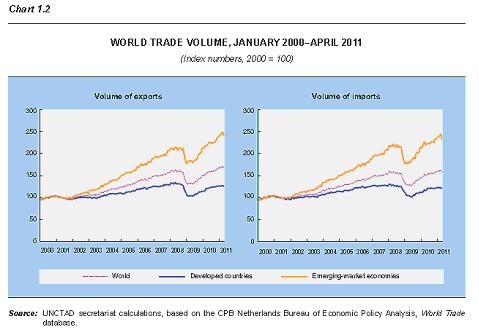
Chart-World Trade Volume 2000 - 2011

Trade and Development Report, 2011: Post-crisis Policy Challenges in the World Economy, United Nations Conference on Trade and Development (UNCTAD).

—————

“Last year alone the daily volume of currencies traded was 220 per cent higher than that in 2001, and 65 per cent of the transactions were cross-border ― up from 54 per cent in 1998. Since 1990 foreign direct investment increased more than six fold.”

Moisés Naím, The Dangerous Cocktail of Global Money and Local Politics, Financial Times, November 18, 2011, (published on Carnegie Endowment for International Peace website).

—————

“Assuming a cyclic dynamics of national economies and the interaction of different countries according to the import-export balances, we are able to investigate … the synchronization phenomenon of crises at the worldwide scale. … The results support the theory of a globalization process emerging in the decade 1970–1980, the synchronization phenomena after this period accelerates and the effect of a mesoscopic [intermediate in size] structure of communities of countries is almost dissolved in the global behavior.”

Pau Erola, Albert Diaz-Guilera, Sergio Gomez, Alex Arenas, Modeling international crisis synchronization in the World Trade Web, arXiv.org, January 10, 2012.

—————

“In today’s financial architecture, as with other supply chains, interdependent networks tend to concentrate in powerful hubs. For example, just two financial centers, London and New York, dominate international finance, and only 22 players conduct 90% of all global foreign-exchange trading.”

Andrew Sheng, Global Finance’s Supply-Chain Revolution, Project Syndicate, January 5, 2012.

—————

“So the degree of synchronisation has evolved fitfully. It is only in the most recent 1973-2006 period that we can speak meaningfully of anything resembling an international business cycle.”

Paul Ormerod, Random matrix theory and the evolution of business cycle synchronisation 1886-2006, arXiv, July 11, 2008. 

—————

“Globalization has made frontiers more porous. We see how one country’s policies, whether pertaining to work, the environment, public health, taxation, or myriad other issues, can have a direct impact on others. And we see such interdependence even more clearly in their economic performance: China’s annual GDP growth rate, for example, will slow by two percentage points this year, owing to sluggishness in the United States and the EU.”

Javier Solana, Whose Sovereignty?, Project Syndicate, March 12, 2012.

—————

“At the news conference Monday, Mr. Zhou said China was especially worried about Europe and its chronic sovereign-debt crisis … The world economy is highly globalized with a very active flow of capital worldwide,” he said. “All of these factors will have an impact on our monetary policy.’”

Ian Johnson, China Talks of More Lending but Less Currency Growth, New York Times, March 12, 2012.

—————

“Undoubtedly politicians should do a much better job of explaining to their constituents’ that what happens beyond the borders of their country-or city has implications for what happens inside their homes.”

Moisés Naím, The Dangerous Cocktail of Global Money and Local Politics, Financial Times, November 18, 2011 ( published on Carnegie Endowment for International Peace website).

COMMENTS

It is becoming increasingly clear that merging the world’s 20th century national economies into our 21st century world economy has raced ahead of merging national economic policy making institutions into a global economic policy making system.  The consequences of this lag in the development of global policy making institutions for the people of the U.S. and other nations are enormous.

National employment and income growth efforts are often ineffectual or only effective for a short time because of the ongoing policy push and shove of nations competing for advantage in the world economy.  What one nation does to improve its position in the world economy and grow jobs and incomes, other nations work quickly to undo.

For the world economy as a whole, this push and shove of nation-centered economic policy making produces a high level of economic instability and a high level of policy incoherence.

One glaring and maddening consequence of this combination of reduced national policy effectiveness and global policy incoherence is that the recovery from the financial crisis of 2008-2009 has proceeded in fits and starts and seems too frequently to be on the verge of collapsing back into crisis.  Global job and income growth is being held back and governments are being denied the tax revenues they need to protect economically vulnerable people from the ravages of poverty.

Most U.S. economists and policy makers continue to hold out hope for a much more robust economic recovery than we have had.  But, one has to wonder whether a more robust recovery is possible while the world’s economic house is so geopolitically divided.

See my related comments in:  The World Economy’s Demolition Derby of Competing and Overlapping Economic Policy Making Entities, January 22, 2012

Where Will They All Work?

“Consider Stanford’s experience: Last fall, 160,000 students in 190 countries enrolled in an Artificial Intelligence course taught by Mr. Thrun and Peter Norvig, a Google colleague. An additional 200 registered for the course on campus, but a few weeks into the semester, attendance at Stanford dwindled to about 30, as those who had the option of seeing their professors in person decided they preferred the online videos, with their simple views of a hand holding a pen, working through the problems.

Besides the Artificial Intelligence course, Stanford offered two other MOOCs last semester — Machine Learning (104,000 registered, and 13,000 completed the course), and Introduction to Databases (92,000 registered, 7,000 completed). And this spring, the university will have 13 courses open to the world, including Anatomy, Cryptography, Game Theory and Natural Language Processing.”

Tamar Lewin, Instruction for Masses Knocks Down Campus Walls, New York Times, March 4, 2012.

COMMENTS

Stanford is only the tip of a global iceberg of educational capacity growth that is beginning to dump huge numbers of well educated workers into the world economy.

A big question for state university systems:  If you are the son or daughter of a middle class family in China or India or Kenya or Peru, why settle for an online education at State U. when universities of the caliber of Stanford, MIT, and Harvard offer unlimited enrollment opportunities?

For more on this issue, see my previous post:

Too Many Well Educated Workers: a Global Problem and a U.S. Policy Dilemma, February 29, 2012

Too Many Well Educated Workers: a Global Problem and a U.S. Policy Dilemma

SEVEN ITEMS FOR YOUR CONSIDERATION

Chart-Tertiary Education enrollment ratiosData source: Global Education Digest 2009: Comparing Education Statistics Across the World, UNESCO Institute for Statistics, 2009.

—————

Chart-Tertiary Education enrollment by regionData source: Global Education Digest 2009: Comparing Education Statistics Across the World, UNESCO Institute for Statistics, 2009.

—————

“Companies no longer need to divide their skills strategies between high-cost ‘head’ nations employing-high skilled, high-waged workers, and ‘body’ nations that are restricted to low skilled, low waged employment. This change has come about via a combination of factors including the rapid expansion in the global supply of high skilled workers, in low-cost as well as high-cost economies, advances in information technologies, and rapid improvements in quality standards in emerging economies, including the capability to undertake research and development.”

Phillip Brown, Hugh Lauder, and David Ashton, Education, globalisation and the knowledge economy, Teaching and Learning Research Programme and Economic and Social Research Council, September 2008.

—————

“Unemployment is running at 14 percent and record numbers of people are emigrating in search of work. … Ireland’s pitch to China was its usual combination of low corporate tax rates, a well-educated work force of English speakers and ready access to the European Union’s market of 500 million people. The country’s technological skill, particularly in agribusiness and education, was also emphasized.”

Douglas Dalby, Ireland Makes Pitch to Official From China, New York Times, February 20, 201.

—————

“More people are losing the same gamble as a 33 percent jump in U.S. graduate school enrollment in the past decade … runs headlong into a weaker job market.”

Janet Lorin, Trapped by $50,000 Degree in Low-Paying Job Is Increasing Lament, Bloomberg, Dec 7, 2011.

—————

[IBM] stopped providing a geographic breakdown of its employees in 2009. At the end of 2008, U.S. staff accounted for 115,000 of its 398,455 employees, according to its annual report that year.

Beth Jinks,  IBM Cuts More Than 1,000 Workers, Group Says, Bloomberg, February 28, 2012.

—————

“Tech drives the economy, but it doesn’t drive employment. ‘We are a 100-person company and we serve 50 million people. That kind of leverage has never existed before,’ said Drew Houston, co-founder of the start-up Dropbox, a service that stores and shares digital files.

Nick Bilton, Disruptions: In Davos, Technology Moves Center Stage, New York Times, January 29, 2012.

COMMENTS

The assertion that a major impediment to economic growth and reducing unemployment and underemployment is a mismatch between the knowledge and skills most workers have and the knowledge and skills corporations are seeking is repeated often in the media and is widely accepted as true.  Thus, calls for investing in the higher education programs that will create a workforce with the newer and higher end knowledge and skills the corporations want are also common.

The policy experts who make the skills mismatch assertion base it on reports by business leaders that they have a hard time filling certain positions.  Unfortunately, those policy experts make the mistake of generalizing from a sample of workforce recruiting situations that is not at all representative of the larger population of U.S. recruitment situations.

Three reasons shortages of high end workers are not representative:

  • They are almost always geographically localized, concentrated in particular industries, and relatively short term
  • They evolve and move from place to place, but they never disappear; they develop when and where innovation is successful and reflect the nature of the innovation
  • On an ongoing basis, they account for only a small part of the overall demand for high end workers.

Those policy experts also make the mistake of drawing artificial national and sub national boundaries around workforce recruitment activities, ignoring the fact that a growing proportion of the world’s corporations, including smaller domestic corporations now recruit globally.  (And new evidence shows that corporations, not small businesses, account for the bulk of job creation and job destruction — see Floyd Norris, Small Companies Create More Jobs? Maybe Not, New York Times, February 24, 2012. )

The Global Problem

For the world economy as a whole, the salient shortage is the other way around: high end workers face a shortage of opportunities to put their educations and skills to work in good jobs (living wages and adequate benefits, safe working conditions, socially beneficial products and services).  And this mismatch between the supply of high end workers and the demand for their knowledge and skills is getting worse.

The key factors:

  • Global demand for highly educated workers is growing very slowly because the world economy as a whole is growing very slowly;
  • The global supply of highly educated workers is increasing rapidly as nations, states, provinces, and cities invest in education as a way of competing for the business investments that generate good jobs
  • Businesses of every size and in every economic sector pursue competitive advantage by investing in newer technologies than can now do the kinds of communications, evaluation, and decision-making work that most college educations prepare people to do.

Education is a good in and of itself, but global investing in higher education will not solve the long term problems of high unemployment and declining wages and benefits in the world economy.  Public investments in education address the supply side of the global labor market equation, but unemployment and underemployment in a world with an expanding population of workers, including well educated workers is fundamentally a demand side problem.

U.S. Public Policy Dilemma

Again, education is a good in and of itself, but more U.S. investments in higher education will not pay off in better jobs and growing incomes for U.S. workers.  The reasons are tied to extensive U.S. engagement in the world economy:

  • Investments in higher education produce high end workers who become part of the global supply of high end workers; the skills and knowledge of those workers are available not only to U.S. corporations but to the competitors of U.S. corporations
  • Those investments also put more downward pressure on high end wages and benefits in the U.S. because they add to an already excessive global supply of high end workers available to U.S. corporations
  • Investments in programs that increase the demand for high end workers (big government investments in transitioning to green energy sources is often proposed) don’t increase demand only for U.S. high end workers; not only do U.S. corporations outsource work and recruit lower cost workers from other countries, so too do government agencies.

U.S. workers will get more employment opportunities and wage growth from investments in higher education only if the global demand for high end workers is brought into balance with the global supply.  U.S. policy makers, acting alone, cannot cause this to happen.  A much higher level of global management of investments in higher education, investments in job creation programs, and investments in income supports for working people whose labor is not needed is required.

A good model for this is offered by federal government management of the supply and demand for workers in the in the U.S. 1950’s and 1960’s.

In those decades, federal investments in higher education increased substantially, but it also made large investments in job creating programs – notably, investments in the development of military technology, in an ambitious space program, in research across the spectrum of intellectual fields, in new regulatory programs, and in community jobs programs.  It also expanded income supports for workers not easily absorbed into the labor force because of disabilities, age, and skill limitations.

Thus, while higher education investments increased the demand for high end jobs, other government investments increased the supply of high end jobs, low end jobs in both the public and private sectors, and moderated the overall demand for jobs.

U.S. policy makers could and should lead in implementing this model for managing labor force development in the world economy as a whole.  That would serve the interests of U.S. working families.  But they cannot even fully participate in such an effort because American voters believe strongly in American exceptionalism and have an associated strong dislike for multinational government institutions (and for government involvement in economic matters in general).  And that is a real dilemma.

U.S. Workers Are Settling Into a Global Era of Fewer Good Jobs and Declining Incomes

ITEMS FOR YOUR CONSIDERATION

Chart-Missing Civilian Labor Force
Source: Andrew Sum, et al (see citation below quote)

“Following 2007, the pool of hidden unemployed has risen steadily and strongly from 4.7 million in 2007 to close to 6.5 million in 2011; a rise close to 1.8 million or 40%. This was the third largest annual average number of hidden unemployed in the 45 year history for which such data exist dating back to 1967.”

Andrew Sum, Mykhaylo Trubskyy, with  Sheila Palma, The Great Recession of 2007-2009, the Lagging Jobs Recovery, and the Missing 5-6 Million National Labor Force Participants in 2011: Why We Should Care, Northeastern University Center for Labor Market Studies, January 2012

—————

Change in Average Hourly Earnings of U.S. Employees, 2006 – 2011

Chart-Average Hourly EarningsSource: Historical Data, Current Employment Statistics, Bureau of Labor Statistics.

—————

“Spain’s jobless rate for people ages 16 to 24 is approaching 50 percent. Greece’s is 48 percent, and Portugal’s and Italy’s, 30 percent. Here in Britain, the rate is 22.3 percent, the highest since such data began being collected in 1992. (The comparable rate for Americans is 18 percent.)

Thomas Landon, For London Youth, Down and Out Is Way of Life, New York Times, February 15, 2012

—————

Looking at the changes within countries over time, the overall long-term trend is obvious: the majority of countries have witnessed increases in low-wage employment over the past 15 years. Overall, figure 20 shows that, since the second half of the 1990s, low pay has increased in about two-thirds of countries for which data are available (25 out of 37 countries). … While it is too soon for an assessment of the short-term effect of the crisis on low pay (since few countries have published their data on low pay in 2009), there is little reason to believe that a global recession will have brought about any improvement in the overall situation of low-paid workers.

Global Wage Report 2010/11: Wage policies in times of crisis, International Labour Organization, December, 2010

COMMENTS

In a free market economy, buyers and sellers negotiate prices.  When buyers have lots of choices and sellers don’t, buyers have the leverage to push prices downward.

We have seen this in the U.S. housing market: huge numbers of houses are on the market and an army of builders are waiting in the wings to put even more houses on the market – the ratio of sellers to buyers is very high.  Thus, even though houses are beginning to sell a little better, prices are still falling.

The same thing has happened in the global labor market: the ratio of available workers (sellers) to employers with jobs to fill (buyers) is very high, and it will stay high.  There are several structural reasons:

  • the integration of national economies into a single world economy based on free market principles has made huge numbers of unemployed and underemployed workers newly available to the world’s major employers and many intermediate size employers
  • expanding national education systems are producing a growing supply of skilled workers for the global labor market
  • the global economic crisis of 2008-2009 produced large numbers of business failures and consolidations, reducing the number of employers competing for the growing global supply of workers
  • the production of a given volume of goods and services continues to require fewer and fewer workers as machines and computers do more of the brute work and more of the routine thinking
  • global consumption of goods and services is not growing fast enough to reduce the ratio of available workers to available jobs.

Thus, even though hiring in the U.S. is beginning to get a little better, the bargaining position of U.S. workers, even those who are unionized, continues to deteriorate.  Given this trend, either real U.S. wages and incomes will decline much further, or rates of unemployment, underemployment, and non-participation of working age people in the workforce will remain high.