Why are Americans Stumped about the Economy? Nonsense for Analysis

SOURCE ITEMS

Some Federal Reserve policy makers are citing the lowest inflation rate in at least five decades as an alarm bell for the economy. Economists at UBS Securities LLC say the figure isn’t as troubling as it appears. … Among the reasons for slowing inflation are improved efficiency and a stronger dollar, which puts downward pressure on prices of imported goods such as cars and clothing.

“If anything, the price softening is helping to support demand,” and the dollar is set to rise further, said Coffin [an economist at UBS Securities]. … “Households are getting a little bit more purchasing power out of their income growth.”

Michelle Jamrisko, Inflation at 53-Year Low Belies U.S. Demand Vigor: Economy, Bloomberg, June 12, 2013.

COMMENTS

If a stronger dollar means you can buy more T-shirts from Bangladesh, then the manufacturing job growth will be there not here.  Just as importantly, who says you are going to buy another T-shirt or a new Toyota with money saved because a stronger dollar creates lower real prices.  Maybe you just might bank the extra money  or buy a couple more GM stocks.   What happens to demand growth in that case?

Then, there is the other side of the stronger dollar.  While American consumers can buy more T-shirts from Bangladesh with the same wages, the factory owners in Bangladesh have to pay higher real prices for the American parts to keep their sewing machines running.  Maybe they turn to China or Brazil for those parts.   Quite logically, any demand growth at home can easily be offset by losses in demand from abroad.

(Of course, most economists either work for global corporations and investors or support their agendas.  Global corporations and investors don’t care where the demand is rising and where it is falling or where jobs are being created or being destroyed.  Unlike you and me, they are not tied to a particular nation or a particular city or a particular family, so their fortunes do not rise and fall in connection with a particular place or a particular group of people.)

The key point is that supply and demand functions are global.  To write about supply and demand in nation terms is misguided and misguides readers.  The U.S. has to export goods and services to pay for the things we import — although we are now wedded to a way of life in which we buy goods and services made in other countries on credit and then pay our debts by selling ownership of our tangible wealth to global investors in those other countries.

Debt supported buying has obscured the loss of wealth in the U.S.  But, only in the short term can debt do this.   Sooner or later a transfer of real wealth has to take place to clear the debt — then the loss that occurred a decade ago is finally seen for what it is.  (It may well be that one part of the value of  the foreclosed home down the street from you now belongs to an Asian investor and the other part belongs to a Swiss investor.)

In a world economy, what matters for the working people in the U.S. and for working people everywhere else in the world is the structure of global investment decisions that give life to the relationship between global supply and global demand.  Globally, there are now too many businesses and not enough buyers, and tracking the ebbs and flows of demand within the U.S. obscures the far greater power of this global reality over our working lives.

Economists at a Crossroads: The Ideology of National Policy Making Sovereignty vs. the Reality of a Global Economy

 SOURCE ITEMS

When Sweden’s Riksbank was founded in 1668, followed by the Bank of England in 1694, the motivation was that a single economy should have a single central bank. Over the next three centuries, as the benefits of instituting a monopoly over money creation became more widely recognized, a slew of central banks were established, one for each politically bounded economy.

What was not anticipated was that globalization would erode these boundaries. As a result, we have returned to a past from which we tried to escape – a single economy, in this case the world, with multiple money-creating authorities.

This is clearly maladaptive, and it explains why the massive injections of liquidity by advanced-country central banks are failing to jump-start economies and create more jobs.

Kaushik Basu (Senior Vice President and Chief Economist of the World Bank and Professor of Economics at Cornell University), Two Policy Prescriptions for the Global Crisis, Project Syndicate, April 23, 2013.

COMMENTS

Since the economic crisis of 2008, most economists have been telling political leaders and their constituents what they want to hear – that national policy making sovereignty is still viable.  (Implement the right policies and your nation will do well no matter what is happening in the rest of the world.)

The time is up for this kind of political expediency.  With more than four years of policy failure now weighing on the world’s political leaders and no promising economic corners in sight, economists can only lose the last of their credibility by continuing to tell policy makers that they are the sole masters of the destinies of their peoples.

The choice for the field of economics is clear: take a chance that some political leaders and some constituencies are ready to acknowledge that national policy making sovereignty is a thing of the past.  That’s the only approach that will save the field of economics from becoming an object of contempt.

See related source items and comments in earlier blog posts:

Accumulating Evidence Shows That the World’s Nation-Centered Economic Policy Making Paradigm is Obsolete, March 21, 2012.

The World Economy’s Demolition Derby of Competing and Overlapping Economic Policy Making Entities, January 22, 2012.

What Happens In Vegas Doesn’t Stay In Vegas: National Policies Have Global Consequences, November 30, 2011.

Fragmented and Weakened Global Governance Perpetuates the World’s Employment Crisis, September 9, 2011.

Job and Earnings Churning Is Not Job and Earnings Growth

Paul robs Peter, then Peter robs Paul.  Round and round and round.  And we all fall down.

SOURCE ITEMS

At the price of a doubling in unemployment and near-10 percent plunge in labor costs, the so-called peripheral euro nations are reviving manufacturing and trade. In Spain, exports reached a record 222.6 billion euros ($287 billion) in 2012.

Joblessness already tops 25 percent in both Spain and Greece…

Ford Motor Co. (F) (F) said at the end of last year it will increase capacity near Valencia as it shuts plants in the U.K. and Belgium. Peugeot (UG), which is cutting workers in its home market of France, is also lifting output in Spain and Portugal.

Simon Kennedy, Even Greece Exports Rise in Europe’s 11% Jobless Recovery, Bloomberg, March 21, 2013.

—————

Barely two years ago, Brazil’s rapid economic growth and expanding middle class made it the darling of financial markets …. With slow growth and stalled economic reforms, financial markets were about to write off Mexico as a lost cause.

So Brazil has become the star that disappoints, while Mexico is the underperformer that suddenly shines.

Andres Velasco, A Tale of Two Countries, Project Syndicate, March 14, 2013.

—————

Mexico’s minimum wage commission set the increase for 2012 at 4.2% for all three of the country’s geographic zones…

The increase brings the minimum wage in Mexico to 62.33 pesos ($4.60) a day for zone A, which includes Mexico City. The minimum wage is slightly lower in other geographic zones.

What is the minimum wage in Mexico?,Maquila Reference website.

—————

Perry sent letters to 26 gun and ammunition manufacturers earlier this month inviting them to consider a move to Texas if the states they currently operate in impose “restrictive laws” on their industry, according to a copy of the letter and list of the manufacturers provided to ABC News by the governor’s office.

“As you consider your options … you may choose to consider relocating your manufacturing operations to a state that is more business-friendly.  There is no other state that fits the definition of business-friendly like Texas,” Perry wrote, pointing out financial incentives the state offers companies.

Arlette Saenz, Rick Perry Invites Gun Manufacturers to Set Up Shop in Texas, ABC News, February 22, 2013.

—————

We find that products systematically tend to co-appear, and that product appearances lead to massive disappearance events of existing products in the following years…. This is an empirical validation of the dominance of cascading competitive replacement events on the scale of national economies, i.e. creative destruction.

Peter Klimek, Ricardo Hausmann, and Stefan Thurner, Empirical confirmation of creative destruction from world trade data, arxiv, December 13, 2011.

COMMENTS

A few years back, business was booming in Ireland and experts were hailing it as the land of smart policy.  Then things went south.  Overnight, the land of smart policy became the land of dumb policy.

The problem for the world’s nations isn’t whether a nation adopts smart policy or dumb policy. The problem is that the world economy is a system of trade and competition in which nations, provinces, states, and local governments design and implement policies to steal jobs and earnings from other nations, provinces, states, and local governments.  As a result, there is much less actual job and earnings growth in the world economy and much more inter-territorial migration of jobs and earnings (churning) than is typically claimed by the champions of global capitalism.

This has always been the case, but decades ago this reality was much less visible to Americans and Western Europeans because the churning took place at a much slower pace and the winners and losers were not so intimately connected to each other through global systems of communication and transportation.  Moreover, we were usually winners in the global job churning system, so we had little incentive see the churning.

In the interceding decades, the rate of inter-territorial movement of jobs and earnings has been accelerating.  Global communications and transportation systems have expanded and improved markedly, facilitating ever rising numbers of inter-territorial financial transactions and deal closings. In turn, job and earnings churning has and continues to accelerate.

As the churning accelerates, it is becoming more visible to Americans and Europeans.  One reason is that the same communications and transportation systems that are accelerating churning are also connecting the peoples affected by the churning more closely together.  More importantly, though, Americans and Europeans are now more often finding themselves on the losing side of the churning.  Seeing the churning has become more likely because not seeing the churning only leads to policies that work only over a short period of time that is growing increasingly shorter.

The best policy move for everyone is for the world’s leaders to put an end to global job and earnings churning.  In the U.S. we certainly must put an end to interstate job and earnings churning, or our political gridlock and policy floundering will likely pull us deeper into an accelerating spiral of economic and political disasters. 

February Job Numbers: Evidence for a Growth Trend or Just One More Outlier in an Era of Employment Volatility and Too Little Growth?

SOURCE ITEMS

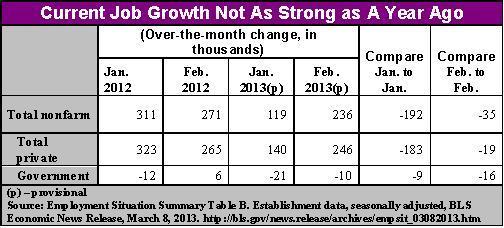
Chart-Current Job Growth Not as Strong as last yearSource: Employment Situation Summary Table B. Establishment data, seasonally adjusted, Bureau of Labor Statistics Economic News Release, March 8, 2013. 

—————

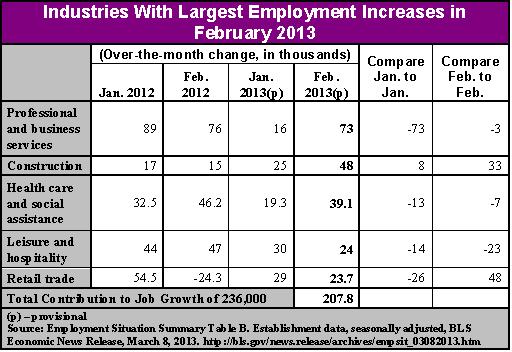
Chart-Industries with largest employ increases, feb 2013 Source: Employment Situation Summary Table B. Establishment data,seasonally adjusted, Bureau of Labor Statistics Economic News Release, March 8, 2013.

—————

Looking at a series of economic indicators, and going back to the costliest 18 hurricanes of postwar history along with the Northridge earthquake of 1994, Goldman’s research team found that retail sales, construction spending, and industrial production “show a clear dip in the month of the disaster, followed by a significant recovery within 1-3 months that typically takes their growth rate above that seen prior to the disaster.”

Agustino Fontevecchia, Despite $50B In Damages, Hurricane Sandy Will Be Good For The Economy, Goldman Says, Forbes, 11/06/2012.

—————

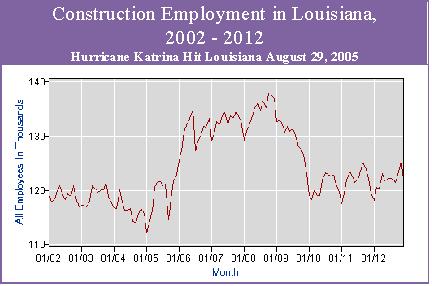
Chart-Construction employment in Louisiana, 2002-12  Chart generated by BLS State and Area Employment web site.

—————

The largest global disasters of 2012 were Hurricane Sandy (with a cost of $65 billion) and the year-long Midwest/Plains drought ($35 billion), according to the company’s Annual Global Climate and Catastrophe Report, which was prepared by Aon Benfield’s Impact Forecasting division.

Doyle Rice, Hurricane Sandy, drought cost U.S. $100 billion, USA TODAY,  January 25, 2013.

————— Chart-Major Disaster Declarations 1953-2011

Bruce R. Lindsay, Francis X. McCarthy, Stafford Act Declarations 1953-2011: Trends and Analyses, and Implications for Congress, Congressional Research Service, August 31, 2012

—————

Joel Naroff of Naroff Economic Advisors … expects average monthly job gains of 200,000-plus this year if the White House and Congress can agree to put off the budget cuts. If all the reductions occur, it likely would mean monthly gains of about 165,000, he says.

Paul Davidson, Employers add a stunning 236,000 jobs in Feb., USA TODAY, March 8, 2013.

COMMENTS

Stronger than usual February job growth is widely hailed as part of an economic recovery in the U.S. that many are seeing in recent positive market signals – rising housing prices and a flourishing stock market, for examples.  The explicit expectation is that we will not look back a year from now and see February’s 236,000 added jobs as only an outlier in year of mostly disappointing employment news.

It is possible that job growth will be strong this year, but it is unlikely.

Several factors involved in the production of February’s job growth numbers suggest that job growth numbers will bounce up and down in 2013 as they have in the past and leave the U.S with unemployment, underemployment, and labor force participation rates much as they are today.

Job growth is weaker this year than last

The first indicator that we should not put much stock in February job growth numbers is that job growth numbers for January and February 2012 were considerably better than the numbers for January and February 2013.  Yet 2012 ended with little progress toward getting Americans back to work.

Unpredictable weather events may be a factor in February job numbers

Both the Midwest/Plains drought and Hurricane Sandy damaged industries and destroyed property.  Smaller weather events, such as severe winter storms, have also done damage.

Rebuilding after Hurricane Sandy and repairs following winter storms could well have contributed to February job numbers.  In the case of Hurricane Sandy, which did $50 billion or more in damage, cleanup, redevelopment planning, negotiating insurance payments, and getting money flowing from government agencies may have pushed much of the impact on the demand for goods and services into 2013.  So, it is possible that:

  • the impact of Hurricane Sandy on the construction and retail industries is just now peaking
  • hospitality and leisure are still be benefiting from housing people displaced by the hurricane
  • Hurricane Sandy still has a significant impact on the demand for social services
  • some professional and business services, such as legal, architectural, engineering, document preparation and clerical, security and surveillance, cleaning, and waste disposal services, are part of recovery efforts related to Hurricane Sandy.

Employment related to Hurricane Sandy and winter storms will fall off as the year progresses.  Of course, other disasters and damaging weather events will strike.  But, when and where those events strike and how much demand for goods and services they will generate can’t be known.

It is fairly certain, though, that the impact of large and small natural disasters on employment will grow larger over the coming years, adding more volatility to month to month job growth numbers.

 Volatile government spending adds volatility to some private sector industries  

Although jobs in health care and social services are listed in the private sector, many of those jobs are paid for by grants and contracts from local, state, and federal government agencies.  The same is true for employment in most educational institutions and in many manufacturing business service industries that supply goods to government agencies.

Given the volatile political tugs-of-war over revenue and spending policies at all levels of government, jobs in industries with federal funding can come and go quickly.  Perhaps some of this effect is in the February job numbers.

A final note

 It is good to have job growth, but it is certainly less than optimal if a growing proportion of new jobs are associated with repairing and replacing the damaged wealth of those who already have it rather than creating new wealth to be shared with the very large number of Americans who have no net wealth at all.

Climate change and government gridlock are robbing both those of us with wealth and those of us without it.

The Annual Season of Spending Is Routinely Misinterpreted by Economists and Financial Experts, Creating Cycles of Hope and Disappointment

SOURCE ITEMS

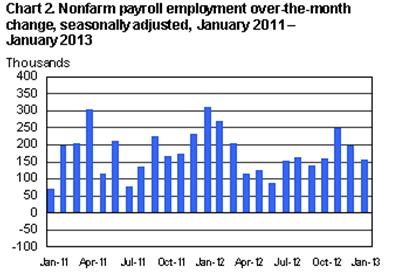
Chart-Employment-Over the month change, 2010-13

The Employment Situation for January 2013 News Release (PDF Version), Bureau of Labor Statistics, February 1, 2013.

—————

Chart-Quarter to quarter growth in real GDP

U.S. Bureau of Economic Analysis, January 20, 2013.

—————

Despite a moderate pick-up in output growth expected for 2013–14, the unemployment rate is set to increase again and the number of unemployed worldwide is projected to rise by 5.1 million in 2013, to more than 202 million in 2013 and by another 3 million in 2014.

Executive Summary, Global Employment Trends 2013, International Labour Organization, January 2013.

—————

As the global economy has gone from crisis to crisis in recent years, the cure has become part of the disease. In an era of zero interest rates and quantitative easing, macroeconomic policy has become unhinged from a tough post-crisis reality. Untested medicine is being used to treat the wrong ailment – and the chronically ill patient continues to be neglected.

Stephen S. Roach, Macro Malpractice, Project Syndicate, Sep. 30, 2012.

—————

The euro-area recession deepened more than economists forecast with the worst performance in almost four years as the region’s three biggest economies suffered slumping output.

The European data chimed with statistics in Japan, where the economy unexpectedly shrank last quarter as falling exports and a business investment slump outweighed improved consumption. GDP fell an annualized 0.4 percent, following a 3.8 percent fall in the previous quarter.

Marcus Bensasson, Euro-Area Economy Shrinks Most Since Depths of Recession, Bloomberg, February 14, 2013.

COMMENTS

Every year a spate of optimistic stories about the recovery from The Great Recession pour into American homes, offices and automobiles, as businesses and consumers rev up for the annual Season of Spending (and Hopeful Signs).  This season begins with the returns to school in August and September and ends with the post-holiday sales in early January.

Soon after the Season of Spending ends, the optimistic stories begin to disappear as the economists and financial experts to whom writers and commentators in the media turn for information begin to grudgingly acknowledge that all is not well, after all, in the land of beautiful spending.  The Season of Spending fades into memory and the artificially pumped up optimism of American business owners and consumers gives way to disappointment.

The annual cycle of positive and negative economic news is real, as the charts of over-the-month employment changes and quarter-to-quarter real growth in GDP illustrate[1].  But, the annual cycle of hope and disappointment is manufactured by influential economists and financial experts who either willfully ignore the flat trend line that cuts through the multi-year cyclical pattern, or worse, aren’t even aware of it.  Ignore the underlying trend line and every fall time spending spree becomes a new “morning in America.”

Instead of pumping up optimism each fall on the basis of positive economic signals that are demonstrably temporary, economists and financial experts should be pointing out that job growth is not accelerating and explaining why the level of job creation remains well below the level needed to restore full employment and grow incomes.  The trouble is, they can’t explain the trend line because it doesn’t make sense in traditional nation-centric models of employment growth.

The cyclical pattern of employment change in the U.S. is influenced by domestic spending, but the trend line around which U.S. employment change fluctuates is greatly influenced by world economic factors.  U.S. employment trends are a subset of global employment trends, which are embedded in global economic processes, investment trends, and spending trends.

The world economy is limping along and recent reports strongly indicate that little improvement will take place over the next couple of years.  GDP growth will be too slow to generate adequate employment growth, so unemployment and underemployment will rise.  In this context it is wishful thinking to suppose that this spring will not bring another round of disappointment about job and income growth in the U.S.


[1] This pattern makes sense given the seasonal pattern of spending by Americans.  The most difficult to resist pressures to spend are concentrated in the last five months of the year, the Season of Spending.  Parents have to pay school fees and buy backpacks, computers, new clothes, and even cars for their children.  During the holiday season, which follows close on the back to school season, spending increases because we all face powerful pressures from family and friends and advertisers, and because many of us have postponed optional spending until the holidays give us dispensation to empty out savings accounts and haul out the credit cards.

Global Shortage of Skilled Workers is a Myth; Global Failure to Create Jobs is the Reality

SOURCE ITEMS

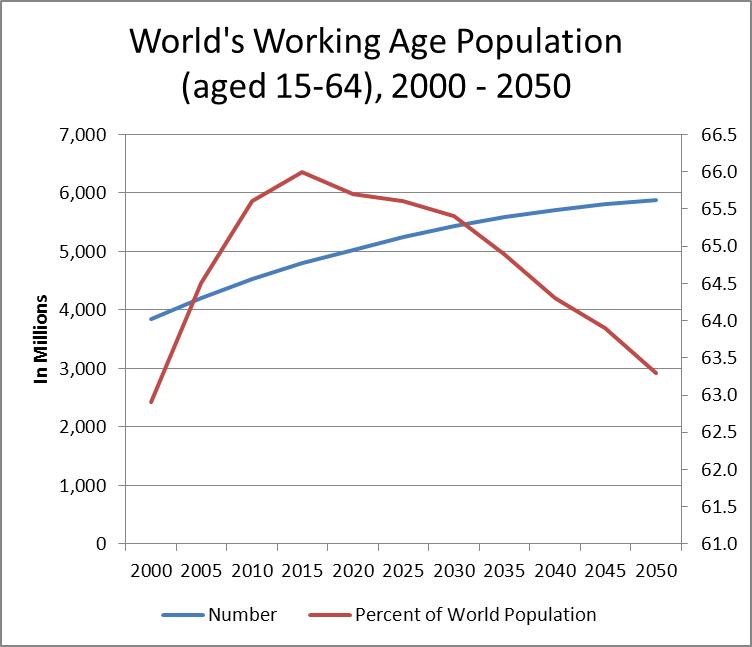
Chart-Global Working Age Population, 2000-2010

Data Source: World Population Prospects: The 2010 Revision, Population Division, Department of Economic and Social Affairs, United Nations.

—————

Last May I wrote about Coursera — co-founded by the Stanford computer scientists Daphne Koller and Andrew Ng — just after it opened. … When I visited last May, about 300,000 people were taking 38 courses taught by Stanford professors and a few other elite universities. Today, they have 2.4 million students, taking 214 courses from 33 universities, including eight international ones.

 Thomas Friedman, Revolution Hits the Universities, New York Times, January 26, 2013.

—————

According to UNESCO data, 177 million students participated in formal tertiary education around the world in 2010, an increase of 77 million students since 2000, or 77% (UNESCO Institute for Statistics, 2011).

Education at a Glance 2012, OECD indicators. OECD Publishing, September 2012.

—————

The Washington-based bank yesterday projected the world economy will expand 2.4 percent, down from a June forecast of 3 percent, after growing 2.3 percent in 2012. It halved its forecast for Japan, cut the U.S. projection by 0.5 percentage point and predicted a second year of contraction in the euro region. It also lowered projections for emerging markets led by Brazil, India and Mexico.

Sandrine Rastello, World Bank Cuts Growth Forecasts as Developed Nations Lose Steam, Bloomberg News, January 16, 2013.  

—————

In recent years, the proportion of high-skill migrants has been rising – from 19 percent in 1980 in the United States, to 26 percent in 2010, for example – as immigrants filled demand that domestic supply alone could not match.

The World at Work: Jobs, Pay, and Skills for 3.5 Billion People, McKinsey Global Institute, June 2012.

COMMENTS

The world economy has no shortage of workers and no shortage of well educated and skilled workers.  It has a devastating shortage of jobs for people of working age.

The brutal reality is that insufficient global job creation is the problem.

Flooding the world’s labor force with more and more highly educated and skilled workers will not solve that problem.  It will only expand the population of underemployed and inappropriately-employed college educated workers.

If a shortage of skilled workers really did exist, the world’s global corporations, which are awash in record profits and holding large amounts of cash, would be spending much more on worker training and aggressively lobbying governments to increase investments in higher education.  Instead, it’s only lip service for investments in education and training and, in richer countries like the U.S., lobbying for more visas for the world’s growing supply of skilled workers.

A new governmental approach to job creation is the solution.

Governments must shift from passively accepting private sector job creation failure to actively driving private sector job creation decisions.  To begin, they must stop competing with each other for the investment attention of global corporations and start working together to demand more job creation from those corporations.

More Evidence That Global Policy Making is the Only Path to Job and Income Growth

SOURCE ITEMS FOR YOUR CONSIDERATION

The size and composition of spillovers across countries is one of the many issues that have resurfaced in the wake of the Great Recession. It is now apparent that events in some countries can have profound spillovers elsewhere which are not limited to their immediate neighbors but can ricochet around the globe.

Although progress is being made, the financial sectors in large macroeconomic models are poorly developed and, at an even more basic level, there are no strong theories as to why financial markets are as closely linked as they appear to be in the data.

The structure of a typical large macroeconomic model generates low correlations of output, bond yields, and (where modeled) equity prices across countries. This does not correspond to the high correlations actually seen in the data. Imposing these financial market correlations produces estimated output spillovers that are much closer to those seen in the data, but we lack a comprehensive model explaining why these international asset price correlations are so high.

Bayoumi, Tamim ; Vitek, Francis, Macroeconomic Model Spillovers and Their Discontents, Working Paper, International Monetary Fund, January 2013.

COMMENTS

In other words, most economists are holding us back, not leading us forward.

Nations are more economically interconnected that most economists admit.  Really, we live in one world economy, not a world of national economies, and the scope of policy making must match the scope of the economy.  Otherwise, we will keep getting the terrible job and income growth consequences and the associated domestic and geopolitical turmoil we have been getting.

Liberals and Conservatives Share an Outmoded Belief that Underpins False Hopes for Job Growth

ITEMS FOR YOUR CONSIDERATION

With five cameras, a sonar sensor that detects motion 360 degrees around it, and enough intelligence to learn tasks within an hour, Baxter is designed to work safely alongside humans and do simple jobs such as picking items off a conveyor belt. It’s also cheap enough, at $22,000 a unit, so that the investment math works: If Baxter performs three years of eight-hour shifts, it’s the equivalent of labor at $4 an hour … To teach Baxter a job, a human simply grabs its arms, simulates the desired task, and presses a button to set the pattern.

Brad Stone,Smarter Robots, With No Wage Demands, Bloomberg BusinessWeek, September 18, 2012.

 —————

Anyone who endured Macroeconomics 101 was taught that recessions and depressions occur because of insufficient demand or from overproduction and a general glut of things that no one can buy. This explains the still popular Washington economic cure, which involves artificially generating more economic demand via federal outlays.

The opposite perspective emerges from Say’s Law (named after Jean-Baptiste Say): the proposition that supply creates its own demand when economies are unshackled.

Wayne Crews, Stimulating Demand Misses the Point, Forbes Magazine, September 26, 2011.

COMMENTS

Now that we are so far away from the trauma of 2008, experts generally agree that policies haven’t worked as expected – but they continue to hope that GDP growth will produce massive job growth.  That hope is based on a shared belief that increases in GDP require equivalent increases in job growth.

The two sides offer competing formulas for stimulating GDP growth, but both rest on this belief.  Liberals call for increasing consumer demand (demand side economics), which in turn should generate more investment and more jobs.  Conservatives call for increasing investor funds (supply side economics), which in turn should increase hiring and then generate more consumer demand.  Both formulas end up in the same place: high GDP growth and a low unemployment rate.

The key connection for both formulas is the belief that the production of commodities that will be sold in markets is primarily dependent on human activity.  More production requires more human activity.

Well into the 20th century this belief had considerable validity.  It no longer does.  Machine activities have replaced large portions of human activity in the production of commodities for sale in markets, and more machines are being brought on line every day around the world.  Increasingly, machines are not only replacing physical production activities (like assembly line tasks), they are replacing information gathering and decision-making tasks.

In this context, the old formulas for job growth don’t work.  A large amount of investment in buildings and machines produces only a tiny amount of job growth.

In the 21st century, jobs must be created intentionally, not as a byproduct of investment growth or demand growth.  Competing companies can’t do that kind of intentional job creation without putting themselves out of business.

Only governments can intentionally create jobs.

Debt Got Us Here; More Debt Will Keep Us Here

ITEMS FOR YOUR CONSIDERATION

The Federal Reserve opened a new chapter Thursday in its efforts to stimulate the economy, saying that it intends to buy large quantities of mortgage bonds, and potentially other assets, until the job market improves substantially.

Binyamin Appelbaum, Fed Ties New Aid to Jobs Recovery in Forceful Move, New York Times, September 13, 2012.

 COMMENTS

The likely outcome of the Federal Reserve’s new round of bond buying is another round of investment bubbles, another financial crisis, and another round of concentrating the world’s wealth in the hands of fewer and fewer people.

The underlying problems are 1) income growth for the majority of the world’s people and 2) downward pressure on global GDP growth from limits to the earth’s carrying capacity.

The tradeoff between job growth (which is dependent on rapid GDP growth) and high rates of inflation is a problem tied directly to the finite carrying capacity of the earth.  We started hitting those limits in the 20th century.

Debt growth in the 1970s, 1980s and 1990s worked fairly well as a way to sidestep stagnant income growth for the majority of the world’s middle class people, but it no longer works because of the carrying capacity problem.  As the world economy is currently structured, a jump in global demand from debt growth or from a radical redistribution of wealth sufficient to push job growth to acceptable levels would push prices toward the stratosphere.

The solution to the world’s employment problems is not more debt and it is not classical redistribution of wealth, its a global economic transformation that ends the tradeoff between employment and inflation.

The ‘All’ in ‘We’re All in This Together’ Is the Whole World

ITEMS FOR YOUR CONSIDERATION

… that if you just “work hard and play by the rules” you should expect … a decent life and a chance for your children to have a better one. There is just one problem: It’s out of date.

… when Clinton first employed his phrase in 1992, the Internet was just emerging, virtually no one had e-mail and the cold war was just ending. In other words, we were still living in a closed system, a world of walls, which were just starting to come down. It was a world before Nafta and the full merger of globalization and the information technology revolution, a world in which unions and blue-collar manufacturing were still relatively strong, and where America could still write a lot of the rules that people played by.

That world is gone. It is now a more open system.

 Thomas Friedman, New Rules, New York Times, : September 8, 2012.

—————

Anybody with an idea and a little expertise can set assembly lines in China into motion with nothing more than some keystrokes on their laptop. A few days later, a prototype will be at their door, and once it all checks out, they can push a few more buttons and be in full production, making hundreds, thousands, or more….“Three guys with laptops” used to describe a Web startup. Now it describes a hardware company, too.

Voilà, a Factory in Your Garage, Reading File, New York Times, February 6, 2010.

—————

Both cyclical and structural effects appear evident in the recession, suggesting that some features of the U.S. economy can benefit from stimulatory monetary and fiscal policy, while others are more permanently damaged and unlikely to respond to such policies.

 Eric Swanson, Structural and Cyclical Economic Factors, Economic Newsletter, Federal Reserve Bank of San Francisco, June 11, 2012.

—————

After all, borders are not impermeable. On the contrary, globalization – the immense flow across borders of people, ideas, greenhouse gases, goods, services, currencies, commodities, television and radio signals, drugs, weapons, emails, viruses (computer and biological), and a good deal else – is a defining reality of our time. Few of the challenges that it raises can be met unilaterally; more often than not, cooperation, compromise, and a degree of multilateralism are essential.

Richard N. Haass (Director of Policy Planning for the US State Department (2001-2003), To the Victors Go the Foils, Project Syndicate, Apr. 25, 2012.

COMMENTS

When there are no limits to competition, competition destroys the commons – whether that commons is arable land, fish stocks in the ocean, the earth’s breathable air, or the economy in which all the world’s working people must earn an income sufficient to support a family and contribute to the well-being of their communities.

Structural factors that rob working people of living wage jobs are not confinedto the U.S., are not confined to any nation. There are national and local variations, but, fundamentally, the structural problems are global in scope and must be addressed through globally coordinated efforts.

A global system in which one nation outdoes others for a few years, and then another nation outdoes others for a few years, while the global trend is greater hardship for the greater number, is not one the American people should want and it is not one in which a high standard of living can be sustained.